The Thai Micro Crab is an incredibly small crab species that are not commonly seen in this hobby. It is a freshwater crab species that looks like a small spider and it will not get larger than 1/2 of an inch! Thai Micro Crabs are fully aquatic so they will not require any land area in their enclosure. Although they are not very commonly seen at Pet Stores, you can often find Thai Micro Crabs for sale at AquaticArts. This Micro Crab is not recommended for beginner aquarium keepers, because of their small size. If you’re looking for crabs that are larger and/or partially terrestrial, check out 9 Unique Terrestrial, Semi-Terrestrial, Brackish & Freshwater Crabs. This article will cover aquarium requirements, food and diet, tank mates, and more for the Thai Micro Crab.
Aquarium Requirements
Thai Micro Crabs are a much smaller species of crab, this makes them excellent for nano fish tanks. These crabs will do well in aquariums that are about 2 gallons or larger. Larger aquarium’s water parameters are likely to be more stable so I always recommend at least a little larger fish tank. Their enclosure should also be full of a variety of aquatic plants, and caves/rockwork for them to hide in.
Water parameters are important for aquatic animals, and it is no exception for this crab. The following are the recommended water parameters for the Thai Micro Crab:
Temperature: 72°-82° F
pH: 6.5 – 8.0
KH: 6 – 15 dKH
This little crab should settle in its new home beautifully if the water parameters in the aquarium match what it needs. Keep in mind that many invertebrates are incredibly sensitive to fluctuations in water parameters such as the ones above, but also to nitrates, phosphates, and many others!
Food & Diet
For the most part, the Thai Micro Crab should be able to find food on its own. They will primarily filter feed using little hairs on their claws. However, like most crabs, they are opportunists and may try to make a meal out of some small invertebrates such as shrimp. They are too small to cause harm to most fish. If your aquarium is not completely mature, consider feeding this Micro Crab flake food or pellet food.
Tank Mates
The Thai Micro Crab is incredibly peaceful. It mostly keeps to itself and will not harm most inhabitants of the aquarium. It may take a chance at a small invertebrate, but most fish are safe around this crab. I would be more worried of certain fish trying to eat the Thai Micro Crab due to its incredibly small size. I would keep this crab with fish such as:
Neon Tetra
Ember Tetra
Endler’s Live Bearers
Harlequin Rasbora
Other peaceful small mouthed fish
I would not house this crab with larger fish or fish that can fit the Micro Thai Crab into its mouth. Fish such as Angelfish, Rams, Kribensis, and larger may think this crab is food!
Breeding
After researching the topic, it seems that the Thai Micro Crab is incredibly hard to breed. If it breeds successfully, the offspring do not survive very long. If you have any success or more information on this topic, please consider sharing it!
Final Notes
The Thai Micro Crab is an excellent invertebrate to add to your freshwater fish tank if you have a proper setup. If you’re looking to add a crab to your aquarium, really consider this species. They will not bother fish or plants, and they are not destructive like crayfish. They can be hard to find for sale but with a little patience, one will pop up.
Red Devil Crabs are a species of small semi-terrestrial crab that are native to Indonesia. They’re incredibly vibrant with their mostly red & orange colorations. These are much different than the similarly named Thai Devil Crab, so do not mistaken the two. Red Devil Crabs can be great pets but, in my opinion, you really have to love them. I am saying this because they’re not incredibly active, you should not physically handle them like you would other animals and they’re skittish. They’re a great pet, if you’re ok with not seeing them all the time and if you provide them with the proper habitat.
Aquarium Requirements
The Red Devil Crab will require at least half of its enclosure to be terrestrial and the other half having water. You will most likely need to design a paludarium for this species of crab. A male and two females should do well in a 5 gallon aquarium. If you want more crabs, you’ll have to get a larger enclosure. They’re much different from fully aquatic freshwater crabs such as: Pom Pom Crabs, Panther Crabs, and the Thai Micro Crab. Red Devil Crabs live along forest streams and rivers in the wild. It usually hangs out on the land but will occasionally drop in the water, especially to molt.
Your paludarium should reflect its natural habitat as close as possible. I would recommend adding a lot of mosses, driftwood and rocks for a hardscape. Also, adding a bunch of leaf litter is and other vegetation will give this crab plenty of cover and privacy. It should not eat healthy plants so this gives you plenty of options to scaping the enclosure.
Like most other crabs, Red Devil Crabs are excellent climbers and escape artists. You should provide a tight fitting lid to guarantee this crab does not escape from your enclosure. A tight lid will also help keep humidity levels at a higher level which is important for the Red Devil Crab.
Invertebrates are usually a little more sensitive to water parameter fluctuations and quality. The Red Devil Crab is no different. The overall temperature of its enclosure should sit between 75° and 82° F (24° – 28° C). Humidity levels should be 75% or higher. The water portion of the terrarium should have the following parameters:
Temperature 75° – 80° F
pH 7.5 – 8.0
KH 4 – 10
This will promote ideal conditions for Red Devil Crabs which will hopefully help keep them healthy and living longer.
Food & Diet
Red Devil Crabs are omnivorous scavengers This is similar to just about every other crab out there. This is nice because it opens up many doors to what we can feed them. These freshwater crabs eat primarily plant based foods. I would offer them greens such as lettuce, algae pellets, algae wafers and much more. They will also forage the waters of the paludarium and consume algae and detritus. Because they are opportunistic animals, I would occasionally offer them foods like worms, crickets, and other insects normally found in pet stores.
If fish are kept in the paludarium, the Red Devil Crab may occasionally make a meal out of them. Make sure the fish you keep are fast moving to help prevent them from becoming lunch. Also, larger and more aggressive fish should not be kept with Red Devil Crabs. Fish I would consider for a paludarium with Red Devil Crabs are:
Keep in mind that you will have to provide the proper water parameters for any included fish, which can add more work, especially for newer hobbyists.
Tank Mates
Red Devil Crabs are very similar to Vampire Crabs in shape, size, and habitat requirements. However, they do best with only Red Devil Crabs. Red Devil Crabs are communal animals but with their own species. They may fight with each other but they will definitely fight with crabs of a different species. They are best kept with a ratio of 1 male to 4 females. This will help settle aggression and lower competition between crabs.
Breeding
There is not too much information on Red Devil Crab breeding habits. However, when a female is ready to mate she will allow a male to do so. The female will then hold onto the eggs until it’s time to hatch. She does not require saltwater to successfully release her eggs. The released eggs will more than likely be found in the water without any red colorations. Although not mandatory, consider removing the eggs from the parents’ enclosure because there is a small chance of cannibalization. The young crabs should take care of themselves as long as their is enough water and algae in the aquatic habitat but crushing flakes and food into small pieces will help them acquire additional nutrients to promote growth.
Final Notes
Red Devil Crabs are a very wonderful pet if you have the patience for them and are ok with not always seeing them. Remember, these are not aquarium crabs and will require a paludarium. They mostly care for themselves and will not enjoy being handled. Your job is to feed them and provide proper husbandry for their enclosure. Otherwise, enjoy your new semi-aquatic companion!
The backbone of many saltwater systems is a good cleanup crew. Algae will opportunistically try to use the nutrients in your water body. A saltwater aquarium can be plagued with quite a bit of algae if water parameters are high. It is impossible to have an aquarium without algae due to the feeding and production of fish waste. Invertebrates and fish are used to help prevent algal blooms. Invertebrates such as snails and crabs can wedge themselves into areas many fish cannot and eat food that has fallen into these crevices. The main goal is to enjoy this hobby and not suffer from algal blooms’ hands. A good cleanup crew can help!
Cleanup Crew for Reef Aquariums
Reef aquariums can have a large assortment of critters to help maintain your aquarium and keep your algae at bay. I will do my best to list the best ones for the job and will provide information on the potential flaws of each. Before adding any new invertebrate or fish test out your salinity and water parameters with an Aquarium Salinity Refractometer and an API Reef Master Test Kit! Make sure your water parameters are in check before adding any new wildlife.
Snails
There is a large variety of saltwater snails that can be thrown into your reef aquarium. They help clean up algae, eat food that is left behind by fish, and help clear up your sand bed. The biggest problem with snails is that they can be quite clumsy and will sometimes fall upside down and not be able to flip back over. This can become a nuisance because we as hobbyists have to come to the rescue. The most common snail to do this (in my opinion) is the Mexican Turbo Snail. They somehow always seem to end up flipped and require a little assistance from us. Snails will sometimes climb out of an aquarium with an open top and fall to their deaths. Lastly, like many inverts, snails can and will knock over coral and move rock that is not placed well. I will go a little more in-depth on which snails are great to have in your reef system!
Zebra/Mexican Turbo Snail
I like to call these snails the “tanks.” They grow large and are remarkable at cleaning up an aquarium with algae. They are specialists at decimating hair algae but will also eat many other types of algae. As stated above, they commonly flip themselves and cannot flip back so pay close attention to that. Due to their size, these large snails have the power to move rock and coral that are not properly placed/glued down. They’re a great addition to larger reef systems but may need supplemental food if no algae are present. Omega One Seaweed Sheets are commonly used to feed this snail and fish when no algae are present.
Bumblebee Snails
The bumblebee snail is not as commonly found but they’re a great addition if you can find them. They’re especially a good add-on because of their tiny size. These little invertebrates can crawl into the smallest nooks and crannies of your aquarium and find detritus and uneaten food. This is great because they are carnivorous and will happily eat uneaten meaty food such as frozen Mysis shrimp. If food is scarce for this little snail, it may turn and attempt to eat other slow-moving snails! They will occasionally burrow in the sand which will help aerate it. The black and yellow coloring on these snails resembles a bumblebee which is where the name comes from.
Nassarius Snails
Nassarius snails sometimes called zombie snails are exceptionally great snails that will help aerate your sand bed. These snails are carnivorous so they will happily eat any meaty food that is uneaten. They also spend most of their time in the sand and will rise from the depths when fish feeding is occurring. They should be introduced into an established aquarium because they require a sufficient amount of detritus and other food. Like many invertebrates, they are very sensitive to water parameter differences when introduced so a drip acclimation is recommended.
Tiger/Fighting Conch
The conch is a wonderful addition to a larger reef system. These critters spend all of their time grazing on the surface of your sand bed. They are omnivores and will consume just about any food they can find. They do a great job of keeping your sand nice and clean and will burrow partly into the sand once it is done grazing. The biggest problem with the fighting conch is that it will reach about 4″ in length at full size.
Trochus, Astrea, Nerite Snails
These snails are different but I clumped them together because they have very similar jobs. They are all fantastic at consuming hair algae on live rock and also nibble on cyanobacteria that may be present in your aquarium. These three snails do not get as large as the Mexican and zebra turbo snails but can still pack a punch! They’re also a little showier because of their coloring and shell shapes. They’re great for all types of hobbyists.
Fish
There is a handful of fish that happily assist in keeping your aquarium clean and free of algae. There are a few more requirements to keeping certain fish such as aquarium size and experience levels but I will go into more detail below.
Tangs/Rabbitfish
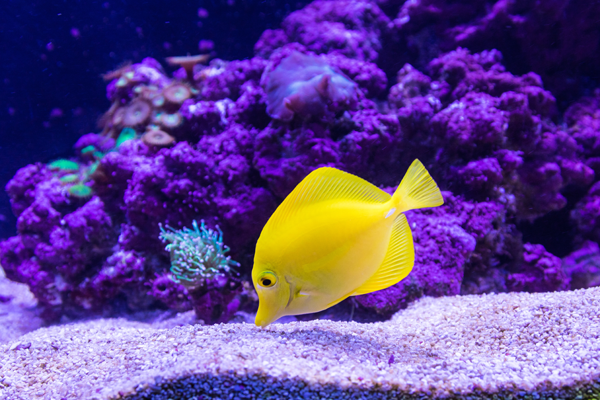
I love having tangs and rabbitfish in my reef aquarium. They’re remarkable grazers and just a joy to have around. The problem with these fish is they need a large aquarium due to their size, feeding habits, and active personalities. Except for the Tomini tang, I would not recommend keeping tangs in an aquarium smaller than 125 gallons. Yellow Tangs spend much of their day grazing and actively swimming around so having quite a bit of space for them is a must.
Certain species of rabbitfish will be fine in 75 gallon aquariums but I would also not keep most of them in an aquarium smaller than 125 gallons. Rabbitfish also have a venomous barb in their dorsal fin. So please be mindful of their ability to sting you! Lastly, the rabbitfish can occasionally eat LPS as well as soft coral so be mindful of keeping them with those types of corals. Otherwise, they are fantastic to have and a thrill in an aquarium.
Gobies
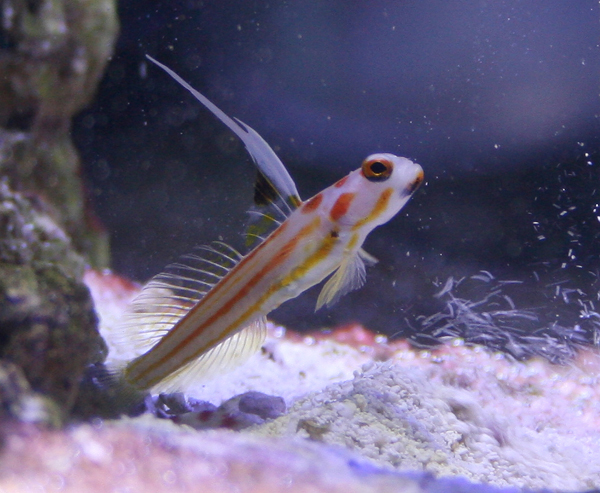
Gobies are great at keeping a sand bed spotless! Due to their varying sizes, certain species are great for large aquariums but others can be put into Nano fish tanks. For example, a large sleeper goby would be great for a big reef tank and a Yasha goby is fantastic for a much smaller system. Keep in mind that a sandy substrate such as CaribSea Arag-Alive Sand and a deep sand bed should be used if keeping gobies. Also, these fish are notorious jumpers. A closed lid is recommended for these fish because of their ability to launch out of the fish tank.
The main species of blenny I will mention is the lawnmower blenny. If there is an algae problem in your system, these fish will clear it up quite quickly. I would normally recommend only one blenny per aquarium unless your fish tank is incredibly large. These fish are usually quite peaceful but will fight with other fish that are similar in shape. They can occasionally nip on stony coral and clams so please be mindful of that! They will grow to approximately 5″ when they are fully grown and should be kept in aquariums of 30 gallons or more!
Crabs/Shrimp
This category of inverts can go be talked about for quite some time. I will provide as much information without adding too much unnecessary detail.
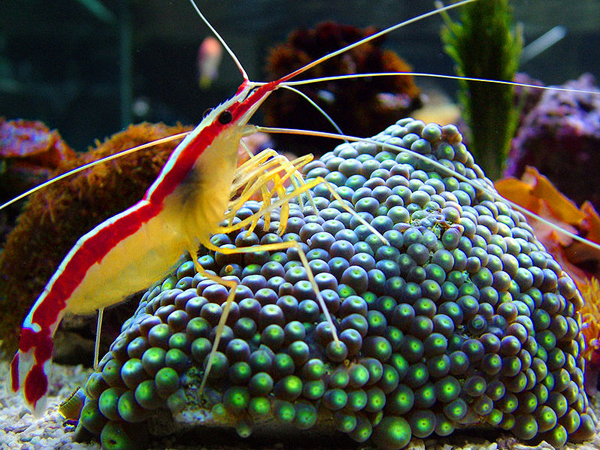
Scarlet skunk cleaner shrimp are fantastic at cleaning your fish. They will hang out on rocks and wait for fish to stop in for quick cleaning. Many fish will allow this shrimp to climb on their body to find dead skin. They’re especially fantastic for larger fish. The only downside is they may try to snatch food from coral when feeding.
Peppermint/camel shrimps are incredible at removing nuisance aiptasia from your reef tank. Give them enough time and the pests will be gone. Be careful though because once the aiptasia is gone, this invert may turn and eat up some of your coral! I personally do not add these into my system unless I have a big aiptasia infestation.
Emerald crabs are very good inverts at removing bubble algae. They are normally green in color and lay pretty flat with the rocks and spend most of their day grazing on bubble and hair algae. Just like peppermint shrimp, be mindful because they can cause damage to coral!
Hermit crabs are great because they will spend all day grazing and looking for food. They will eat just about anything offered. Remember that not all hermit crabs are reef-safe! They will fight one another as well as kill snails for their shells. It is recommended to have different-sized empty shells available for your hermit crabs to use.
Final Thoughts
Many different types of cleanup crews can be used in a reef aquarium. Do your best to fill every niche to maximize the efficiency of your cleaning squad! It will help make the healthiest and most stable aquarium. Living cleanup crews, water changes, and things such as Chemi-Pure Elite, media pads, and protein skimmers such as the Reef Octopus Classic 110 can help keep reef systems spotless!
Manage Consent
To provide the best experiences, we use technologies like cookies to store and/or access device information. Consenting to these technologies will allow us to process data such as browsing behavior or unique IDs on this site. Not consenting or withdrawing consent, may adversely affect certain features and functions.
Functional Always active
The technical storage or access is strictly necessary for the legitimate purpose of enabling the use of a specific service explicitly requested by the subscriber or user, or for the sole purpose of carrying out the transmission of a communication over an electronic communications network.
Preferences
The technical storage or access is necessary for the legitimate purpose of storing preferences that are not requested by the subscriber or user.
Statistics
The technical storage or access that is used exclusively for statistical purposes.The technical storage or access that is used exclusively for anonymous statistical purposes. Without a subpoena, voluntary compliance on the part of your Internet Service Provider, or additional records from a third party, information stored or retrieved for this purpose alone cannot usually be used to identify you.
Marketing
The technical storage or access is required to create user profiles to send advertising, or to track the user on a website or across several websites for similar marketing purposes.