Tag: no heater

  • How To Heat an Aquarium Without a Heater

    How To Heat an Aquarium Without a Heater

    Heating an aquarium, especially during cold winter months with a power outage can be incredibly challenging. Winters can be brutal, and cold can creep into older and poorly insulated homes very quickly. Although many fish have a fair amount of temperature tolerances, it’s important to have a plan ready in case the temperatures drop below that threshold.

    Besides power outages, having dozens of aquariums running individual heaters can be expensive. You use up a lot of outlets, spend money on replacements, and risk purchasing a faulty heater which can ruin a fish tank. Warming an aquarium in different ways might be a better option. This guide will discuss many options to warm your aquarium during power outages and a recommended method to warm multiple aquariums to help lower those high electricity bills.

    Heating the Room

    A room with many fish tanks is called a fish room, and heating a fish room is often cheaper than heating individual fish tanks. If you have a room completely devoted to your fish tank hobby, it might be time to toss the aquarium heaters and switch to something that will heat the whole room instead. Heating the room instead of individually heating aquariums has a few perks:

    • Cost saving
    • Heaters won’t break in your aquarium
    • No more heater replacement
    • Saves outlet space

    I have dug around to see the best way to heat a fish room. Many aquarists suggest using an Oil Filled Radiator Heater, such as the PELONIS Oil Filled Radiator Heater. As a bonus, I would recommend also using a fan, like the Genesis 20″ Box Fan, on a low setting to help disperse the heat around the room. You’ll want to choose the heater and fan that is appropriate for your room’s size.

    The reason many fishkeepers enjoy using this type of heater is that it uses less electricity compared to a space heater, and also doesn’t get as hot, which lowers the chance of it causing a fire. You’ll have to look to see whether your heaters use more electricity compared to the Oil Filled Radiator Heater before deciding whether this switch makes sense.

    Add a Well-Fitted Lid

    Equipment such as hang on back filters, circulation pumps, and lights create heat as a byproduct while working that will warm your fish tank. A lot of heat from water is lost at the surface. Something as simple as adding an aquarium glass top can help warm a fish tank. When you add a lid to your aquarium, you are essentially creating a barrier between warm fish tank water and cool ambient air. It takes longer to alter temperature through glass than a large opening such as the top of a fish tank.

    This method isn’t ideal, because you may not reach a desired aquarium temperature, and you might not have enough equipment running to warm the fish tank. Also, keeping a stable temperature will be impossible because you’re ideally at the whim of the ambient temperature and whatever equipment you have running. There are a lot of glass top options on Amazon, you’ll just have to match the available options with the dimensions of your fish tank.

    How To Heat Aquarium During Power Outage

    If you’re stuck in a power outage and do not have a way to warm your aquarium, there are a few things you can do to help your fish tank when your heater is out of commission. These are temporary solutions that can provide relief for your slowly cooling aquarium. You can try one method or both to help keep your aquarium warm.

    Wrapping a Blanket Around Your Aquarium

    If your power is out, and the temperature in your home is slowly dropping, you may be worried that your fish tank temperature will also drop to dangerous levels. A temporary but quick solution is to wrap your aquarium with a blanket. The blanket will help insulate your fish tank for some time while you wait for the power to return. Besides a blanket, you can use styrofoam or something like FOAMULAR insulation to temporarily protect your aquarium from the cold. Styrofoam and FOAMULAR are great at keeping heat in and cold out.

    Heating Aquarium With Water Bottles

    You can likely boil some water if you have access to a gas stove during power outages. In a pinch, you can boil some water, place the hot water into a plastic bottle, or a bottle with a secure lid, and place that into the aquarium. The water will slowly release the heat into the aquarium. You can repeat this process until the power comes back on. If you have a small fish tank, keep an eye on your aquarium’s thermometer so the temperature doesn’t get too warm. I recommend a battery-operated air pump, like the AquaMiracle Battery Powered Aquarium Air Pump, to help move the water around as well as provide much-needed oxygen to your fish for elongated power outages.

    Keep Cool Water Fish

    If you’re not attempting to warm your aquarium but instead are trying to avoid using a heater but still want to keep fish in an aquarium, consider purchasing cool water fish. Many different species of fish will do great in colder water. Goldfish and White Cloud Mountain Minnows are just two of many different species that are great options. Regardless of what you decide to keep, it’s important to research their preferred habitat type, tank mate compatibility, aquarium sizing needs, and other husbandry requirements before purchasing them.

    Final Notes

    There are many different options to warm your fish tank without a heater. Unfortunately, most of these options are only temporary solutions for very short periods. If you want to rid yourself of your heater altogether, you’ll have to consider cool water fish or other cold water-loving animals to keep in your aquarium. Check out the 6 Best Aquarium Heaters for Freshwater & Saltwater Fish Tanks if your heater is on its last legs or has recently broken. If you have your own method for keeping your aquarium warm, let me know!

  • Putting Together Your First Freshwater Jarrarium!

    Putting Together Your First Freshwater Jarrarium!

    Putting together a jarrarium, as simple as it may seem, can be intimidating at first. Luckily, once all the material is collected it becomes really simple. It seems to be a growing hobby and it is quite a lot of fun to put together. This is a step-by-step jarrarium guide that will hopefully give you a good idea of how to put together an eye-catching jar.

    Due to their small footprint, a jarrarium will begin to look quite cluttered when adding equipment. A preset heater is highly recommended to help keep a stable water temperature, but it is not required if your residence is consistently at a set temperature. Adding filtration is not too common. Many jarrariums rely on water changes to maintain good water quality.

    Step 1: Finding a Container

    We of course need to begin with acquiring a jar for the new jarrarium. Glass containers are most commonly used. I have seen old glass bottles, vases, ice buckets, and so many more things used as a jarrarium. I do my best to have my jar be at least 1 gallon but smaller or larger is always a possibility.

    The most important thing is to make sure that the container is clean! DO NOT use soap when cleaning. At most use vinegar and then thoroughly rinse the container. Once the container is ready we can move on to the next step.

    Step 2: Adding Soil

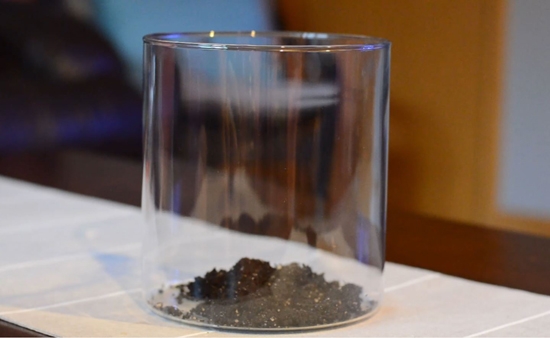
    Once we have the glass ready it is time to add some soil! I would recommend adding organic soil with compost into your jar. Avoid soils with fertilizer because it may add undesirable nutrients to your jarrarium. Also, certain soils with fertilizers may not be good for the inhabitants of your new jar. While adding the soil be sure to compact it down in an attempt to remove any air bubbles. About an inch of soil should be present once it is compacted.

    Once the jar is up and running it is highly recommended not to disturb the soil portion of your setup. In a few steps we will be adding a “seal” to prevent the soil from getting out but for now, let’s move onto adding the hardscape.

    Step 3: Adding the Hardscape

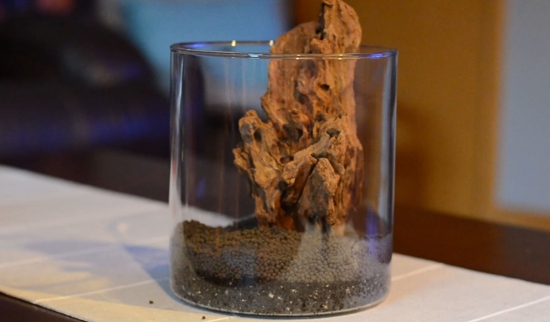
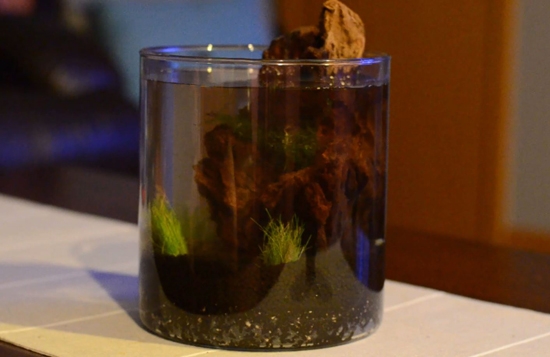
    Many different types of hardscapes can be used for a jarrarium. I used a piece of driftwood when I was putting together this one. Be mindful that it is preferred to boil or soak your driftwood before adding it into an aquarium or jarrarium otherwise, it runs the risk of releasing tannins into the enclosure. The tannin is not dangerous but it causes the water to look yellow or brown for a long period. Large pieces of driftwood can be used or spindly spider wood can be used.

    Rocks are also commonly used for an enclosure. Be mindful, because rocks that are made of limestone will raise your pH and water hardness levels, which may be undesirable when keeping live plants. Common rocks that are used are river rocks or lava rocks. Check out local fish stores for rock options.

    Lastly, a jarrarium can have any aquarium decor that will fit into it for decoration. A tiny pirate ship, skulls, pillars, etc. are fair game but make sure that it will fit or at least not crowd the whole enclosure. With any of the decorations, make sure that it is firmly touching the bottom of the jar for stability.

    Step 4: Adding the Seal

    Now is the time to add substrate to seal the soil. I recommend adding 1″ of a substrate on top of the soil. In this jar, I used Fluval Stratum, but other substrates can be added such as the Eco-Complete planted aquarium substrate!

    The substrate will seal the soil in place to help prevent it from floating up and leaching nutrients but it will also allow plant roots to reach down there and use what nutrients are in the soil. We will have to be careful when adding water to not disturb the soil and substrate!

    Step 5: Adding a Portion of Water

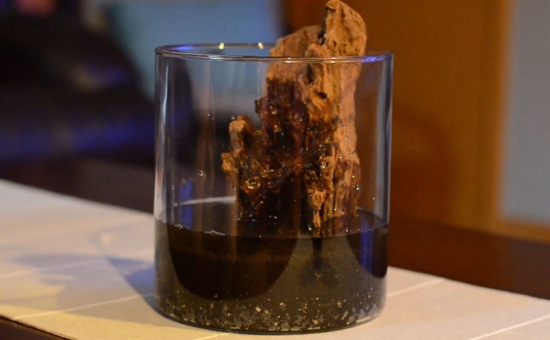
    Steps 5 and 6 can honestly be interchanged. I chose to add roughly a third of water into the jarrarium before adding plants. I did this to see whether my substrate sealed the soil correctly and I also wanted to have some water in the jar before adding plants. As stated above, be sure not to allow your substrate to be disturbed! You do not want the soil to get kicked up.

    Allow the water to run down your decoration or create a strainer to let the water trickle down. A cheap way to make a strainer is to poke holes in the bottom of a plastic bottle and pour the water into there. The water will probably get a little murky. After a few days, most of the murkiness should settle.

    Step 6: Planting

    Adding plants is probably my favorite part of putting together a jarrarium. It brings the enclosure to life! You can always experiment with many different plants but to start I would recommend adding a low light Anubias, some riccia for the foreground, and perhaps some java moss. This is a great way to dip your toes into keeping live plants in an aquarium-type setting.

    In this enclosure, I have dwarf hair grass and moss but I am only experimenting to see how well they do. If they do not grow well I may swap out the dwarf hair grass with an easier-to-keep plant.

    Step 7: Filling to the Top

    Now it is time to finally fill this jarrarium to the top! Use your strainer or piece of decoration and slowly and gently fill it with water. Once the water has reached your desired height, you are done with setting up your new jarrarium!

    The jar may be murky or discolored. Give this a few days to pass. The substrate and the tiny soil particles will settle and the coloration should clear up! Throw in a few pieces of fish food to begin the nitrogen cycle and begin considering what livestock to add to the enclosure. Also, consider adding an artificial light source and avoid having your jar too close to a window. A light fixture with a CFL bulb will suffice. There isn’t a need to go out and spend hundreds of dollars on a light fixture. Being so small with the potential of having swinging water parameters we will be limited to what can be added to the jar. I would only recommend small shrimp and snails for anything smaller than 5 gallons. At 5 gallons a betta fish could be added with a heater.

    Final Notes

    There are a few things I would highly recommend purchasing when setting up a jarrarium or any aquarium for that matter. An API Freshwater Master Test Kit can be used to keep track of ammonia levels, nitrates, and so on. This is important for really small enclosures such as this. It is also important to have while your jarrarium is going through the nitrogen cycle which takes roughly 6 weeks. During this time we will allow the food we threw in to decompose and we will not add any livestock. Only top off the water as it evaporates and do not replace any water during the cycle. The nitrogen cycle is completed when your test kits read 0 ammonia, 0 nitrites, and a hint of nitrates (10 ppm).

    A water conditioner, like the API Tap Water Conditioner, is recommended if using tap water to remove unwanted chlorine from your water. This will help make the water stable for your little critters. Other than that, just a few things like shrimp food, nets, and buckets should be kept. Lastly, enjoy experimenting with your new jarrarium! Hopefully, this guide gave a good idea of how to put one together!

    Check out this video of me putting together this jarrarium: