Tag: predator

  • Black Ghost Knife – Complete Care Guide

    Black Ghost Knife – Complete Care Guide

    Black Ghost Knife Information

    The Black Ghost Knife fish is a very unique but incredibly interesting fish found in the hobby. Although it is a carnivorous animal, this gorgeous fish is more on the shy side, especially when first introduced into an aquarium. Once acclimated to the fish tank, it can become more active but that is subjective because this fish is nocturnal and is more active at night.

    Black Ghost Knives do not really have significant teeth, if any at all, but instead have a beak. They use this beak to grab prey and consume it. This tropical fish is not recommended to be kept by amateur fish keepers because of a few traits they possess.

    One very unique trait of the Black Ghost Knife is the way it commonly finds food. It has an organ that is electrically charged. Kind of like a sonar and it uses that to find food in the wild or in a fish tank. Also, they do not have scales and are more prone to becoming infected with disease and illnesses. Under ideal conditions this fish can grow to sizes well over a foot in length (approximately 18 inches). These are a few reasons this fish is not recommended for anyone just starting with fishkeeping. This guide will go into detail on keeping Black Ghost Knife fish.

    Aquarium Requirements

    Because of its size once it reaches adulthood, the Black Ghost Knife should be kept in an aquarium that is at least 150 gallons. Length in an aquarium is important but really consider the width as well, especially for this fish. It is long and skinny so providing it with a wide aquarium is ideal!

    As stated above, this animal is carnivorous. Its diet will consist of protein rich food. As a result, keeping this fish will require a good filtration system to help maintain proper water parameter levels. Luckily, it should not really bother plants in an aquarium and the plants can help a little with maintenance! Regardless, keeping up with water changes will help keep this fish healthy. It does best in water parameters with the following ranges:

    • Water Temperature: 73 – 82 degrees Fahrenheit
    • KH 0 – 10
    • pH 6.5 – 7.0

    The Black Ghost Knife fish is a pretty shy fish. It will hide in nooks and crannies within the aquarium for most of the day. I really recommend providing it with many different types of places to hide. Also, providing a lot of shade with plants will keep this fish happy because it prefers lower light. It will most definitely try to hide under driftwood, rocks or even wedge itself in-between plants. Fishkeepers can place an appropriately sized, clear plastic tube into the aquarium to view this fish during the day when it is hiding. Beware of sharp or jagged decorations. This fish is more prone to getting infections from scratches because it lacks scales!

    Food & Diet

    Being carnivores, you can easily assume the types of food this fish can eat. Foods such as bloodworms, brine shrimp, and flake food should work well for the Black Ghost Knife when it is small. Once it grows, foods such as squid, krill and earthworms are fantastic to feed this animal. Be mindful of the invertebrates you add into your aquarium with this fish around because they may become a snack!

    <script async src="https://pagead2.googlesyndication.com/pagead/js/adsbygoogle.js"></script>
    <ins class="adsbygoogle"
         style="display:block; text-align:center;"
         data-ad-layout="in-article"
         data-ad-format="fluid"
         data-ad-client="ca-pub-8588085402939015"
         data-ad-slot="5445868760"></ins>
    <script>
         (adsbygoogle = window.adsbygoogle || []).push({});
    </script>

    Tank Mates

    It is not recommended to keep incredibly small fish with Black Ghost Knife fish. Little fish may become a quick meal for this carnivore. On the other hand, overly aggressive fish and fish that nip and bite shouldn’t be kept with Black Ghost Knife fish. This species of Knife fish do best with peaceful fish that are larger than it. Black Ghost Knife fish are compatible with fish such as:

    • Peaceful Cichlids (Angelfish, Discus, Geophagus)
    • Cory Cats
    • Plecos
    • Clown Loaches

    Remember, if it can fit into the Ghost Knife’s mouth it can most certainly become dinner.

    I do not recommend keeping two Knife fish together. Whether that’s the Black Ghost Knife or other species. Mostly due to their large size when they’re full grown but they may also become aggressive towards one another. If you’re considering adding two into your fish tank, really make sure the aquarium is large enough.

    Breeding

    I will not dive into how to breed Black Ghost Knife fish because it is incredibly challenging. The hardest part of breeding is acquiring a mature mated pair. Also, if you’re interested in breeding this fish, know you’ll most likely need a large pond or a very large fish tank.

    Final Notes

    The Black Ghost Knife is a gorgeous fish and hopefully its unique requirements do not scare you away from keeping it. It is definitely a commitment and your aquarium’s design should revolve around it but its appearance and personality are definitely worth the challenge! If you have personal experiences with this fish or have your own advice, please share it in the comments below!

    Featured image by: Vassil on wikiMedia Commons

  • 5 Unique Predatory Fish for Saltwater Aquariums

    5 Unique Predatory Fish for Saltwater Aquariums

    Predatory fish tanks are both fun and rewarding without the hassle of attempting to keep coral alive. Most saltwater fish have vibrant colors with remarkable personalities that will keep you entertained for years! This guide will showcase 5 unique and interesting saltwater fish that may do well in a predatory aquarium.

    1. Harlequin Tuskfish

    The Harlequin Tusk comes from two different bodies of water. One can be found in the Indian Ocean and the other in Australia. Regardless, it is one of the most beautifully colored fish available to purchase in this hobby. The Australian’s coloration is just a tad more vibrant and pronounced.

    This fish will become around 10″ when it is fully sized. It requires an aquarium that is 125 gallons or larger. Provide a lot of rock so it has places to hide and to allow it to set up its territory. It has very similar water parameter needs to most other saltwater fish which are:

    • Water Temperature between 72 – 78 degrees Fahrenheit
    • dKH levels between 8 and 12
    • pH levels between 8.1 and 8.4
    • salinity levels between 1.020 and 1.025 sg

    When first introduced into a fish tank, the Harlequin Tusk may be very shy and hide in rock work. Once it becomes acclimated into the aquarium it will begin to show their true character. Harlequin Tusks are wonderful fish to have in a FOWLR (Fish only with live rock) aquariums with similarly sized fish. They do very well with Large angelfish, tangs, foxfaces, small triggers and larger wrasses. Only one Harlequin Tusk should be kept in an aquarium!

    The Harlequin Tusk will not bother coral but invertebrates such as shrimp, snails, crabs, and many others will become lunch. Small fish may also become lunch for this fish due to its carnivorous tastes. Check out the Harlequin Tusk Complete Care Guide for more information on this fish!

    2. Porcupine Pufferfish

    Have you ever seen a fish with colored eyes? If you haven’t, check out the Porcupine Puffer! This fish is unique because it doesn’t have pelvic fins so its body shape is much different from other fish. It also takes on the characteristics of a curious toddler and playful puppy. The highly curious, intelligent and gorgeous Porcupine Pufferfish is a fantastic predator fish to keep in a FOWLR aquarium.

    When it is fully grown it will be roughly one foot in length. It should be housed in a 180 gallon aquarium when it becomes this size with a well running protein skimmer. Its water parameters are nearly identical to the Harlequin Tusk.

    • Water Temperature between 72 – 78 degrees Fahrenheit
    • dKH levels between 8 and 12
    • pH levels between 8.1 and 8.4
    • salinity levels between 1.020 and 1.025 sg

    The Porcupine Puffer does well with many other predators in an aquarium. Similar to the Harlequin Tusk, the Porcupine Pufferfish will do well with large tangs, foxface, large angelfish, triggers, large wrasses and eels! They may nip on tank mates, so be prepared to see round holes in other fish’s fins. I personally would not recommend a pufferfish in a reef tank because crustaceans like shrimp, crabs, clams and snails are their natural prey and they will spend their time foraging for them. The Porcupine Puffers beak constantly grows so they may nip on coral and live rock to try to grind down their beaks.

    Food such as snails, crabs, shrimp and clams will help help grind down this fish’s teeth. It will also happily feed on krill, mysis shrimp, and possibly silversides. For more information, check out the Porcupine Puffer Complete Care Guide.

    3. Volitan Lionfish

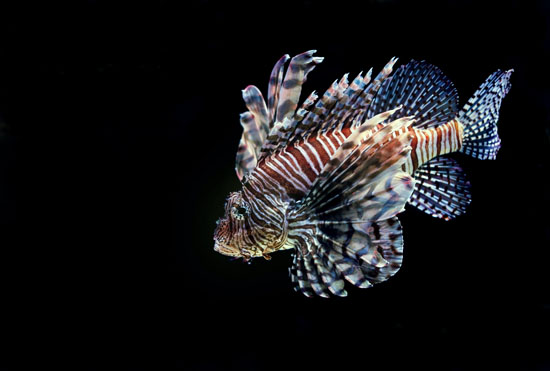
    The Volitan Lionfish may seem like a decile and elegant fish but they are incredible predators that will consume just about any fish that will fit into its mouth. Also known as the Turkeyfish, this animal has many very pronounced fins all over its body that gives it a very unique appearance. Its very powerful colorations make it a visual spectacle! First they’re very shy and hide in aquariums but once acclimated, they become more active and swim in the open.

    The Volitan Lionfish grows to be over a foot in length and it will require a fish tank that is a minimum of 120 gallons in size with plenty of hiding spots to keep it happy. They have similar water parameter requirements as the Harlequin Tusk and Porcupine Pufferfish with the exception being that they prefer salinity ranging between 1.021 and 1.023.

    This species of lionfish becomes incredibly large so finding tank mates that will do well with it may be a bit more challenging. Fish that are at least 75% of the lionfish’s size are recommended. The Volitan Lionfish will try to eat anything and everything that can fit into its mouth. Tangs, butterflyfish, eels, groupers and triggers are all candidates that will usually do well with a lionfish. Unfortunately, most crustaceans become food for a lionfish.

    Lionfish can be fed an assortment of live and frozen foods. The goal is to feed your Lionfish frozen food and occasionally feed something live. Many hobbyists feed Volitan Lionfish silversides, frozen squid, uncooked shrimp and pre-made frozen foods found at pet stores.

    A lionfish has spines that are quite venomous and are far more painful than a bee sting. The venom is not normally lethal but precaution should be taken especially if you are sensitive to stings from animals. If stung, remove any spines that have broken into your skin, and place the affected body part into hot but tolerable water. Keep your appendage in this water for roughly 30 to 45 minutes. We recommend seeing medical attention for extra precaution.

    4. Bluestreak Cleaner Wrasse

    The Bluestreak Cleaner Wrasse is not your normal predator. This one does not get insanely large like many others but it is an excellent fish for a predator aquarium. This fish does not have a big appetite, it does not swallow prey whole, but it does enjoy removing parasites off fish!

    This fish reaches roughly 5.5 inches in length when full size. It also has a very active personality so should be kept in aquariums that are 90 gallons or larger to provide adequate swimming space. This wrasse’s water parameters are the same as the Porcupine Puffer and Harlequin Tusk. We encourage using a tightly sealed lid because of this fish’s jumping tendency. Unlike the rest of the fish on this list, the Bluestreak Cleaner Wrasse is reef safe!

    A big fish tank with large fish are great for the Bluestreak Cleaner Wrasse because it can be a finicky eater at times and only consume what can be found in the fish tank. Its primary diet consists of parasites that attach to fish’s mouths, gills and scales but it can also eat meaty foods such as:

    • Mysis Shrimp
    • Brine Shrimp
    • Small Pellet Food
    • Flake Food

    If your fish is being a finicky eater try feeding with garlic or garlic extract. Be sure to check out this article for information on garlic and feeding fish!

    The Bluestreak Cleaner Wrasse will do perfectly well with fish such as tangs, angels, groupers, foxface, eels, triggers and pufferfish! Be careful because the cleaner wrasse may fight with other wrasses and they are a hit or miss with lionfish.

    5. Blue Throat Triggerfish

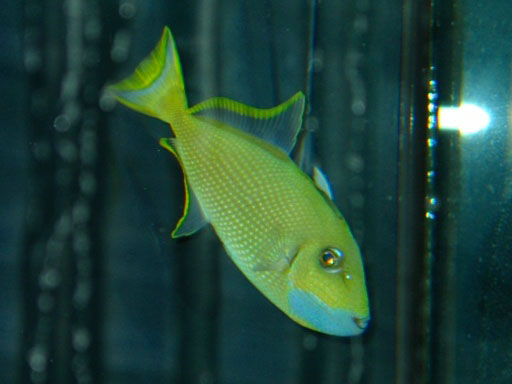
    The Blue Throat Trigger is a gorgeous fish that finds a home in many predator tanks. It has a couple of unique features that differ from all the other fish on this list. First, the Blue Throat Trigger has different color patterns depending on whether it is male or female! The male will be a darker color with a blue throat and a female will normally be much lighter in color without the blue coloration. This fish also has the capability to grunt under water which is quite a funny thing to listen for.

    The Blue Throat Trigger will grow to around 9 inches in length and requires a minimum of 125 gallons of water. The fish tank should provide quite a bit of live rock so the trigger can hide. Live rock needs to be very large or placed securely because Blue Throat Triggers move them. The water parameters of a Blue Throat Trigger are identical to the Porcupine Puffer, Harlequin Tusk and Bluestreak Cleaner Wrasse.

    Image by Sean McGrath on wikiMedia

    Like many other triggers, the Blue Throat’s teeth continuously grow and it will require foods that help grind down the teeth. Snails, hard shelled shrimp, and clams are all excellent foods to give your trigger to help grind down its teeth. It can also be fed squid, krill and mysis if it is incredibly small. The Blue Throat is considered to not be 100% reef safe because it will most likely destroy a clean up crew population. Although less common, it has the potential to nip on coral and knock things over when it decides to break rocks and move things around to find prey.

    This fish does well with eels, squirrelfish, lionfish, groupers, hawkfish, large angels, tangs and pufferfish. They have incredibly sharp teeth and can provide a nasty bite when threatened but overall they are a fantastic fish to have in a predator aquarium!

    Final Notes

    There are so many different predatory fish available on the market but these 5 have some unique features. They are all gorgeous and may be fantastic additions to an already established fish tank! If you do not know your fish tanks size but want to figure out the volume of water before adding any of these fish be sure to check out the aquarium volume calculator here!

  • Snowflake Eel – Complete Care Guide

    Snowflake Eel – Complete Care Guide

    Snowflake Eels (Echidna nebulosa) otherwise known as Starry Moray or Snowflake Moray Eel, are interesting animals kept in aquariums. They are commonly found in predatory tanks but are occasionally added into reef tanks! This guide will give insight on Snowflake Eel aquarium requirements, feeding, and other information for anyone interested in this fish.

    Fish Information

    Snowflake Eels are incredibly easy to care for. They are very hardy and an excellent introductory eel for new hobbyists. They are considered semi-aggressive and are nocturnal predators usually hunting and ambushing crustaceans such as shrimp and crabs. In an aquarium, it is common to see them poke their heads out of rocks during feedings. They use two sets of jaws to grab prey and drag it down into their gullet during feeding. Be cautious when keeping this fish in a reef tank because it consumes crustaceans. It may knock corals over since it stays inside and very close to live rock. The Snowflake Eel will be roughly 2 feet (60cm) in length when it is grown in captivity. It is possible for them to be larger in the wild.

    Aquarium Requirements

    When fully sized, the Snowflake Eel should be kept in fish tanks that are 50 gallons or larger. A well covered top is needed because this fish is known to be one of the best escape artists. Because of its size and temperament, the eel should have quite a bit of live rock with varying hole sizes. This will give it room to move around, hide when threatened, and provide similar habitat it experience in the wild.

    Snowflake Eels do best in water temperatures ranging from 72 – 78 degrees Fahrenheit, dKH levels between 8 and 12, pH levels ranging between 8.1 and 8.4 and lastly salinity levels between 1.020 and 1.025 sg. As stated before, they are quite hardy and have a nice range of water parameters they can tolerate.

    Food & Diet

    Snowflake Eels are carnivorous animals and require a nice range of foods. There is a wide variety of food that it can eat such as:

    A Snowflake Eel can also be handfed but caution must be taken because they can give a powerful bite! It is best to start handfeeding when the moray is small to minimize risk of getting bitten or at least to receive a smaller bite. It is a predator so it may mistaken your fingers for a quick snack!

    Tank Mates

    The Snowflake Moray Eel can be kept with fish that are larger in size and that won’t easily fit into the eel’s mouth. They should do fine with coral, snails, anemones and sea urchins, but not crustaceans such as crabs, lobsters and shrimp. Keep in mind that this species of eel will become quite large so fish that are larger than its mouth at first, may not be in the future.

    Eels are commonly kept in larger aquariums with bigger and sometimes more aggressive fish. They are commonly kept with tangs, large angelfish, lionfish, foxface, groupers and large wrasses.

    It is possible to keep 2 Snowflake Eels in a marine tank together. The eels should be introduced at the same time and they should also be similar in size. Snowflake Eels are cannibals and if the opportunity to eat a much smaller eel arises, it will do so! I would personally not keep 2 Snowflake Eels in a fish tank together unless it is 150 gallons or larger. They are quite territorial and larger aquariums will give them more room to create their own territory.

    Breeding

    Breeding Snowflake Eels has not really been conducted in captivity because of their mating rituals, inability to distinguish between male and female, and rarity in acquiring a mating pair.

    Final Comments

    Snowflake Eels are a fantastic fish for a saltwater aquarium. They all have very unique personalities and are quite active moving within the live rock scaping of your aquarium. Be mindful of the fact that eels are escape artists and if a well sealed lid is not provided there is a high possibility of them jumping out!

    Image by Michael Bentley on wikiMedia