Tag: rasbora

  • Chili Rasbora – Full Care Guide

    Chili Rasbora – Full Care Guide

    The Chili Rasbora (Boraras brigittae), sometimes called the Mosquito Rasbora, is a incredibly small fish, with vibrant colors, that enjoy schooling in large groups. Originally found in Indonesia, it has swept through the aquarium hobby and is loved by many fish keepers. Primarily red and orange in color, this little fish strikingly pops in well planted aquariums. This guide will provide information on Chili Rasbora care and breeding habits.

    Fish Information

    Chilli Rasbora do not get larger than .8 inches (2 cm). It is the perfect fish for aquariums that are 5 gallons or larger. A school should contain 6 individual fish or more. 6 to 10 Chili Rasbora should do well in a 5 gallon fish tank. Although the Chili Rasbora remains incredibly small, its colorful body and habit of schooling create beautiful movement and liveliness in a densely planted aquarium.

    Like many other rasbora species, this one primarily spends its time in the middle and top of the aquarium. It will occasionally swim at the bottom of the fish tank.

    Aquarium Requirements

    The Chili Rasbora is a tropical fish that does well in a large temperature range. It can survive in water temperatures between 68 and 82 degrees Fahrenheit, but 75 and 78 degrees Fahrenheit is the ideal range where it will thrive. It enjoys KH levels between 3 and 12 dKH and lastly does great in acidic water that has pH levels ranging between 4.0 and 7.0.

    This species of fish suffers terribly in new aquariums so only add them into already well established fish tanks. Once introduced and settled, they are quite hardy.

    Because of its small size, keep this fish in slow moving waters. They will be thrown around the aquarium when caught in fast moving currents. Providing many live plants and great filtration is ideal for this fish.

    Food & Diet

    The Chili Rasbora is small and remains small its whole life. It is very important to feed it food that it will be able to fit into its mouth. There are many options to offer this fish to provide it with a varied diet. Flake food can be taken and crushed into powder which makes it small enough for this fish to consume. Micropellets can be fed with little problems because they are designed for tiny fish like Chili Rasbora. Also, feeding daphnia, brine shrimp, and cutting up bloodworms are fantastic options to give this fish a varied diet. Providing many different food options will keep this fish vibrant and healthy.

    Tank Mates

    Chili Rasbora are easily outcompeted for food. Take pre-caution when choosing tank mates. The Chili Rasbora do exceptionally well with other small and peaceful fish in the aquarium. Do not keep them with larger or more dominate fish such as:

    • Platys
    • Mollies
    • Swordtails
    • Betta Fish
    • Angelfish
    • Large Mouthed Fish (Cichlids, Goldfish)

    Keeping Chili Rasbora in larger fish tanks is more than possible. They will thrive with fantastic fish such as:

    • Tetras (ember, neon, cardinal, green neon)
    • Rasboras (harlequin, green kubotai)
    • Endler’s Livebearers
    • Guppies
    • Celestial Pearl Danios
    • Corycats
    • Dwarf Gouramis

    The amount of fish that can be kept in an aquarium are determined by the number of plants in the fish tank, filtration, and physical size of the aquarium. A densely planted aquarium will be able to keep more fish happy over a sparsely planted one. A stronger and better filter will go a long way in allowing you to keep more fish in the enclosure. Larger aquariums aid in keeping water parameters stable when a fish tank is heavily populated. Regardless, do not cram too many fish in a fish tank.
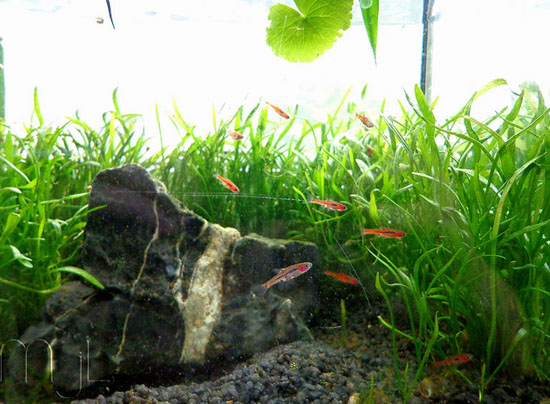
    Shrimp and snails should do perfectly fine with Chili Rasboras even in 5 gallon aquariums. In fish tanks this small it is important to closely monitor water parameters because they are more prone to swinging which can be detrimental to both fish and invertebrates.

    Breeding

    Chili Rasbora will openly breed and produce offspring in aquariums. The males may become a bit more territorial during breeding periods and will also deepen its red and black coloring. After successfully breeding a female will appear rounder than the male and not pregnant females.

    Eggs will be laid on plants and decorations and will not be cared for by either parent. The best chance for survival for the fry are in heavily planted aquariums. The plants will provide the much needed cover the fry will need to reach adulthood. The parents are sometimes observed to eat the fry once they hatch from their egg.

    Final Comments

    The Chili Rasbora is fantastic for aquariums both large and small but fill the micro aquarium niche very well for keepers that do not have the space or money to spend on large aquariums. Their vibrant colors stand out in aquariums so they will always be able to be observed. Check them out if you get a chance!

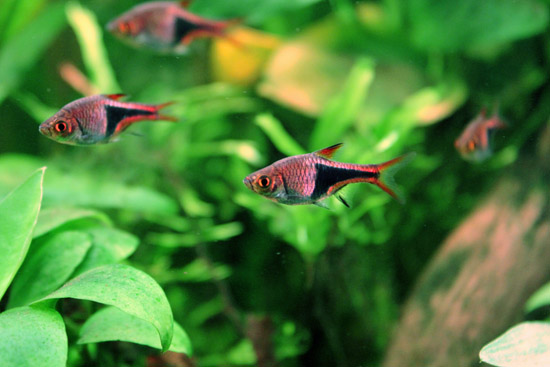
    Image by JoKrimmel on wikimedia

  • 5 Fantastic Freshwater Fish for 10 Gallon Aquarium

    5 Fantastic Freshwater Fish for 10 Gallon Aquarium

    Setting up a fish tank is a very fun and rewarding process. Making it your own work of art is definitely a long term endeavor. Deciding what fish to introduce into your aquarium is part of the process and probably the most exciting part of it all. This guide will help showcase some of the many freshwater fish that can happily reside in a 10 gallon aquarium. If you haven’t already setup a freshwater aquarium, check out this guide.

    Harlequin Rasbora

    To begin, I would like to introduce you to the harlequin rasbora, sometimes known as the t-bone rasbora. This rasbora has the iconic black pork chop shape displaying from the middle to the back of its body. Besides that, it has a beautiful copper/red toned body that stands out in an aquarium.

    This fish is small and will be around 2″ in size when it is fully grown. Due to its schooling habits, it is recommended to have around 8 – 10 beautiful rasboras in an aquarium together. They normally do a great job closely schooling together and will fill the middle to top of your aquarium with life!

    Male and females can be distinguished from one another by observing the bottom part of their “pork chop” pattern. The males will have a straight tip at the bottom and females will have a more rounded tip. Females will also be a little bit larger than the males. These fish will successfully breed inside of a well planted aquarium. They require broad leaved plants in order to do so. Plants like the Anubias are excellent option to have in the aquarium. If one or many are available, the rasbora will potentially lay eggs on the underside of the broad leaf.

    This species of fish are omnivorous. Providing a nicely ranged diet of pellet, flake, and frozen meat foods will keep this fish happy. They enjoy temperatures ranging from 72 – 78 degrees Fahrenheit, KH levels around 6 – 10, and pH levels in between 6.0 and 6.5. These fish are excellent choices for heavily planted aquariums.

    Threadfin Rainbowfish

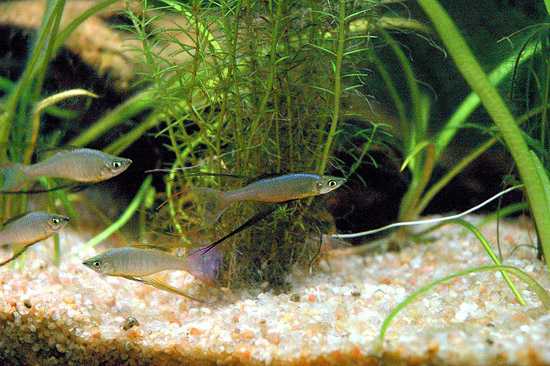
    Threadfin Rainbowfish may not be as common as the harlequin rasbora but regardless it is an interesting fish to add into a freshwater 10 gallon aquarium. Their colors aren’t as vibrant as fish like the neon tetra but they can get a beautiful blue, gray, red, and black coloration on them. Males will have long threadlike appendages that reach out from their anal and dorsal fins. If you think their colors are lacking, the fins and shape surely make up for it.

    This fish species maxes at 2″ in size and are perfect for a planted aquarium 10 gallons or larger. They enjoy being in schools and I would recommend 5 to 8 individuals in a 10 gallon aquarium. 5 in an aquarium that is fairly open without too many decorations and 8 in a heavily planted aquarium.

    Like stated before the males will have the long threadlike appendages protruding out of their dorsal and anal fins. The females will not. This is the easiest way to distinguish the two. Also, males will most likely be far more vibrant in color compared to the females. These fish have the possibility of laying eggs in an aquarium.

    Threadfin rainbows are omnivorous creatures and benefit from having a large range of food. Due to their small mouth sizes it is recommended to feed them smaller pellets and meaty food. Flake food will work as well! This species of fish do well in water temperatures ranging 72 – 78 degrees Fahrenheit, KH levels between 7 and 10 and pH levels between 6.0 – 7.2.

    Male Betta Fish

    Male betta fish are very common fish in the freshwater aquarium hobby. They are often kept in large bowls without filtration due to their ability to acquire their own oxygen. They can and should be kept in larger aquariums than a bowl to keep them even happier. The betta fish has a fantastic personality and interacts well with humans. You can’t take it out and play with it but they know when it’s dinner time and will swim up to the glass to greet you. They have many different colors and a wide variation in fin shapes. I will be broadly providing information about bettas here.

    Most betta species reach a max size of 2.5 inches. There may be a little variation dependent on their fin lengths. They should be the only betta kept in an enclosure. They may be kept with other fish but be sure the others will not nip at the betta’s fins and because the betta could nip at fish with long fins as well. Female bettas can be kept in an aquarium together but they do not have as pronounced fins.

    blue male betta fish

    Males and females should only be housed temporarily if they are breeding. The male will build a bubble nest and the female will lay her eggs in it. Once that occurs, the female should be removed. The male will tend to the eggs until they hatch. Once hatched very small food should be given to the newly hatched fry. Foods such as baby brine shrimp and crushed flakes should be provided.

    Betta fish are carnivorous fish. Their diets should consist mostly of protein rich foods such as bloodworms, brine shrimp, or protein heavy pellet food. Due to their diets the aquarium might see spikes in undesirable water parameters so testing the water should be a common occurrence. The betta fish also thrives in water temperatures between 75 and 80 degrees Fahrenheit, KH between 0 and 25, and pH levels ranging from 6.0 – 8.0.

    Endler’s Livebearers

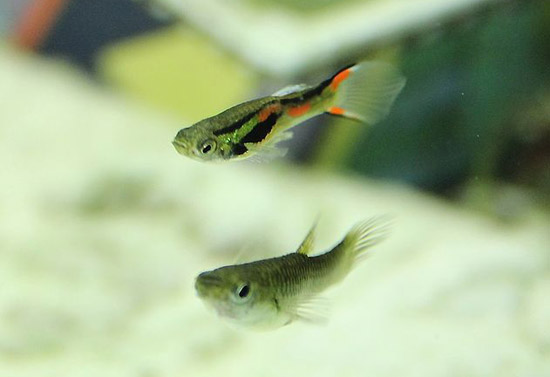
    Endler’s Livebearers continue to gain traction and popularity in the freshwater aquarium keeping hobby. Their vibrant assortment of colors make them a wonderful addition to any aquarium. They are fantastic to add if you are looking for lively fish for the middle to top of the aquarium.

    endler's livebearers in fish tank
    Image by Usien on Wikimedia

    These fish normally start off very small, usually purchased when they are less than an inch in length. They will grow to be roughly 2 inches in sizes when they are fully grown. Keeping around 6 – 8 in a 10 gallon fish tank is suitable with the understanding that this species of fish breeds like no tomorrow and 6 fish can easily turn into 20 then 50 and so on. Proper housing for the new offspring will be required.

    Endler’s livebearers are as their name suggests, live bearers. They do not lay eggs but instead their offspring come out of their womb very well and alive. Treat them like any other platy, guppy, or swordtail when for breeding purposes. They do not require anything special.

    This species of fish is omnivorous and would love a nice variety of foods. Like stated above, pellet, flake, and frozen meat foods will provide all the variety this fish needs to obtain its nutrients. Keep in mind they are usually sold very small so flake food might need to be crushed a little for them to enjoy it. They do best in water temperatures ranging from 75 – 80 degrees, KH levels ranging between 10 and 30, and pH levels with a wide range of 5.5 – 8.0.

    Cardinal Tetra

    Last but not least on this guide is the beautiful cardinal tetra. Do not mistaken this fish with the neon tetra. They look incredibly similar but the cardinal tetra’s red stripe runs from its eyes to tail and it lacks that white area near its stomach. This fish is more for expert fish keepers because they’re a little more finicky than other fish.

    cardinal tetra in planted tank
    Image by Elma on Wikimedia

    When they are full grown, cardinal tetras reach a size of 2 inches. They are perfect for densely planted aquariums of 10 gallons or larger. I would keep a school of 6 to 8 cardinal tetras in a 10 gallon aquarium. They are quite an active little fish and their vibrant colors add to their beauty.

    It is possible to breed cardinal tetras in an aquarium but it is not very common. They require very specific water parameters to successfully breed. Specifically dH levels between 1 and 2 and pH levels as low as 5 and 6.

    Just like many of the other fish in this list, cardinal tetras are omnivores and benefit from a range of food. Starting off with flake food is a good idea until this fish is able to consume larger pellets. Brine shrimp is always recommended as well as bloodworms! This is a fantastic fish with colors that can drop jaws!

    Final Thoughts

    This is just a small list of fish that will do well in 10 gallon aquariums. I wanted to choose fish with vibrant colors or very unique fin shapes and designs. Hopefully this list helps provide information needed to help choose some cool freshwater fish for 10 gallon fish tanks. If you already have the fish, check out information on low light freshwater plants you can add to your fish tank!