Tag: red phantom tetra

  • Red Phantom Tetra – Complete Care Guide

    Red Phantom Tetra Facts

    Red Phantom Tetras, as the name suggests, are beautiful red fish with a black-tipped dorsal fin. They are freshwater schooling fish and great additions to many community aquariums. They look similar to other tetra species such as the Bleeding Heart Tetra and Serpae Tetra. It is best to keep this species in groups of 6 or more. This guide will detail the Red Phantom Tetra’s aquarium requirements, dietary needs, compatible tank mates, and more.

    How Big Do Red Phantom Tetras Get?

    The Red Phantom Tetra will be about 1.5″ – 2″ in length when fully grown.

    Are Red Phantom Tetras Fin Nippers?

    Red Phantom Tetras should not nip on other fish species when they are in large enough groups, but there is always a possibility. If their school is too small, they may resort to bullying and nipping on the fins of other fish. Red Phantoms are also less commonly known as fin nippers compared to the similarly looking Serpae Tetra, which has a reputation for nipping on the fins of other fish.

    Aquarium Requirements

    To make them comfortable and give them the best chance at thriving in your fish tank, Red Phantom Tetras should be kept in 20-gallon aquariums or larger. They will also do best in a well-planted fish tank with a variety of rocks and driftwood to provide cover when stressed. Driftwood also releases tannins over time which can help soften your water and lower its pH. The side effect is that it may also tint your aquarium brown. Consider checking out Coral Driftwood and/or Spiderwood which are some of my favorite looking types of wood. You can follow the link which will take you to their store page on Amazon!

    Although Red Phantom Tetras aren’t commonly known as jumpers, I would still recommend placing a well-fitted lid on the fish tank to truly prevent it from happening. Most fish can potentially jump out of the aquarium when they are startled.

    Water Parameters

    Water parameters are an important aspect of keeping your fish happy. Every fish species has specific water parameters they do best with. The following are the parameter ranges for the Red Phantom Tetra.

    • Temperature: 72°F – 78°F
    • Water Hardness: 4 – 8 KH
    • pH: 5.5 – 7.5

    Keeping your water parameters within this range doesn’t always guarantee your fish will succeed in your aquarium, but it will help give it the best chance. You can keep your temperature stable with a heater and thermostat. Check out what are in my opinion, the 6 best Heaters for Freshwater and Saltwater Aquariums! Furthermore, to know what kind of water you have, you’ll have to purchase testing kits. My go-to testing kits are the API Freshwater Master Test Kit and API GH & KH Test Kit. The master test kit lets you test for pH, ammonia, nitrites, and nitrates. The GH & KH test kits will help you figure out what the hardness levels of your aquarium are.

    Food & Diet

    Red Phantom Tetras are omnivores and often readily consume any type of food introduced into the aquarium. I would recommend providing a variety of different food to give them a well-rounded diet. They should consume frozen daphnia, bloodworms, and brine shrimp with no problems. I would also provide them with flake foods such as the New Life Spectrum All Purpose Flakes and Omega One Mini Pellets.

    Tank Mates

    This species of fish is generally very peaceful and will mostly spend time tightly and loosely schooling with other Red Phantom Tetras. They should do perfectly fine with most other community fish like Neon Tetras, Mollies, Platies, Rasboras, Corydoras, and many other peaceful fish. In a large enough aquarium, they should also be fine with different species of Ram, Angelfish, Rainbowfish, and Barbs.

    I would not recommend keeping them with African Cichlids, and other aggressive and large fish like Oscars, Jack Dempsey, Pike Cichlid, and other similar types of fish. Anything that can easily fit a Red Phantom Tetra into its mouth should be avoided.

    Can I Keep Red Phantom Tetras With Shrimp?

    Red Phantom Tetras will not actively hunt shrimp. However, many fish are opportunistic eaters so there is a possibility that they may try. Most adult shrimp’s exoskeletons will protect them from becoming a meal, but they are vulnerable when they molt because they shed their hard battle armor. Also, newborn shrimp and very small shrimp can become food for Red Phantom Tetras.

    If you’re looking to mix these two, I would recommend providing an abundance of hiding spots like caves and well-planted sections where the shrimp can take refuge.

    Breeding

    Before discussing breeding, you have to know how to tell the difference between male and female Red Phantom Tetras. The easiest way to do this with this species it to look at their dorsal fins. Males will have a much large dorsal fin compared to the female. During spawning, the males should also pop in color more than the female does.

    This fish species should breed on their own in a well-established aquarium. It is best to keep them in slightly acidic water to encourage breeding. You will see males courting the females in the aquarium when it’s time to breed. They do not care for their eggs. Instead, they scatter them throughout the aquarium and leave the eggs to develop on their own. Some aquarists will put their spawning Red Phantom Tetras into a breeding tank to release their eggs. Once the eggs are released, the breeders are removed from the breeding fish tank. This way, the eggs have the highest chance of survival because the parents and other fish will not prey on the eggs.

    Final Notes

    Red Phantom Tetras are wonderful fish and likely the peaceful counterpart of the Serpae Tetra. They’re fantastic fish to add to a community aquarium and will add a striking red color to the environment. Larger schools of these are always preferred to get the full effect of this fish species. However, if the Red Phantom Tetra isn’t for you, consider checking out a few other Red Tropical Fish for your Freshwater Aquarium!

  • 10 Red Tropical Fish for Your Freshwater Fish Tank

    10 Red Tropical Fish for Your Freshwater Fish Tank

    Freshwater fish come in many different colors, shapes, and temperaments. There is a red freshwater fish to fill every niche in this hobby whether you want to fill a planted community tank or a large aggressive predatory aquarium. This guide will discuss some fantastic red tropical fish that are available for freshwater aquariums. As a disclaimer, I will not be covering a lot of the care needed for these fish, but I will showcase the many different species out there.

    1. Cherry Barb

    Cherry Barbs are beautiful freshwater fish and are first on this list of red freshwater fish. Unlike many other barbs, this is a very peaceful fish that will do great in a freshwater community tank. The males usually showcase a dark red color, which becomes a vibrant cherry red when breeding, and females are usually a mixture of brown and dull red.

    How Many Cherry Barbs in a 10 Gallon Tank?

    I personally would not recommend keeping Cherry Barbs in a 10 Gallon Tank. I would recommend for aquariums that are 20 gallons or larger. Although they do not tightly school, it is recommended to keep them in groups of 5 or more. On top of that, this species of fish enjoys exploring the whole fish tank. A 10 gallon aquarium does not provide enough space for your Cherry Barb to explore.

    How Big Do Cherry Barbs Get?

    Cherry Barbs get to about 2″ when fully grown. They do not get very large so they should not dominate other community fish during feedings.

    2. Ember Tetra

    Ember Tetras are beautiful little fish with vibrant red colors, that do great in freshwater aquariums. Similarly to many other tetras, this species does best in groups. This species is great if you’re looking for a very small fish to add into a freshwater aquarium. They should not get larger than 1″ when fully grown. They’re very peaceful and will keep to themselves so they will be great in a species aquarium, or a community fish tank with similarly sized fish.

    How Many Ember Tetras in a 10 Gallon Tank?

    If you’re just keeping only Ember Tetras in your aquarium, you should be able to stock the fish tank with about anywhere between 8 and 14. Someone with more experience, excellent water conditions, and a fish tank full of plants will likely keep 14 successfully. On the other hand, I would recommend 8 if you’re newer to fishkeeping or don’t always keep up with water changes/keeping water parameters in check.

    How Many Ember Tetras in a 20 Gallon Tank?

    Ember Tetra size and small bio-load allow you to stock a 20-gallon with anywhere between 16 and 24 individuals. Like a 10-gallon, a well-kept aquarium should hold 24 individuals. 16 Ember Tetras are recommended for aquariums that may have a few other fish or that may not always have the best water parameters. Every aquarium is unique, so I cannot definitively answer how many fish can be kept in a fish tank. These are merely suggestions.

    3. Red Phantom Tetra

    If you love Ember Tetras but want something that’s a little bigger, then you have to check out Red Phantom Tetras. The Red Phantom Tetra is slightly transparent with different red tones on its body. This species grows to about 2″ as an adult, and will do great in aquariums that are 20 gallons or larger. Like many other tetra species, Red Phantom Tetras do best in schools of 6 individuals or more.

    How Many Red Phantom Tetras in a 10 Gallon Tank?

    To have a properly sized school, I would not recommend keeping Red Phantom Tetras in a 10-gallon tank. A 20-gallon or larger will be more suitable for this fish species. The extra aquarium space will allow you to keep anywhere between 6 and 9 Red Phantoms.

    Can I Keep Red Phantom Tetras with Shrimp?

    Red Phantom Tetras should not normally bother adult shrimp. However, they may try to make a snack out of recently molted shrimp due to them temporarily having a soft body. Also, baby shrimp may become food for this species of fish. If you are interested in keeping shrimp with Red Phantom Tetras, consider providing many hiding places and heavily plant your aquarium to provide cover for your shrimp.

    4. Betta Fish

    colorful betta

    Betta fish come in a wide assortment of colors. There are fully red bettas or betta fish with red mixed with different types of colors. There is a choice for pretty much anyone. Also, Betta fish are fantastic fish to have due to their wonderful personalities. I have seen aquarists go so far as to teach their betta tricks. I will cover a few things about bettas below, but consider checking out the Betta Complete Care Guide for more information.

    How Long Do Betta Fish Live?

    A Betta Fish can live anywhere between 2 and 5 years. Excellent water parameters and a properly sized aquarium should help this fish live a stress-free life which should help it live longer.

    Do Betta Fish Need a Filter?

    From personal experience, I do recommend providing a filter for your Betta Fish. The filter, whether it’s a Hang-on back or sponge filter, holds a lot of beneficial bacteria that help keep your water parameters stable. Although bettas can acquire oxygen from the atmosphere, filters will assist in oxygenating your water to make your life easier for your fish.

    There are a few things to keep an eye on when running a filter with a Betta Fish. The biggest is probably the flow rate, especially in smaller aquariums. Many Bettas have long showy fins, and a filter with a high flow rate can toss the fish around. This can damage the fish’s fins and stress it out. You may see this happen more often with hang-on back filters. Also, a hang-on back filter’s suction could potentially be deemed a hazard for your fish. I feel a healthy fish should not generally get caught in a filter’s suction, but a Betta Fish has long fins that may get pulled in.

    I recommend using either a sponge filter for a betta fish tank or putting a sponge over the filter intake to slow the flow of water. If you cover the intake, debris may build up on the sponge, which will need to be cleaned out from time to time.

    5. Red Blood Parrot

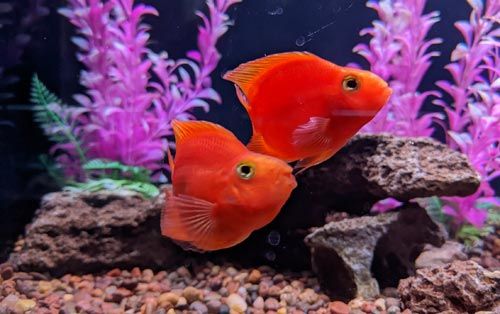
    Blood Parrots are hybrid fish made from breeding certain types of cichlids. They have gotten a lot of popularity due to their unique shape and vibrant red colorations. They can grow to about 8″ and will do best singularly in a 30-gallon aquarium. If you would like to keep more, keeping them in groups of 3 or more is recommended. However, you will also need a larger fish tank to house more Blood Parrots. Keeping a pair will likely cause one to be much more dominant and aggressive toward the other.

    Are Blood Red Parrot Cichlids Aggressive?

    From experiences with Blood Parrots, they can be aggressive, but they are much less aggressive than other cichlids like Jack Dempsey, Convict Cichlid, or Oscar. They can hold their own and are sometimes kept with Oscars and will also do well with Angelfish, larger Tetras, and other Blood Parrot Cichlids.

    Can African Cichlids Live with Blood Red Parrots?

    I would not recommend keeping African Cichlids with Blood Parrots, due to the Blood Parrot’s docile nature. Also, Blood Parrot Cichlids are more commonly kept in planted aquariums because they do not destroy plants or dig in the substrate like many other cichlids do, and prefer more acidic and softer water.

    6. Red Oscar

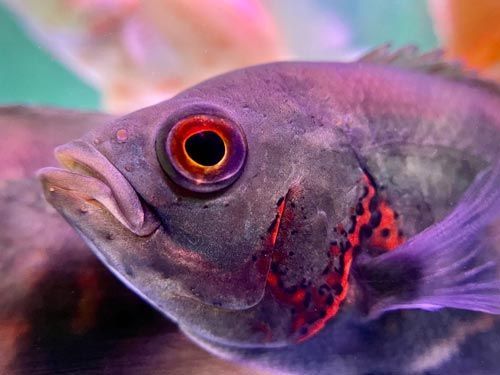
    Red Oscars are a gorgeous species of cichlid that has a variation of colors on its body, with vibrant red being one of them. As beautiful as they are, this species of fish is not for everyone, due to their large size as adults. Working with fish for most of my life, I have seen vast amounts of neglect on Oscars (and other fish) due to improper husbandry. If you love large species aquariums and are on top of filtration/water changes, consider picking up a Red Oscar Cichlid.

    Are Red Oscar Cichlids Aggressive?

    Yes, like most other cichlids, the Red Oscar fish is an aggressive species. They are also a larger species of cichlid and grow to around a foot long. Due to this size, they should be kept in aquariums that are 75 gallons or larger for one Oscar fish. If you are interested in keeping two, they will likely need anywhere between a 125 or 150-gallon aquarium. If you’re looking for common aquarium sizes, check out some Standard Aquarium Sizes.

    7. Red Honey Gourami

    The Red Honey Gourami is a great addition to a community tank. They are usually a dull red/yellow color that stands out from a planted aquarium background. This fish can do well in a 10-gallon aquarium singularly, but a group of 3 can be kept in 20-gallon aquariums. They’re an excellent choice if you have a nano aquarium, or are looking for a single fish that does not need to school.

    Are Red Honey Gouramis Aggressive?

    Red Honey Gouramis should not be aggressive. This species of fish may become shy if there are highly active or semi-aggressive fish in the aquarium.

    8. Red Livebearers

    For the sake of this article’s length, I am grouping Mollies, Platies, Guppies, and Swordtails into just livebearers. They all come in many different flavors but each can be found with red colorations. Each of these fish should do well in community fish tanks. Guppies are the smallest livebearer fish in this group, with males having long flowy fins.

    As a disclaimer, live bearers do just that, they have live offspring. If you are not careful, they may plague your aquarium with offspring which may become a headache to control.

    9. Red Irian Rainbow

    Red Irian Rainbow Fish is next on this list with their vibrant red, orange, silver, and gold coloration. Their colors pop the most when there are both males and females in the aquarium. This Red Rainbow Fish does well with a combination of both densely planted and open swimming areas.

    Aquarium Size for Irian Red Rainbow

    This species of fish will grow to be about 4-5 inches, and on top of that they’re schooling fish. I would recommend keeping them in at least a 55 gallon aquarium to provide optimal space. You may get away by starting them off in a 30 gallon, but eventually upgrading to a 55 gallon aquarium is highly recommended.

    10. Celestial Pearl Danio

    Celestial Pearl Danios, sometimes called Galaxy Rasboras, are not as red as most other fish on this list, but their red fins explode in color and I felt they would be a great addition to this list. This species has a predominately blue/silver body, orange/yellow spots, and vibrant red fins. It is a gorgeous fish to keep in a heavily planted fish tank.

    Celestial Pearl Danios enjoy staying in groups and will do best in groups of 6 or more individuals. Take caution against the number of males in the group, especially in smaller aquariums. If there are many males, with too few hiding places, the less dominant of the group will be picked on. Luckily, the Celestial Pearl Danio bicker amongst themselves and should not bother any other tank mates. This species will do great in well-planted 10-gallon fish tanks or larger. Take a look at the Celestial Pearl Danio Complete Care Guide for more information on this fish species.

    Final Notes

    There is an abundance of red-colored fish available for purchase. These are just a handful that stands out to me and that you can pick up for your aquarium. Take a look at 11 Blue Freshwater Fish for Your Aquarium if you’re looking for a different burst of color in your fish tank. Please let me know if you have a red-colored fish you think should have made a list.