Category: Freshwater Fish

  • 9 Best Bottom Feeder Fish for Freshwater Aquariums

    9 Best Bottom Feeder Fish for Freshwater Aquariums

    A Brief Summary of Bottom Dwellers

    Bottom Feeders are the backbone of a lot of aquariums. These fish are the janitors or part of the cleanup crew in your fish tank. There are many different kinds of species of bottom dwelling fish. They all come in different shapes, sizes and nuances. This article will discuss some of the best bottom dwelling fish for freshwater aquariums. The fish here will vary in species, aggression, colorations and more.

    1. Cory Catfish

    You can’t start a bottom dweller list without Cory Catfish. I lumped them all together because (in my opinion) all Cory Cats are great. These beautiful shoaling fish are excellent bottom feeders. They love sitting at the bottom of the substrate, waiting for food or they’ll swim around scavenging. They’re fun fish with amazing personalities and are incredibly friendly so they’re perfect for community fish tanks. There are two species of Cory that I will highlight because of unique characteristics they possess.

    Pygmy Cory

    The first Cory Catfish I wanted to highlight is the Pygmy Cory. The unique characteristic this fish has is in the name. The Pygmy Cory is a small fish and it remains fairly small its whole life. You will likely never see see one larger than 1.5 inches (~3.2 cm). Because of it’s max size being so small, this fish is excellent for fish tanks that are 10 gallons or larger. A fish tank this large will allow you to create a shoal that is at least 6 corys strong. Larger shoals are always better so the more corys you can keep the happier they will be.

    Emerald Green Cory

    The Emerald Green Cory is the second fish I would like to highlight. This fish’s unique characteristic is its coloration. There are green fish available purchase but it’s not as common as blue, red and silver colorations. The Emerald Cory’s green color is vibrant and very well looks like an emerald! Unlike the Pygmy Cory Catfish, the Emerald Green Cory grows to have a max size of 3.5 inches. They require at least 30 gallons of water to be happy. Similarly to other Cory Cats, this species of fish requires to be in a shoal of at least 6 fish to be happy.

    2. Bristlenose Pleco
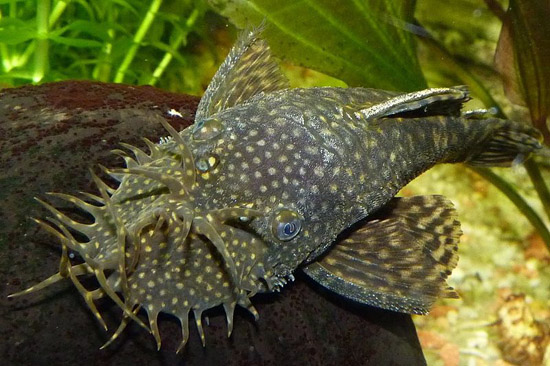
    bristlenose pleco
    Image by JanRehschuh on wikiMedia

    The Bristlenose Pleco, sometimes called the Bushy Nose Pleco, is a fantastic fish to add to fish tanks that are 30 gallons or larger. The Bristlenose Pleco is a fantastic algae eater which does not get incredibly large. It will grow to be roughly 6 inches in size but does a great job eating algae at every stage of life. If this pleco runs out of algae to eat, you will have to supplement it with algae wafers or other foods. The Bushy Nose Plecostomus has a unique feature to it. The males of this species grow a face full of whiskers. On the other hand, the females grow much smaller whiskers. It’s a unique but incredibly cool feature of this fish. You can find different variants of Bristlenose Pleco for sale in stores and online. You can find them in regular, albino, red and other varieties.

    3. Kuhli Loach

    The Kuhli Loach is a long “noodle like” fish that is very popular in the hobby. This fish species spends a lot of its time scavenging for food along substrate and is an excellent bottom feeder. A Kuhli Loach’s max size will be around 4-5 inches. This makes it perfect for aquariums that are 20 gallons or larger. They love to burrow so having sand in the aquarium is incredibly beneficial for them. Overall, they are a very peaceful fish and does well with other community fish like tetras, rasboras, and other fish. They can get territorial with other Kuhli Loaches so I would recommend adding 5 extra gallons of water for each additional loach.

    If you’re looking to remove pest snails, you will have to look at other loaches. Unlike other loach species, you will rarely see a Kuhli Loach eat snails. However, it is possible for these loaches to eat smaller species of shrimp. If you really want to keep shrimp with this loach, Amano Shrimp and other larger shrimp have a better chance of survival. If you’re looking for ways to remove pest snails, check out this guide, which shows different methods of controlling and removing nuisance snails.

    4. Clown Loach

    Clown Loaches are a fantastic bottom feeder, if you have the room to house it! Although it is a very slow grower, the Clown Loach size maxes at 1 foot! They require at least a 100 gallon fish tank once they are fully grown. If you can house one, I highly recommend it. They have very cool colorations and interesting personalities. This fish species will spend quite a bit of time foraging for leftover food and invertebrates in a fish tank. That’s right, the Clown Loach is an excellent invertebrate hunter. There is no snail or shrimp that is safe from this fish! If you have an infestation of snails, consider getting a Clown Loach or for smaller tanks, get a Yoyo Loach which is further down this list!

    5. Otocinclus

    Ottocinclus on driftwood

    Otocinclus are incredible bottom feeders that are an excellent addition to nano fish tanks. They do great in fish tanks that are 10 gallons or larger. Ottos love being in groups. I would keep a minimum of 6 in a fish tank but more is always recommended. Otocinclus eat brown algae as well as green algae. They’re fantastic fish to own and having a group of them adds a liveliness into the fish tank. The one drawback to this fish is that they can be very sensitive. They’re not known to be hardy fish and even in established fish tanks sometimes struggle. With that in mind, be cautious when adding Ottos into your fish tank.

    6. Yoyo Loach

    If you need a pest snail hunting fish, Yoyo Loaches might be what you’re looking for. This fish is an excellent invertebrate hunter and will take down snails and shrimp. Keep that in mind if you have snails and shrimp you want to keep in the tank. With their very interesting colorations and pattern work, a Yoyo Loach should be kept in fish tanks that are 30 gallon or larger. They will spend their days hunting inverts and consuming whatever food makes its way down to the substrate.

    7. Redtail Shark

    red tail shark swimming
    Image by Astellar87 on wikimedia

    Knowing that Redtail Sharks aren’t always the kindest fish in the fish tank, you have to admit that their colorations are beautiful! A lot of people miss out on keeping Redtails because of their temperament, which is understandable. This fish can take over the fish tank and pick on everything inside. If you’re lucky, they can be incredibly peaceful and keep to themselves. Redtail Sharks will definitely be more aggressive towards bottom dwelling fish. I would not recommend keeping them with Cory cats, Plecos, and most other bottom feeders. This fish can potentially pick on other fish even outside of their territory. Be vigilant when keeping Redtails.

    Redtail Sharks get to be 4 inches in length. This might not seem very big but their aggression can make up for it. If you are thinking of keeping this fish, I would suggest housing it in aquariums 55 gallons or larger. Also, provide it with plenty of plants, hiding places of varying sizes and other nooks and crannies it can hide in. Providing all of this may help in keeping the Redtail Shark’s aggression down a bit. You can find Redtail Sharks for sale at most pet stores and online!

    8. Clown Pleco

    The Clown Pleco is a unique species of bottom feeder. Along with algae and leftover food, much of the fish’s diet is driftwood! It’s a unique quirk, and you may even hear it munching on wood from outside the aquarium. A Clown Plecos size maxes at around 4 inches. It is great for fish tanks that are 20 gallons or larger. Some hobbyists do not keep Clown Plecos because of the amount of waste they produce due to their unique diet. If you’re interested in learning more about this fish, check out the Clown Pleco Complete Care Guide!

    9. Hillstream Loach

    I had to add the Hillstream Loach also known as the Reticulated Hillstream Loach into this list. Not as much for it’s ability to be an excellent bottom feeder but because its overall appearance. The Hillstream Loach has a very flat body which helps it stay put in fast flowing waters. In the wild it lives in fast moving, highly oxygenated and cooler waters. Your aquarium should mimic the appearance of a river, with strong filtration and possibly a powerhead/circulation pump to provide fast currents for this fish. Hillstream Loach care might limit what can be mixed with it. Regardless, this is a very fascinating and rewarding fish to keep in a fish tank!

    Final Notes

    There are many other bottom feeders that will do very well in a fish tank. I wanted to name off some of the best and unique that I have come across. If you have bottom dwelling fish that you love, let me know! I am always happy to learn more and spread the information along.

  • Clown Pleco – Complete Care Guide

    Clown Pleco – Complete Care Guide

    Clown Pleco Information

    The Clown Plecostomus is a freshwater fish that is often missed in this hobby. it is a gorgeously colored fish that is an excellent addition to an aquarium. This beautiful fish spends its time in a fish tank eating away at leftover food, algae and driftwood. Yes, this species of fish love and require driftwood in the fish tank. They munch on driftwood often, to the point that you can sometimes hear the crunching outside of the fish tank. It is great for smaller aquariums because a full grown Clown Pleco is only 4 inches. One thing to note, is that Clown Plecos will produce a lot of waste due to their unique diet. You may have to siphon and physically remove the waste from your aquariums.

    You can find the Clown Pleco for sale online and not as commonly in stores. This guide will go over the aquarium requirements, diet, tank mate compatibility and breeding habits of this fish species. All of this will help you provide proper Clown Pleco care.

    Aquarium Requirements

    Because of the Clown Pleco size in adulthood, it should do well in fish tanks that are 20 gallons or larger. This should provide it enough room to move around. A fish tank this large will help prevent water parameters from negatively spiking because of this fish’s ability to produce a lot of waste. A full grown Clown Pleco will be very happy in a 20 gallon aquarium as long as plenty of hiding spaces are available.

    Clown Plecos should do perfectly fine with live plants although it may nibble on plants if hungry. They normally focus on algae and driftwood for sources of food. Also, Clown Plecos are normally not known for jumping but still consider keeping a well fitted lid on your fish tank.

    Do Clown Plecos Need Driftwood?

    The answer to this question is yes. Clown Plecos do need to be able to chew on driftwood to provide them with additional nutrients and supplements not normally found in regular foods. Check out some driftwood on Amazon but really think of your aquarium’s size before finalizing a purchase! As a side note, certain driftwoods will leach tannins into your fish tank. It is recommended to boil your driftwood for about 30 minutes to help prevent this from happening.

    Water Parameters

    Like any other fish or aquatic invertebrate, having excellent and stable water parameters is one of the most important things to keep your pet happy and healthy. Clown Plecos are no different in this aspect. The following water parameters will help keep this fish comfortable and not stressed:

    • Temperature Range: 74-80°F
    • pH Range: 6.5 – 7.5
    • KH Range: 6-10

    Healthy water parameters for freshwater fish tanks do not really have a sweet spot. You will have to research information on fish species and determine parameters that the fish thrive in. Many fish are incompatible because of this.

    Clown Pleco Diet

    As stated before in this article, you will need driftwood for Clown Plecos which you can easily find on Amazon or many pet stores. A Clown Pleco’s diet will primarily consist of driftwood, algae, leftover fish food and algae wafers you provide. If there is no algae in the fish tank, supplementing your pleco with algae wafers is a must! If you Pleco goes on the glass, you can monitor how fed it is by observing the belly. Indented bellies are signs that your Plecos are starving.

    Clown Plecos like most other plecos primarily have a herbaceous diet. However, like any other fish, they are opportunists. If there is a chance to eat, they will take it. Clown Plecos will not actively hunt fish and freshwater inverts but if one is on its last legs or freshly dead, they will more than likely try to eat it.

    Tank Mates

    Clown Plecos are very peaceful fish. They will normally keep to themselves and not bother any fish swimming about. If there isn’t enough room, Clown Plecos will fight with others of the same species for territory. Otherwise they’re excellent for community tanks. They do great with fish such as:

    This list isn’t the full extent of what can be kept with Clown Plecos. They will do great with just about every species of Tetra, Livebearers, Rasboras, Gouramis and more. I would personally keep them away from more aggressive species of cichlids like Tiger Oscars, Jack Dempsey and others. They are also incompatible with fish like African Cichlids because of the differences in water parameters. Do some research before deciding what species of fish to add into a fish tank!

    Clown Pleco Breeding

    Breeding Clown Plecos is a little difficult. In order to do so, first you have to find a male and female to breed. Male Clown Plecos will have a few more bristles on its head compared to the female. If you are not purposely trying to breed them you can house a male/female pair together in a 30 gallon fish tank. Otherwise you would have to provide a breeding tank for these fish.

    Aquarium Setup

    In a normal aquarium setting, it will be important to provide this fish with a lot of driftwood and caves. Clown Plecos will more than likely lay their eggs in these caves. If you are using a breeding tank, you will have a similar setup. Furthermore, you will have to lower the water level in the fish tank roughly 30% to trigger a drought season. Once 30% of the water is removed, you will need to refill it with clean water to initiate a large rain event. If you do this there is a chance Clown Plecos will begin to breed.

    Feeding & Time

    I would recommend feeding your Clown Plecos a diet rich in nutrients after refilling the fish tank with clean water. This replicates an increase in nutrients & resources which are ideal breeding conditions. Otherwise, only time will tell whether this fish will breed and spawn. Males will guard the eggs until they are hatched which can take about a month.

    Final Notes

    Clown Plecos are a cool fish to add into a freshwater aquarium. If you are okay with the amount of waste they produce, they can be a fantastic talking point to visitors and viewers of the fish tank. They stay small so are excellent for smaller aquariums but still are great addons to larger fish tanks. If are interested in other great algae eaters for freshwater aquariums, check out this list!

    Image by Jarne Colman on wikiMedia

  • Roseline Shark – Complete Care Guide

    Roseline Shark – Complete Care Guide

    Roseline Shark Information

    The Roseline Shark or sometimes known as the Roseline Torpedo Shark, Roseline Barb, or Denison Barb is a gorgeous freshwater fish that falls under the barb family. This species has two variations, the regular Roseline Shark and its counterpart the Gold Roseline Shark. After doing a little digging, it seems the Gold Roseline Shark is a mutated form of the regular Roseline Shark. This freshwater fish species is fairly peaceful and loves to school with fish of the same species.

    You can find the Roseline Shark for sale online and less commonly at pet stores. On the other hand, at the time of this writing, you can rarely find the Gold Roseline Shark for sale both online and pet stores. Regardless, ask whether your local pet store can order them for you.

    Aquarium Requirements

    Just like any other fish out there, there are specific aquarium requirements to keep this species happy. To begin, the Denison Barb’s max size is about 4.5 inches. I would keep a small school of Denison Barbs in a fish tank that is 55 gallons or larger. This Torpedo Shark does very well in an aquarium with freshwater plants but they can nip at the plants. I would recommend hardy more resilient plants with Denison Barbs. Also, this species of fish appreciate high oxygen levels in aquariums because they are often seen in fast moving streams in the wild. Consider adding an air pump to your fish tank to provide extra oxygen. This shark shaped air pump from Amazon is an excellent choice.

    Keeping your water parameters up to par is probably one of the most important things in this fishkeeping hobby. It’s important to have stable parameters for the health of your freshwater fish. Roseline Sharks do best in the following water parameter ranges:

    • Temperature Range: 60-77° F
    • KH Range: 4-10,
    • pH Range: 6.8-7.8

    When water parameters are in check, Roseline Sharks are hardy fish. I would not recommend using them to cycle a fish tank. Lastly, The Roseline Barb fish is prone to jumping out of aquariums. It is important to keep a lid on your fish tank to help prevent this from happening. Regardless, they are a cool freshwater fish with a unique shape and coloration.

    Food & Diet

    This freshwater fish is omnivorous. Denison Barbs will happily take on both meaty foods and foods that are more fibrous, like algae wafers. Providing a mixture and balance of both will benefit this species of fish. I would highly recommend feeding this fish frozen food such as bloodworms & Mysis Shrimp and high quality flake/pellet food. I personally prefer feeding my fish frozen food over freeze dried food when dealing with bloodworms and Mysis Shrimp but everyone has their preferences.

    Roseline Shark Tank Mates

    Roseline Sharks are not fin nippers but they are highly competitive during feeding time so they may bully other fish. Also, this freshwater fish can become aggressive when it is in an aquarium that is too small or in a school that does not have enough fish. Otherwise, they will pick on each other from time to time but should not really bother other fish species. You can easily keep Denison Barbs with fish that are similar in size. I would not recommend aggressive cichlids but fish such as:

    Will do fantastic with Roseline Sharks. There are many other fish species that will work but these are some of the most common kept together. Fish being fish, they may take a chance at eating anything that will fit into their mouths. I personally would be weary about keeping small fish like Ember Tetras, Chili Rasbora, Neon Tetras and others with Roseline Torpedo Sharks.

    Roseline Shark Breeding

    Although Roseline Torpedo Sharks are successfully bred in commercial fisheries I could not find any concrete information on how to breed them successfully in an aquarium setting. Certain Zoos & Aquariums may have had luck but in a small fish tank enclosure it is incredibly hard to almost impossible to do. If you have any information on Roseline Shark breeding, please let us know!

    Final Notes

    This fish species is a gorgeous animal and an excellent choice for anyone looking for a large schooling fish. They dominate a fish tank and become a fantastic centerpiece. If you’re considering different freshwater fish, really consider the Roseline Shark. This is not a fish I would recommend if you’re very fresh to the hobby but it definitely is one I would recommend once some experience is gained.

    Photo by Anandarajkumar at wikimedia

  • 5 Unique Halloween Themed Freshwater Fish!

    5 Unique Halloween Themed Freshwater Fish!

    Halloween is just around the corner and it’s time to start thinking about Halloween themed fish tanks! If you love the spooky season, I know you’ll love setting up a fish tank filled with some oddball fish that fit the theme. Even if you’re not all of these are really cool fish that would look great in most aquariums. The following freshwater fish will get anyone’s head turning.

    Bleeding Heart Tetra (Hyphessobrycon erythrostigma)

    Bleeding Heart Tetra in Fish Tank
    Image by Citron on wikiMedia

    You can’t start off a Halloween themed fish list without Bleeding Heart Tetras. This species of fish is a faint pink and/or clear color with a dark pink patch where its heart is. This tetra fish is great for Halloween because of this pink patch. As the name suggest, it resembles a bleeding heart. Blood is a common decoration theme for Halloween. The Bleeding Heart Tetra Fish is a peaceful fish that is perfect for aquariums that are 10 gallon or larger. Take a look at their quick care guide here. This freshwater fish species has a similar shape to Serpae Tetras, Ember Tetra and Black Skirt Tetra. You can find the Bleeding Heart Tetra fish for sale fairly commonly online and in stores.

    Ghost Catfish (Kryptopterus bicirrhis)

    Glass Catfish in Aquarium
    Image by jacilluch on wikiMedia

    The Ghost Catfish, commonly knows as the Glass Catfish or Ghost Glass Catfish, is the next species of freshwater fish on our list. This fish species falls into the spooky theme because it is translucent and looks like a skeleton. If you look closely you can see through the Ghost Catfish. You can also see its vertebrae, just like you would on an actual skeleton! This skeleton fish can live up to 8 years under ideal fish tank conditions. Also, a full grown glass catfish will be about 4 inches long. It will require an aquarium that is 30 gallons or larger. You can find Glass Catfish for sale commonly online but a little more sparsely at fish stores.

    Albino Cory Catfish (Corydoras aeneus)

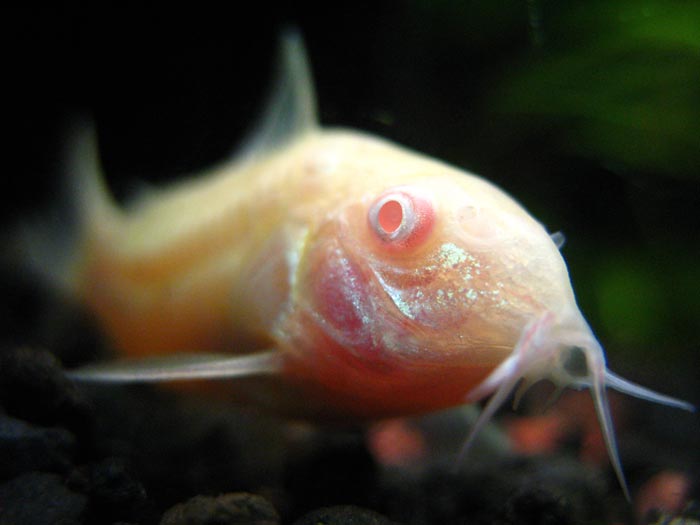
    Next, we have the Albino Corydoras Catfish. This bottom dwelling fish looks eerie with its very white/tan body and red eyes. It fits the spooky theme for a fish tank because it looks so creepy. Overall, they are incredibly peaceful fish and great additions to fish tanks larger than 30 gallons. It normally like to shoal (school) so having a small army of fish from the undead is ideal. Albino Cory size will reach about 2.5 inches when fully grown. You can easily feed Albino Cory Catfish bottom feeder tablets but they will also feed on any food that falls to the bottom of the fish tank.

    Painted Platy (Xiphophorus maculatus)

    The common colors for Halloween are orange and black. That is the main reason the Painted Platy falls onto this list. This species of freshwater fish is a beautiful orange and black color that will pop in any spooky themed fish tank. The Painted Platy fish will grow to be 2 inches in length so it is perfect for 10 gallon fish tanks or larger. They are generally peaceful fish and should be kept with other community fish.

    Painted Platy in fish tank
    Image by Ude on wikiMedia

    Beware, if you have male and female Painted Platy Fish, there is a strong possibility of them breeding like there is no tomorrow. Don’t let that stop you from picking up this black, orange sometimes yellow platy fish. You can find this platy for sale online and may spot them at pet stores.

    Glofish

    Glofish in blue fish tank

    Glofish are very cool fish. Their vibrant colors makes them perfect for a Halloween fish tank! Many people ask, “Do Glofish glow in the dark”? They do not, but you can throw on a blue light with these fish in your aquarium and your fish tank will pop with color! Glofish are not one species. You can find Glofish Danios, White Fin Tetras, and Tiger Barbs. The Danio and Tetra Glofish are peaceful but the Tiger Barb Glofish are not. Click on the following links if you’re interested in Glofish and setting up a Glofish specific tank. You can commonly find Glofish for sale both online and in stores!

    Additional Halloween Fish Tank Ideas

    There are many other things you can add to create a Halloween fish tank. Choose some spooky decorations such as a Skeleton sailor or skulls. You can also add artificial fish tank plants that are incredibly vibrant under blue lighting. Check out this link for plant ideas. The options are limitless for what you can do to create the perfect Halloween fish tank!

    Final Notes

    Themed fish tanks are a lot of fun because you really have to think outside of the box to make it look incredible. Luckily there are many different fish species that fit the theme as well. If themed fish tanks are not for you or you are unfamiliar with setting up aquariums, take a look at the guide that will help setup a simple freshwater fish tank!

  • African Butterflyfish – Complete Care Guide

    African Butterflyfish – Complete Care Guide

    African Butterflyfish Information

    The African Butterflyfish is an oddly shaped but very beautiful freshwater fish available in the aquarium keeping hobby. It is unique because it sits right under the water’s surface, resembles a butterfly/bird, and can actually glide a little if it jumps out of the aquarium. As a disclaimer, please do not allow this to happen! The African Butterfly grows to be about 5 inches so it does not get incredibly big but may try and eat anything that will fit into its mouth. This article will go over aquarium requirements, food & dietary needs, compatible tank mates and breeding habits of the African Butterfly Fish.

    Aquarium Requirements

    The African Butterfly Fish spends most of its time just under the water’s surface. An aquarium with slower water movement is best suited for this fish. This can be hard to achieve because filtration systems naturally create varying rates of water movement.

    Because of its adult size, an African Butterfly should not be kept in an aquarium smaller than 30 gallons. To keep more African Butterfly Fish, you should also consider providing even more space. Although they are usually mild tempered, they can get a little aggressive so providing plenty of space should deter most aggression.

    African Butterfly Fish are unfortunately excellent jumpers (and gliders). A well fitted lid is a must in the aquarium. Otherwise, this fish has a good chance of escaping. Furthermore, provide plants that reach close to the water surface. This will give this fish places to hide when startled or stressed.

    This species of fish is hardy regarding temperature but the pH in the aquarium will need fine tuning. The African Butterfly Fish does best in the following water parameters:

    • Temperature: 75°-86° F
    • pH: 6.5-7.5
    • KH: 1-10

    Luckily, the pH requirement is neither incredibly acidic or basic. It sits right around neutral which should be fairly easy to achieve. Be careful when using buffers to lower or raise pH. Overdosing certain buffers can cause your system to crash with a sudden drop or increase in pH levels. Stability in water is very important to keep your fish and system healthy!

    Food & Diet

    This species of fish is carnivorous. It waits right under the water’s surface for prey to come close or fall in the water and the prey quickly becomes a meal. However, the African Butterfly Fish food type provided by you, as a keeper, can vary. This fish species can eat bloodworms, brine shrimp, Mysis shrimp, Beef Heart and much more meaty foods found in pet stores. If you are feeling adventurous, you can step outside and catch flies and moths to feed your African Butterfly Fish. Be careful because foods caught outside can bring parasites, bacteria and diseases into your fish tank. It is really fun watching the African Butterfly eat.

    Tank Mates

    African Butterfly Fish’s tank mates should be both for the most part be larger in size and peaceful. This species of fish will try eating anything that will fit into its mouth. Smaller fish such as: tetras, rasboras and guppies are not recommended. Furthermore, hatchet fish use the same space as the African Butterfly Fish and also not recommended. I have heard success stories of keeping smaller species of fish with African Butterfly Fish, but it’s always a big risk to do so.

    African Butterfly Fish do great with larger and peaceful fish such as Severums, Angelfish, Rainbowfish, Denison Barbs and Blood Parrots. They will get harassed by aggressive cichlid species like Jack Dempseys, Tiger Oscars and so on. Be mindful of the species you add with this fish. Some may either be too aggressive, too small, or live in incompatible water parameters.

    Breeding

    You will need a few things to successfully breed African Butterfly Fish. You will of course need a male and female willing to breed. I would highly recommend adding Salvinia, which is a floating plant, in the aquarium that has the breeding adults. The eggs will more than likely float to the top of the aquarium and the plants will help protect them.

    The breeding African Butterfly Fish will need to go through a “natural” breeding season. We will recreate the breeding season in an aquarium setting. The two key factors to successfully breeding this fish species are water level changes and water temperature changes. The temperature should sit between 77° and 80

    The breeding African Butterfly Fish will need to go through a “natural” breeding season. We will recreate the breeding season in an aquarium setting. The two key factors to successfully breeding this fish species are water level changes and water temperature changes. The temperature should sit between 77° and 80° F. The more important thing to do is to lower the water level a few inches. Some aquarists lower the water level to where only a few inches are left. This will be impossible in an aquarium with other fish.

    Once water levels are lowered, wait a few days and you should see the fish breed. Increase water levels and if you’re lucky you will see your fish release eggs. I would recommend scooping the eggs up and putting them into their own containers. Otherwise, the adults will eat them. Once the eggs hatch, they must be consistently fed live baby brine shrimp until they are old enough to eat other foods.

    Final Notes

    African Butterfly Fish are very interesting and unique fish that are great additions to specific aquarium types. They have certain requirements that may not work well with all fish. Breeding is fairly easy for these fish but keeping the young alive may be a challenge. If you’re ever at a pet store, check out African Butterfly Fish. Also, take a look at Atparium for more information on fish, reptiles, crustaceans and more!

    Image by Vassil on WikiMedia

  • Elephant Nose – Complete Care Guide

    Elephant Nose – Complete Care Guide

    Elephant Nose Information

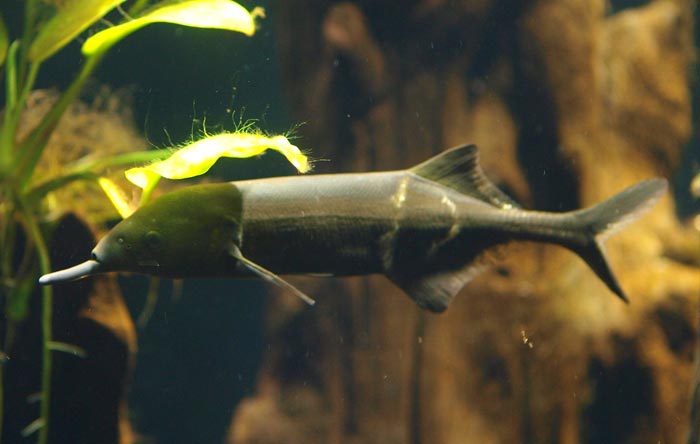
    The Elephant Nose is a very unique fish that is sometimes forgotten about in this hobby. It’s easy to skip out on a fish that doesn’t have flashy colors and hides a good portion of the day. However, you should really look passed that and check out this oddball! The Elephant Nose is an oddly shaped fish with a part of it’s body that looks like an elephant’s trunk. It uses this trunk to look for food, for self defense and communication. Furthermore, this fish releases very weak electrical signals (like sonar) to help find food.

    Be patient with the Elephant Nose because they are incredibly shy and reclusive animals. They will often dart and hide into caves to avoid contact with humans. Overtime and with a lot of patience it should get more comfortable with you. It will grow to be about 9 inches in length when fully grown but will still find ways to hide from you.

    Aquarium Requirements

    Elephant Nose does best in aquariums that are 50 gallons or larger. Because of their length as adults, I would personally keep them in nothing smaller than a 75 gallon aquarium. They do great in planted aquariums filled with rocks and wood where they can hide to get away from the commotion of the aquarium. Many hobbyists will purchase a clear plastic tube to mimic a cave. This gives the Elephant Nose cover but still allows you to view it. This species of fish also does best with fine gravel over large stones or sand.

    Like with many other fish, I would recommend providing a cover or lid for the aquarium because this fish can potentially jump out of the aquarium. That not the most common escape artist but there’s always a possibility.

    Although it has a fairly decent range of water parameters that it can be kept in, the Elephant Nose should be kept in the following ranges:

    • Water Temperatures between 73° and 80° Fahrenheit
    • pH Levels between 6.5 and 7.0
    • KH levels between 0 and 10

    At the end of the day water stability is probably one of the most important aspects of an aquarium. Be very mindful of how stable your water is.

    Food & Diet

    Elephant Nose are carnivorous fish. As a result, you should provide frozen food such as bloodworms and Mysis shrimp. Furthermore they will love eating cut up earthworms as well as pellet and flake food. Only give brine shrimp as an occasional treat because it is not very rich in nutrients. I would recommend providing a variety of foods to give Elephant Nose a broad spectrum of nutrients.

    Tank Mates

    The Elephant Nose does well with larger and peaceful fish. They will not do well with fish that are smaller such as Neon Tetras, Harlequin Rasboras, Ember Tetras and many others. They will do great with fish such as:

    • Denison Barbs
    • Angelfish
    • Blood Parrots
    • Rainbowfish
    • Black/White Skirt Tetras

    All these fish are larger so should not become a snack for the Elephant Nose. They are also peaceful and should not harass the Elephant Nose. There are many other fish that will do well with this species, I only named a few to give some ideas.

    The Elephant Nose is not recommended to be kept with other fish that give off electrical currents. Specifically, it is not recommended to keep multiple Elephant Nose fish or Ghost Knifes with this. The electrical currents that these fish release will cause stress to the others. The battling electrical currents will over time lower the fish’s health which will cause it to die.

    Breeding

    Breeding Elephant Nose is incredibly difficult if not impossible in an aquarium setting. The fish is highly aggressive to another fish of the same species. The dominant fish will pick on the weaker one until the weaker of the two dies. On top of that, it is practically impossible to distinguish whether an Elephant Nose is male or female.

    Final Notes

    The Elephant Nose is an incredibly unique fish that can be kept in the aquarium keeping hobby. It is an amazing talking point and anyone interested should really look into getting one. The interesting shape and colorations of this fish will keep you enjoying every moment of owning it.

    Image by OpenCage on wikiMedia

  • Rope Fish – Complete Care Guide

    Rope Fish – Complete Care Guide

    Rope Fish Information

    Rope Fish are a very unique species of fish in the aquarium hobby. This fish has similar characteristics to eels but are instead more closely related to Bichirs. This freshwater fish has a interesting feature. It will gulp fresh air from the water’s surface using its modified swim bladder. Furthermore, Rope Fish are very curious fish with fantastic personalities, that is when you get to see them. They are nocturnal and will more than likely be more commonly seen moving at night. In the wild, they use the cover of night to hunt their prey. Although they lack great eyesight, they still manage to hunt and take down prey such as insects, amphibians and crustaceans. This guide will go over the many characteristics and needs of Rope Fish. I will discuss aquarium requirements, food & diet, compatible tank mates, and breeding habits of the Rope Fish.

    Aquarium Requirements

    Although Rope Fish are not “beefy” animals, they still should be kept in aquariums that are 50 gallons or larger because what they lack in width they make up for in length. Rope Fish can reach lengths larger than a foot. Furthermore, they are social animals and ideally should be kept with other Rope Fish. Similar to eels, Rope Fish are amazing escape artists so it is highly recommended to keep a good lid on the aquarium. They could find some pretty small holes to jump through.

    Rope Fish love to dwell in aquariums that are heavily planted, with many nooks and crannies for it to hide in. Besides plants, branching and regular driftwood should be provided for this fish to give it varying spaces to hide. They love to move along the substrate so keep in mind that the substrate should be easy to traverse. The best would be fine gravel or sand for parts of the aquarium. Rope Fish are often found in slow moving waters in the wild, so your aquarium’s water flow should be very gentle to replicate that.

    Since your Rope Fish loves to dwell in aquariums with plants, your water parameters should reflect that. They will do best in the following parameters:

    • Temperature between 72° and 82° Fahrenheit
    • pH Levels between 6.0 and 7.5
    • KH levels between 8 and 22

    They have a fairly large range that will keep them happy. With many if not all fish, keeping stable water parameters is key to keeping your fish healthy.

    Food & Diet

    Rope Fish are carnivorous animals and should be fed foods rich in proteins. When they are smaller, foods such as bloodworms and tubiflex worms are great choices. Once the Rope Fish grows, foods such as worms, crickets, other insect larvae and beef heart are excellent sources of protein for the Rope Fish. Live foods are beneficial for this fish but frozen bloodworms and beef heart can be purchased at most pet stores. Remember to thoroughly thaw the food before feeding your Rope Fish.

    Tank Mates

    Rope Fish are very peaceful animals. However, like most fish, they are also opportunistic. With this in mind Rope Fish should not be kept with anything that can fit into their mouths. I would not recommend keeping them with fish such as Cory Cats, Neon Tetras and anything with that similar size. They will do great with fish such as:

    • Denizon Barbs
    • Angelfish
    • Severums
    • Blood Parrots
    • Rainbowfish

    These fish are larger in size so they will not be mistaken for food by the Rope Fish. They also are fairly peaceful for fish their size. I would not recommend keeping Rope Fish with larger and more aggressive fish like Red Devil Cichlids, Jack Dempsey Cichlids, and many others. Lookup different fish species here to find out what could potentially be compatible with Rope Fish.

    Breeding

    I personally do not have experience breeding Rope Fish in a home aquarium. I also know that doing so is incredibly hard. Just like many other fish, first you will need a male and female for breeding. Your aquarium should mimic the Rope Fish’s natural habitat as well as possible. Once that is setup and ready to go, slowly increase the temperature of your water to re-create the breeding season for this fish. Once waters are warmed, you may get lucky and see the Rope Fish breed. If you see any eggs laid around the aquarium, I would suggest removing them from the parent’s aquarium and putting them in their own to hatch.

    Final Notes

    Rope Fish are incredibly unique looking animals. They’re very gentle, peaceful, and charismatic fish that could be fantastic additions to a niche aquarium. Provide them with proper care and you may have an aquatic friend that can live 15+ years!

    Image by Trougnouf on wikiMedia

  • Black Ghost Knife – Complete Care Guide

    Black Ghost Knife – Complete Care Guide

    Black Ghost Knife Information

    The Black Ghost Knife fish is a very unique but incredibly interesting fish found in the hobby. Although it is a carnivorous animal, this gorgeous fish is more on the shy side, especially when first introduced into an aquarium. Once acclimated to the fish tank, it can become more active but that is subjective because this fish is nocturnal and is more active at night.

    Black Ghost Knives do not really have significant teeth, if any at all, but instead have a beak. They use this beak to grab prey and consume it. This tropical fish is not recommended to be kept by amateur fish keepers because of a few traits they possess.

    One very unique trait of the Black Ghost Knife is the way it commonly finds food. It has an organ that is electrically charged. Kind of like a sonar and it uses that to find food in the wild or in a fish tank. Also, they do not have scales and are more prone to becoming infected with disease and illnesses. Under ideal conditions this fish can grow to sizes well over a foot in length (approximately 18 inches). These are a few reasons this fish is not recommended for anyone just starting with fishkeeping. This guide will go into detail on keeping Black Ghost Knife fish.

    Aquarium Requirements

    Because of its size once it reaches adulthood, the Black Ghost Knife should be kept in an aquarium that is at least 150 gallons. Length in an aquarium is important but really consider the width as well, especially for this fish. It is long and skinny so providing it with a wide aquarium is ideal!

    As stated above, this animal is carnivorous. Its diet will consist of protein rich food. As a result, keeping this fish will require a good filtration system to help maintain proper water parameter levels. Luckily, it should not really bother plants in an aquarium and the plants can help a little with maintenance! Regardless, keeping up with water changes will help keep this fish healthy. It does best in water parameters with the following ranges:

    • Water Temperature: 73 – 82 degrees Fahrenheit
    • KH 0 – 10
    • pH 6.5 – 7.0

    The Black Ghost Knife fish is a pretty shy fish. It will hide in nooks and crannies within the aquarium for most of the day. I really recommend providing it with many different types of places to hide. Also, providing a lot of shade with plants will keep this fish happy because it prefers lower light. It will most definitely try to hide under driftwood, rocks or even wedge itself in-between plants. Fishkeepers can place an appropriately sized, clear plastic tube into the aquarium to view this fish during the day when it is hiding. Beware of sharp or jagged decorations. This fish is more prone to getting infections from scratches because it lacks scales!

    Food & Diet

    Being carnivores, you can easily assume the types of food this fish can eat. Foods such as bloodworms, brine shrimp, and flake food should work well for the Black Ghost Knife when it is small. Once it grows, foods such as squid, krill and earthworms are fantastic to feed this animal. Be mindful of the invertebrates you add into your aquarium with this fish around because they may become a snack!

    <script async src="https://pagead2.googlesyndication.com/pagead/js/adsbygoogle.js"></script>
    <ins class="adsbygoogle"
         style="display:block; text-align:center;"
         data-ad-layout="in-article"
         data-ad-format="fluid"
         data-ad-client="ca-pub-8588085402939015"
         data-ad-slot="5445868760"></ins>
    <script>
         (adsbygoogle = window.adsbygoogle || []).push({});
    </script>

    Tank Mates

    It is not recommended to keep incredibly small fish with Black Ghost Knife fish. Little fish may become a quick meal for this carnivore. On the other hand, overly aggressive fish and fish that nip and bite shouldn’t be kept with Black Ghost Knife fish. This species of Knife fish do best with peaceful fish that are larger than it. Black Ghost Knife fish are compatible with fish such as:

    • Peaceful Cichlids (Angelfish, Discus, Geophagus)
    • Cory Cats
    • Plecos
    • Clown Loaches

    Remember, if it can fit into the Ghost Knife’s mouth it can most certainly become dinner.

    I do not recommend keeping two Knife fish together. Whether that’s the Black Ghost Knife or other species. Mostly due to their large size when they’re full grown but they may also become aggressive towards one another. If you’re considering adding two into your fish tank, really make sure the aquarium is large enough.

    Breeding

    I will not dive into how to breed Black Ghost Knife fish because it is incredibly challenging. The hardest part of breeding is acquiring a mature mated pair. Also, if you’re interested in breeding this fish, know you’ll most likely need a large pond or a very large fish tank.

    Final Notes

    The Black Ghost Knife is a gorgeous fish and hopefully its unique requirements do not scare you away from keeping it. It is definitely a commitment and your aquarium’s design should revolve around it but its appearance and personality are definitely worth the challenge! If you have personal experiences with this fish or have your own advice, please share it in the comments below!

    Featured image by: Vassil on wikiMedia Commons

  • Chili Rasbora – Full Care Guide

    Chili Rasbora – Full Care Guide

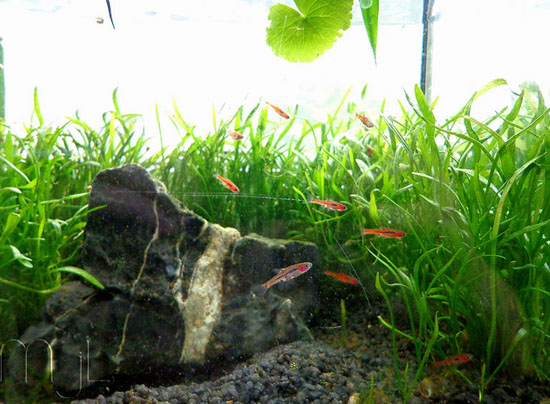
    The Chili Rasbora (Boraras brigittae), sometimes called the Mosquito Rasbora, is a incredibly small fish, with vibrant colors, that enjoy schooling in large groups. Originally found in Indonesia, it has swept through the aquarium hobby and is loved by many fish keepers. Primarily red and orange in color, this little fish strikingly pops in well planted aquariums. This guide will provide information on Chili Rasbora care and breeding habits.

    Fish Information

    Chilli Rasbora do not get larger than .8 inches (2 cm). It is the perfect fish for aquariums that are 5 gallons or larger. A school should contain 6 individual fish or more. 6 to 10 Chili Rasbora should do well in a 5 gallon fish tank. Although the Chili Rasbora remains incredibly small, its colorful body and habit of schooling create beautiful movement and liveliness in a densely planted aquarium.

    Like many other rasbora species, this one primarily spends its time in the middle and top of the aquarium. It will occasionally swim at the bottom of the fish tank.

    Aquarium Requirements

    The Chili Rasbora is a tropical fish that does well in a large temperature range. It can survive in water temperatures between 68 and 82 degrees Fahrenheit, but 75 and 78 degrees Fahrenheit is the ideal range where it will thrive. It enjoys KH levels between 3 and 12 dKH and lastly does great in acidic water that has pH levels ranging between 4.0 and 7.0.

    This species of fish suffers terribly in new aquariums so only add them into already well established fish tanks. Once introduced and settled, they are quite hardy.

    Because of its small size, keep this fish in slow moving waters. They will be thrown around the aquarium when caught in fast moving currents. Providing many live plants and great filtration is ideal for this fish.

    Food & Diet

    The Chili Rasbora is small and remains small its whole life. It is very important to feed it food that it will be able to fit into its mouth. There are many options to offer this fish to provide it with a varied diet. Flake food can be taken and crushed into powder which makes it small enough for this fish to consume. Micropellets can be fed with little problems because they are designed for tiny fish like Chili Rasbora. Also, feeding daphnia, brine shrimp, and cutting up bloodworms are fantastic options to give this fish a varied diet. Providing many different food options will keep this fish vibrant and healthy.

    Tank Mates

    Chili Rasbora are easily outcompeted for food. Take pre-caution when choosing tank mates. The Chili Rasbora do exceptionally well with other small and peaceful fish in the aquarium. Do not keep them with larger or more dominate fish such as:

    • Platys
    • Mollies
    • Swordtails
    • Betta Fish
    • Angelfish
    • Large Mouthed Fish (Cichlids, Goldfish)

    Keeping Chili Rasbora in larger fish tanks is more than possible. They will thrive with fantastic fish such as:

    • Tetras (ember, neon, cardinal, green neon)
    • Rasboras (harlequin, green kubotai)
    • Endler’s Livebearers
    • Guppies
    • Celestial Pearl Danios
    • Corycats
    • Dwarf Gouramis

    The amount of fish that can be kept in an aquarium are determined by the number of plants in the fish tank, filtration, and physical size of the aquarium. A densely planted aquarium will be able to keep more fish happy over a sparsely planted one. A stronger and better filter will go a long way in allowing you to keep more fish in the enclosure. Larger aquariums aid in keeping water parameters stable when a fish tank is heavily populated. Regardless, do not cram too many fish in a fish tank.

    Shrimp and snails should do perfectly fine with Chili Rasboras even in 5 gallon aquariums. In fish tanks this small it is important to closely monitor water parameters because they are more prone to swinging which can be detrimental to both fish and invertebrates.

    Breeding

    Chili Rasbora will openly breed and produce offspring in aquariums. The males may become a bit more territorial during breeding periods and will also deepen its red and black coloring. After successfully breeding a female will appear rounder than the male and not pregnant females.

    Eggs will be laid on plants and decorations and will not be cared for by either parent. The best chance for survival for the fry are in heavily planted aquariums. The plants will provide the much needed cover the fry will need to reach adulthood. The parents are sometimes observed to eat the fry once they hatch from their egg.

    Final Comments

    The Chili Rasbora is fantastic for aquariums both large and small but fill the micro aquarium niche very well for keepers that do not have the space or money to spend on large aquariums. Their vibrant colors stand out in aquariums so they will always be able to be observed. Check them out if you get a chance!

    Image by JoKrimmel on wikimedia

  • Beautiful, Jet Black – Red Tail Shark

    Beautiful, Jet Black – Red Tail Shark

    With all the different and unique freshwater fish to choose from, the red tail shark is sometimes overlooked. Regardless, this fish is remarkably beautiful and highly recommended for fish tanks that will tolerate its lively personality. The black body and red tail are always a sight to see because this color pattern is not very common in fish. The red tail shark has a nice long lifespan of 5 – 6 years.

    Aquarium Requirements & Fish Compatibility

    The red tail shark will be around 6″ in length when it is full size. Although they do not get incredibly large, a fish tank that is 50 gallons or more is highly recommended when it is fully grown due to its aggressive nature. It should be the only red tail shark in the fish tank because it becomes highly territorial. Having other bottom dwelling fish such as plecos, rainbow sharks, and cichlids is also not recommended due to this fish’s aggression. The red tail shark does well with fish such as:

    It is encouraged to provide a lot of places for this fish to hide. The fish tank should be full of decorations, driftwood, rocks, and plants (live or plastic) to help curb the previously mentioned aggression. Adding many decor breaks the line of sight for this fish which can help mellow it out. They love hiding in caves and crevices and will fight for the ability to do so.

    The red tail shark does very well in temperatures ranging from 72 to 78 degrees Fahrenheit, KH levels between 10 and 15 and pH levels ranging from 6.5 to 7.5. Due to its aggressive personality the red tail shark’s care level is little more challenging compared to peaceful community fish.

    Feeding

    The red tail shark is an omnivorous animal so it will consume just about anything offered to it including vegetables such as cucumber and zucchini. Please remember to thoroughly rinse the vegetables before placing them into a fish tank and do not keep the vegetables inside of the aquarium for long periods of time because doing so may cause an increase in phosphate and nitrate levels. Besides vegetables, the red tail shark will go around the aquarium consuming algae that grows on rocks, plants, and glass.

    Other foods that are commonly given to red tail sharks are flake food and frozen fish food. The flake food is meant to provide the nutrients a red tail shark would acquire from algae in the wild and the frozen bloodworms will provide the protein required for the red tail shark. Using these will help provide a well rounded diet for your shark. Other fish will also happily consume these foods! They are not limited to just these two types of food. Flake food can be substituted with pellet food and bloodworms can be substituted with brine shrimp or krill. Krill is normally given to larger red tail sharks.

    Breeding

    Breeding is an incredible challenge for red tail sharks in an aquarium setting. This is mainly because they are intolerable of one another in aquariums at home due to the aquarium’s size limitation and the fish’s territorial personality. Large aquariums may be able to keep more but it is still quite a challenge to get these fish to breed.

    The only physical difference between a male shark and a female is that when matured, the female red tail shark will have an larger abdomen compared to the male. Otherwise the male and female sharks are identical.

    Final Notes

    The red tail shark is a fantastic fish to keep in fish tanks where the other fish swim in the middle to upper parts. Although they are not normally advertised as algae eaters, the red tail shark will remove some algae from aquarium decorations. Adding a few snails to help will be beneficial. Overall, this is a fantastic fish with very unique colors that are great for planted and regular freshwater fish tanks!

    Image by Astellar87 on wikimedia

  • 5 Fantastic Freshwater Fish for 10 Gallon Aquarium

    5 Fantastic Freshwater Fish for 10 Gallon Aquarium

    Setting up a fish tank is a very fun and rewarding process. Making it your own work of art is definitely a long term endeavor. Deciding what fish to introduce into your aquarium is part of the process and probably the most exciting part of it all. This guide will help showcase some of the many freshwater fish that can happily reside in a 10 gallon aquarium. If you haven’t already setup a freshwater aquarium, check out this guide.

    Harlequin Rasbora

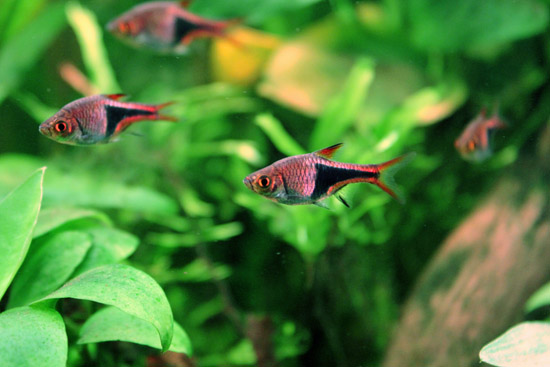
    To begin, I would like to introduce you to the harlequin rasbora, sometimes known as the t-bone rasbora. This rasbora has the iconic black pork chop shape displaying from the middle to the back of its body. Besides that, it has a beautiful copper/red toned body that stands out in an aquarium.

    This fish is small and will be around 2″ in size when it is fully grown. Due to its schooling habits, it is recommended to have around 8 – 10 beautiful rasboras in an aquarium together. They normally do a great job closely schooling together and will fill the middle to top of your aquarium with life!

    Male and females can be distinguished from one another by observing the bottom part of their “pork chop” pattern. The males will have a straight tip at the bottom and females will have a more rounded tip. Females will also be a little bit larger than the males. These fish will successfully breed inside of a well planted aquarium. They require broad leaved plants in order to do so. Plants like the Anubias are excellent option to have in the aquarium. If one or many are available, the rasbora will potentially lay eggs on the underside of the broad leaf.

    This species of fish are omnivorous. Providing a nicely ranged diet of pellet, flake, and frozen meat foods will keep this fish happy. They enjoy temperatures ranging from 72 – 78 degrees Fahrenheit, KH levels around 6 – 10, and pH levels in between 6.0 and 6.5. These fish are excellent choices for heavily planted aquariums.

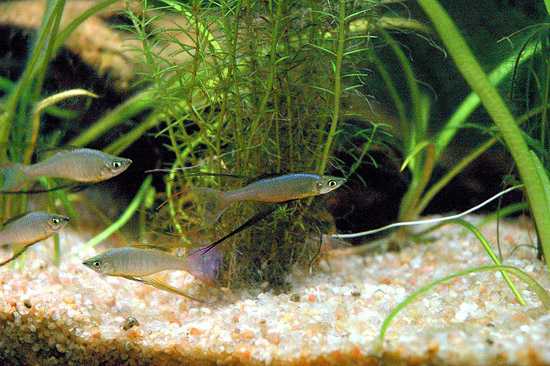
    Threadfin Rainbowfish

    Threadfin Rainbowfish may not be as common as the harlequin rasbora but regardless it is an interesting fish to add into a freshwater 10 gallon aquarium. Their colors aren’t as vibrant as fish like the neon tetra but they can get a beautiful blue, gray, red, and black coloration on them. Males will have long threadlike appendages that reach out from their anal and dorsal fins. If you think their colors are lacking, the fins and shape surely make up for it.

    This fish species maxes at 2″ in size and are perfect for a planted aquarium 10 gallons or larger. They enjoy being in schools and I would recommend 5 to 8 individuals in a 10 gallon aquarium. 5 in an aquarium that is fairly open without too many decorations and 8 in a heavily planted aquarium.

    Like stated before the males will have the long threadlike appendages protruding out of their dorsal and anal fins. The females will not. This is the easiest way to distinguish the two. Also, males will most likely be far more vibrant in color compared to the females. These fish have the possibility of laying eggs in an aquarium.

    Threadfin rainbows are omnivorous creatures and benefit from having a large range of food. Due to their small mouth sizes it is recommended to feed them smaller pellets and meaty food. Flake food will work as well! This species of fish do well in water temperatures ranging 72 – 78 degrees Fahrenheit, KH levels between 7 and 10 and pH levels between 6.0 – 7.2.

    Male Betta Fish

    Male betta fish are very common fish in the freshwater aquarium hobby. They are often kept in large bowls without filtration due to their ability to acquire their own oxygen. They can and should be kept in larger aquariums than a bowl to keep them even happier. The betta fish has a fantastic personality and interacts well with humans. You can’t take it out and play with it but they know when it’s dinner time and will swim up to the glass to greet you. They have many different colors and a wide variation in fin shapes. I will be broadly providing information about bettas here.

    Most betta species reach a max size of 2.5 inches. There may be a little variation dependent on their fin lengths. They should be the only betta kept in an enclosure. They may be kept with other fish but be sure the others will not nip at the betta’s fins and because the betta could nip at fish with long fins as well. Female bettas can be kept in an aquarium together but they do not have as pronounced fins.

    blue male betta fish

    Males and females should only be housed temporarily if they are breeding. The male will build a bubble nest and the female will lay her eggs in it. Once that occurs, the female should be removed. The male will tend to the eggs until they hatch. Once hatched very small food should be given to the newly hatched fry. Foods such as baby brine shrimp and crushed flakes should be provided.

    Betta fish are carnivorous fish. Their diets should consist mostly of protein rich foods such as bloodworms, brine shrimp, or protein heavy pellet food. Due to their diets the aquarium might see spikes in undesirable water parameters so testing the water should be a common occurrence. The betta fish also thrives in water temperatures between 75 and 80 degrees Fahrenheit, KH between 0 and 25, and pH levels ranging from 6.0 – 8.0.

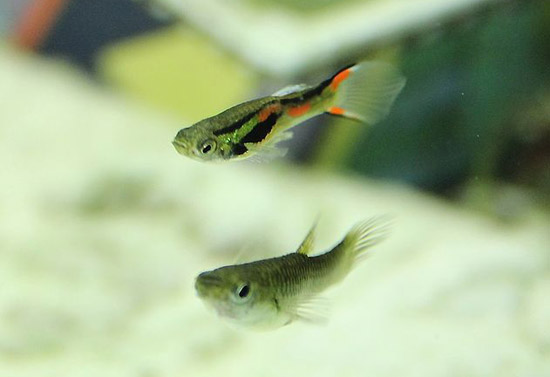
    Endler’s Livebearers

    Endler’s Livebearers continue to gain traction and popularity in the freshwater aquarium keeping hobby. Their vibrant assortment of colors make them a wonderful addition to any aquarium. They are fantastic to add if you are looking for lively fish for the middle to top of the aquarium.

    endler's livebearers in fish tank
    Image by Usien on Wikimedia

    These fish normally start off very small, usually purchased when they are less than an inch in length. They will grow to be roughly 2 inches in sizes when they are fully grown. Keeping around 6 – 8 in a 10 gallon fish tank is suitable with the understanding that this species of fish breeds like no tomorrow and 6 fish can easily turn into 20 then 50 and so on. Proper housing for the new offspring will be required.

    Endler’s livebearers are as their name suggests, live bearers. They do not lay eggs but instead their offspring come out of their womb very well and alive. Treat them like any other platy, guppy, or swordtail when for breeding purposes. They do not require anything special.

    This species of fish is omnivorous and would love a nice variety of foods. Like stated above, pellet, flake, and frozen meat foods will provide all the variety this fish needs to obtain its nutrients. Keep in mind they are usually sold very small so flake food might need to be crushed a little for them to enjoy it. They do best in water temperatures ranging from 75 – 80 degrees, KH levels ranging between 10 and 30, and pH levels with a wide range of 5.5 – 8.0.

    Cardinal Tetra

    Last but not least on this guide is the beautiful cardinal tetra. Do not mistaken this fish with the neon tetra. They look incredibly similar but the cardinal tetra’s red stripe runs from its eyes to tail and it lacks that white area near its stomach. This fish is more for expert fish keepers because they’re a little more finicky than other fish.

    cardinal tetra in planted tank
    Image by Elma on Wikimedia

    When they are full grown, cardinal tetras reach a size of 2 inches. They are perfect for densely planted aquariums of 10 gallons or larger. I would keep a school of 6 to 8 cardinal tetras in a 10 gallon aquarium. They are quite an active little fish and their vibrant colors add to their beauty.

    It is possible to breed cardinal tetras in an aquarium but it is not very common. They require very specific water parameters to successfully breed. Specifically dH levels between 1 and 2 and pH levels as low as 5 and 6.

    Just like many of the other fish in this list, cardinal tetras are omnivores and benefit from a range of food. Starting off with flake food is a good idea until this fish is able to consume larger pellets. Brine shrimp is always recommended as well as bloodworms! This is a fantastic fish with colors that can drop jaws!

    Final Thoughts

    This is just a small list of fish that will do well in 10 gallon aquariums. I wanted to choose fish with vibrant colors or very unique fin shapes and designs. Hopefully this list helps provide information needed to help choose some cool freshwater fish for 10 gallon fish tanks. If you already have the fish, check out information on low light freshwater plants you can add to your fish tank!

  • Freshwater Angelfish – Complete Care Guide

    Freshwater Angelfish – Complete Care Guide

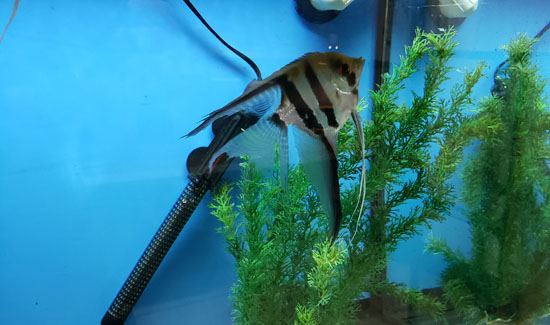
    Freshwater Angelfish, sometimes called tropical angelfish are quite a popular and common fish in the freshwater fishkeeping hobby. They become large and can be the centerpiece of many fish tanks. There is nothing like a mated pair of angelfish swimming side-by-side in a fish tank. They are part of the cichlid family but look a little different with their unique arrow shaped bodies. You can find Freshwater Angelfish for sale at most pet stores and online. This guide will help provide more information on freshwater angelfish and the proper care to keep these fish happy.

    Aquarium Requirements

    There are fish in the saltwater hobby that are also called Angelfish. They have a much different shape from this species and aren’t related. I wanted to point that out for newer fish keepers. Technically speaking, there are both freshwater and saltwater angelfish but these Angelfish live ONLY in freshwater.

    How Big do Angelfish Get?

    Due to its unique body size an Angelfish should be kept in an aquarium no smaller than 30 gallons but a 55-gallon tank is even better for their size. Taller aquariums are preferred because these fish can grow to be roughly 8″ tall and 6″ long. They need plenty of room to turn and maneuver and anything smaller just doesn’t cut it.
    Aquarium Decorations

    Angelfish love having driftwood in their enclosure which helps soften and acidify the water. These fish also love heavily planted aquariums with quite a bit of open space for them to swim. They have long, showy, and delicate fins so it is important to find a balance of open swimming space and decorations.

    Water Parameters

    Freshwater Angelfish are quite hardy and easy to care for. They can handle a nice range of water parameters. The following are ranges that Angelfish are typically kept in:

    • Temperature Range: 75-82° F
    • KH Range: KH 1-5
    • pH Range: pH 5.8-7.0

    These fish do best in waters that are little more acidic. That is partly why they do very well in planted aquariums. Make sure fish kept with angelfish have the same or similar water parameter requirements.

    Veil Angelfish Swimming

    What do Freshwater Angelfish Eat?

    The Angelfish is not a very picky eater but they should be given a variety of foods. They are omnivorous so providing both algae and meaty food will be very beneficial to them. Remember to adjust the food size appropriately depending on the size of the fish. Also, like many other fish, an angelfish will attempt to eat anything that will fit into its mouth. Be mindful of keeping small fish and shrimp with a full-grown angel because they can become a quick snack. Freshwater snails and larger fish should be perfectly fine around angelfish.

    Tank Mates for Angelfish

    Freshwater Angelfish types vary in color, shape, and size. There are Zebra Veil Angelfish, Blue Angelfish, Koi Angelfish, and much more. Each should do just fine with one another, it all depends on your preference in color.

    Angelfish are considered semi-aggressive but are a more peaceful cichlid species. They usually will become aggressive when fighting for territory and mates. As stated above, they have the potential of eating smaller fish and shrimp but do fine with larger fish. Other than that, they don’t usually bother with anything else. They do great with Discus fish, Parrotfish, larger tetras, Denison Barbs, and many other fish.

    When angelfish are small they are commonly kept in larger groups. Once they become larger and mature, they will begin to pair off from one another. It is important to identify a pair and house them together in their aquarium because once they decide to lay their eggs, the pair will bully and fight any other fish to protect the eggs. It is possible to purchase a pair directly from a store, or just have one or two angelfish in an aquarium together but once it is time for them to breed no more than 2 should be housed in a fish tank.

    How to Breed Freshwater Angelfish

    Angelfish are quite commonly bred in the aquarium hobby. They will lay quite a bit of eggs and will defend them with their lives! To breed angels, you first need a pair. Once they are paired up, it is important to provide a flat piece of decor for them to drop their eggs on. The piece can be something like a piece of slate. It should be placed in an area with moderate flow. The eggs require flow to help prevent fungus growth which can ruin the batch. If everything is suitable for the angelfish, the female will drop the eggs and they will adhere to the piece of slate, and the male will follow behind and fertilize the eggs.

    There are many opportunistic fish in the aquarium lurking and waiting. Once they spot eggs they may try and eat them. The angelfish will do their best to protect their brood. After hatching it is important to feed the fry baby brine shrimp until they can eat crushed flake food.

    Final Notes

    Angelfish are wonderful fish that are pretty easy to care for. A pair can be a gorgeous centerpiece for many large aquariums. Their long fins and gentle movement give them a majestic appearance. They are quite easy to breed and for a cichlid are pretty docile. There are many breeders out there with many different variations available such as the Veil Angelfish, Koi Angelfish, Marble Angelfish, and more! Check them out and consider picking up a pair of your favorite!

  • Wonders of GloFish

    Wonders of GloFish

    GloFish are genetically modified fish that have found their way into the aquarium hobby. The original goal was to modify the fish’s gene so its florescence sparks up when it comes in contact with pollutants in water systems. The fish ended up in the aquarium business and now GloFish can be purchased for your aquarium!

    Types of GloFish

    At the time of this writing, four different species of fish have a pronounced fluorescent gene: Zebra Danio, White skirt Tetra, Tiger Barb, and Red-Tailed Shark. These fish come in a variety of colors and can be found at most pet stores.

    GloFish can be added to a normal aquarium or be in their own “GloFish tank.” I think the effect of their florescence is much cooler in their fish tank. The brightly colored fish, decorations that glow under blue light, and black gravel are a great combination for a GloFish Setup. Keep in mind that research should be conducted on the requirements of each fish before purchase. For example, the Zebra Danio and White Skirt Tetra Glofish are peaceful and perfect for a community tank but the Tiger Barb and Red-Tailed Shark GloFish are considered semi-aggressive and should be in a larger aquarium with different types of fish that can handle aggression.

    GloFish Aquarium Setup Requirements

    For the most part GloFish aquariums can be setup like any old fish tank. They will need gravel, decorations, heaters, a filter and light. As mentioned before, if setting up a GloFish specific aquarium, it is recommended to have decorations that will glow under a blue light. They will add an “out of this world” feeling. LED lights that have a blue light setting are perfect for this type of aquarium build. The blue light is what will give the fish their glow. Other than the lighting and decorations, you would setup a GloFish tank like any other freshwater aquarium. Most keepers do not add live plants because they do not do well under blue lighting. For more information on how to setup a freshwater aquarium, check out this guide.

    Maintenance & Feeding

    GloFish are kept almost like any other fish. The main difference is the lighting that is used to enjoy them. Feeding should be just like any aquarium fish. They should be fed once or twice a day and should be given a variety of food such as pellet food, flakes, and frozen meats.

    Maintenance should also be similar to a normal aquarium. A gravel vacuum should be used to siphon the gravel and about 10% of the water should be replaced weekly to keep the water refreshed and to remove nitrates and phosphates. Having a freshwater test kit handy and testing the water will help guide you to proper aquarium care.

    Final Thoughts

    Every aquarium is unique and GloFish aquariums are a new branch of the hobby with a very quirky style to them. The fish themselves have been around for years and the company behind them keeps adding more fish species and colors for consumers to enjoy.

  • What’s The Deal with Danios?

    What’s The Deal with Danios?

    Danios are quite well known with experienced aquarium keepers but sometimes fall under the radar for newer aquarists. These fish are quite hardy and are excellent for new hobbyists. Although I do not recommend cycling a fish tank with just fish, many people turn to Danios to do just that. They’re cheap and like I said before, very hardy.

    Danio Information

    Many different types of danio can be kept in an aquarium. My personal favorites are the zebra danio and pearl danio. They maintain a smaller size but for being such a cheap fish have a little bit of color to them. Other types of danio that can be purchased are the large giant danio which should be kept in an aquarium with a minimum of 30 gallons, glowlight danio which stays quite small and does well in a 10-gallon aquarium, many longfin forms of a few of these fish, and lastly the GloFish variants of the zebra danio for anyone interested in GloFish. These fish enjoy being in groups of 5 or more so keep that in mind when purchasing them.

    Many hobbyists build aquariums for tranquility and calmness. The one downside to Danios is that they provide just the opposite. These fish are highly active and zip around the fish tank constantly. They have an endless supply of energy it seems. They love heavily planted aquariums that also have open spaces for them to swim through. For the most part, they do find in faster moving water as well as very still water.

    Longfin Zebra Danio by Marrabbio2 on wikimedia

    From experience, danios are quite aggressive eaters and will dart up to the water’s surface to grab food that is given to them. They are not picky eaters and will gladly eat bloodworms, flake food, or pellets. Giant Danios especially have quite an appetite.

    The water parameters range for each species but for the most part, they all range and do well in temperatures ranging 70 – 75 degrees Fahrenheit and pH levels ranging from 6.5 – 7.0. Some Danio species do quite well in temperatures as warm as 78 degrees Fahrenheit and pH as low as 6.0. Be sure to check what is right for the species you are interested in.

    Final Thoughts

    Danio fish are quite wonderful for new aquarium hobbyists and also fish keepers who are looking for movement in their aquarium. I prefer the smaller Danio species because they do not dominate the aquarium as much as the giant danio. These are peaceful fish and are perfect for a community aquarium but their active personalities and aggressive feeding behaviors may get in the way of other fish.

    Celestial Pearl Danio by Gedanken.welten on wikimedia

  • Some Information on Black Neon Tetras

    Some Information on Black Neon Tetras

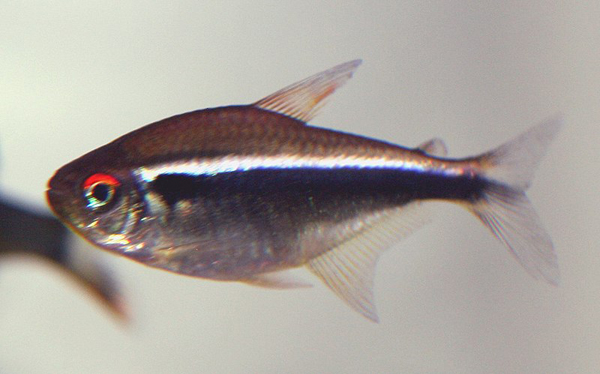
    Black neon tetras are usually overshadowed by the more well-known Neon Tetra. These fish should catch the eye of aquarium keepers though. They may not have that vibrant blue and red coloring but instead have a black and white bar running down their body which is quite remarkable itself. These fish look fantastic in a well-planted aquarium. If you’re ever browsing through a fish store be sure to check them out!

    Black Neon Tetra Requirements

    Black neon tetras are much more hardy than neon tetras. They are more resilient to changing water parameters such as increased levels of nitrates and pH, but remember that not providing stable parameters can lower the health or possibly kill any fish over time.

    These fish are quite easy to keep happy in an established aquarium. They are community fish and should be kept in a school of a minimum of six other black neon tetras. They have been seen schooling with other similarly shaped tetras so mixing may be a possibility. Black Neons max out at 1.5″ which is a little bit bigger than a neon tetra. They do well in an aquarium that is a minimum of 10 gallons.

    Image by Debivort on wikimedia

    The black neon tetra are not picky to food. They will happily eat flake food, pellets, and or frozen meaty food such bloodworms, brine shrimp, or Mysis Shrimp. They are omnivorous so providing a wide range of food is beneficial to their health. They will not eat live plants in an aquarium! Remember to only feed your fish enough so the food does not end up at the bottom of the aquarium. Uneaten food can become a big problem for an aquarium if left unchecked because it will raise the phosphate and nitrate levels.

    Black neon tetras are best kept in water that is between 72 and 77 degrees Fahrenheit. They also do perfectly well in water with a pH between 5.5 and 7.0. They have quite a large range of water conditions they can live in so they will do well with many other tropical fish.

    Final Thoughts

    Black neon tetras are a great addition to most community tanks. They are peaceful, and small, but have a unique color pattern to them. They are quite abundant in the hobby and can be found at most pet stores. These fish are quite inexpensive as well, usually costing between $1.49 and $1.99.

    Image by Juan R. Lascorz on wikimedia

  • Denison Barb – The Peaceful Barb

    Denison Barb – The Peaceful Barb

    With the large variety of fish that can inhabit a fish tank, it can become overwhelming trying to decide the right ones to put inside to inhabit the enclosure. Especially when hearing about barbs (more specifically) tiger barbs have a reputation for being brutes and aggressive in an aquarium. There are more barbs that are also aggressive but there are some that are nice and gentle. Specifically, the Denison Barb.

    Temperment & Size

    Denison barbs sometimes known as Rose Line sharks look like a dominating force inside of an aquarium but they are one of the most beautiful and gentle animals you can keep. It is of course not recommended to keep them with little fish like neon tetras or ember tetras because they will become lunch, but they’re perfectly welcome in a community aquarium filled with larger peaceful fish.

    Photo by Anandarajkumar at wikimedia

    These fish love to be in larger groups preferably 5 or more fish. Also, do not forget to keep a good lid on your aquarium because these fish are known to be jumpers! Because of their love for being in groups and active personalities, I would not recommend putting this fish in anything smaller than 50 gallons of water.

    The Denison Barb is different from your typical barb. This fish is far longer and more streamlined. They are normally found in fast-moving streams in the wild and appreciate higher oxygen levels in an aquarium. They also grow to be about 4 to 6 inches when they are full-grown.

    Feeding & Aquarium Requirements

    The Roseline Shark will happily take most foods and giving them a large variety of food only benefits them. They will gladly eat bloodworms, fish flakes, pellet food, and algae flakes/wafers/pellets. They are safe to keep with live plants and will not go out of their way to eat them! They’re omnivorous fish so giving them many options will keep them happy!

    They enjoy an enclosure with a pH between 6.8 – 7.8 and temperatures ranging from 60 – 77 degrees Fahrenheit. They should be right at home with other tropical fish because for the most part, their water parameter needs are quite similar. Overall, they are quite easy to care for as long as they are introduced into an established aquarium.

    Final Thoughts

    Denison barbs are incredibly active fish and are insanely beautiful with their gray black and red coloring. They will make any aquarium seem more vibrant and bring new life to the setup. Keep them in nice groups and feed them a variety of food and they should be happy for quite some time! 

    Photo by Anandarajkumar at wikimedia

  • Tiger Barb – Friend or foe?

    Tiger Barb – Friend or foe?

    Tiger barbs are quite a gorgeous little fish. They have beautiful vibrant black, orange, and tan coloration! This is the perfect Halloween-themed fish. They’re also a wonderful centerpiece for many other aquariums because of the dominating presence of swimming in large shoals. Unfortunately, caution must be taken when keeping tiger barbs because they are fin nippers. Male tiger barbs are the primary nippers because they constantly battle with one another to assert dominance. They are considered semi-aggressive fish which may limit which fish they can be mixed with. This guide will try and give some useful information on helping tiger barbs thrive as well as help the fin-nipping problem in your aquarium.

    Tiger Barb Requirements

    Tiger barbs can grow to a size of about 4 inches long. A 30-gallon aquarium is the minimum requirement to keep a tiger barb happy, but anything larger is always appreciated. Setting up a larger aquarium for them will allow them to fade into the background and not be the dominating aspect of the fish tank.

    Keep in mind that they are shoaling fish so they do best in groups of 6 or more. Anything smaller will cause them to be more aggressive than they already are. If they are in a large enough shoal they usually keep to themselves and do not bother fish of a different species.

    It is perfectly fine keeping these fish in temperatures around 76 – 78 degrees Fahrenheit which allows them to be mixed with most other tropical fish. They also do wonderfully in a planted aquarium and are a great addition to one because they like slightly acidic water. Also, having a heavily planted aquarium will help create barriers and hiding places for other fish if the tiger barbs start becoming a little nippy.

    These colorful fish are not very picky when it comes to eating! They are perfectly fine eating flake food, pellet food, blood worms, brine shrimp, and other foods that are introduced into the aquarium. They should normally be fed once a day.

    Photo by ToT89 on Wikimedia.

    Final Thoughts

    Although there are quite a few ways to alleviate a tiger barb’s fin-nipping habit still take precautions if you want to add them to a community tank. To reiterate what was said before: Do not add less than 6 tiger barbs into an aquarium, be sure they are fed, and try to load up your aquarium with decorations to provide barriers and hiding spots. Remember, these barbs are used to fighting for dominance, it is in their nature, so add more tiger barbs and let them keep to their species and pick on one another. These fish should do quite well in a semi-aggressive aquarium but can be problematic in a peaceful, community tank. They’re wonderful to have because of their vibrant colors and active nature but also can become troublesome for new and even knowledgeable aquarists if precautions aren’t taken.

    Photo by Faucon on wikimedia

  • Neon Tetras – The Schooling Fish

    Neon Tetras – The Schooling Fish

    Neon Tetras are probably one of the most well-known freshwater fish in the hobby. Their vibrant colors pop and stand out from the green background of a planted aquarium. They’re straightforward to acquire and on the cheaper end regarding cost. They’re gorgeous little fish that love to be in schools. This article will provide general information for Neon Tetras.

    Requirements

    Neon tetras are small and stay that way. They max out at a size of around 1.25″. They are perfectly comfortable in an aquarium of 10 or more gallons. Having a large school for them is a requirement. They do not do well alone. A minimum of six neon tetras are recommended but even more, are preferred! They are not picky eaters, but small food must be considered that will fit into their mouths. They will happily eat micro pellets, flake food, or bloodworms. They can live in waters with a temperature between 68° and 78° Fahrenheit but do best at temperatures between 76° and 78° Fahrenheit. These fish are very peaceful and will not bother other fish in an aquarium. Having a well-established aquarium will help these little aquatic animals thrive!

    Due to their smaller size and docile personality, these fish should be kept with other peaceful fish. It is not recommended at all to keep them with larger Cichlids, predatory fish, or aggressive fish. If they are, they will become a quick meal for the larger fish or be beaten up and pushed around by the aggressive fish. Other peaceful and smaller fish are the best neighbors for Neon Tetras.

    Photo by Tan Meng Yoe on wikimedia commons

    More Information

    After working at a pet store for many years I noticed that many people would like Neon Tetras to be the first fish in their aquarium. From experience, this is usually a death sentence for this fish. Neon tetras are not hardy at all. They’re not expensive so it’s an attractive choice for a first fish. Many hobbyists use the first fish in the aquarium to jump-start their nitrogen cycle.

    To quickly sum it up, a new aquarium cycles through three stages. An ammonia stage, a nitrite stage, and ends at the nitrate stage. Fish produce ammonia through their waste and it gets converted to nitrates by bacteria. At low levels, nitrates are less toxic to fish than ammonia and nitrites. The nitrogen cycle transitions through each stage which is very hard on neon tetras. Once, the aquarium runs through this cycle it is safer to introduce the neon tetras. There is plenty of fish that do much better through the cycle such as a smaller species of danio, red phantom tetra, Serpae Tetra, and many others. It is preferred to use a hardy fish for the nitrogen cycle.

    Final Thoughts

    Having a school of Neon Tetras weaving in-between plants, driftwood, and other decorations is a wonderful sight. They’re peaceful and easy to care for once in an established aquarium. Mixing them with other peaceful animals is wonderful and they will do well with shrimp and snails. If you’re looking for other blue colored fish for your fish tank, check out 11 Blue Freshwater Fish for Your Aquarium.

    Photo by H. Krisp on wikimedia commons

  • Betta Fish – Complete Care Guide

    Betta Fish – Complete Care Guide

    Betta Fish Information

    Betta fish, also known as the Siamese Fighting Fish, has been in the fish-keeping hobby for quite some time. They are colorful, beautiful, but highly territorial fish with outstanding personalities. They’re a great introductory fish for children and adults due to their ease of keeping. They do not require too much space, have gorgeous colors, and have wonderful personalities. They also have a nice long life of 3 – 5 years when living under healthy conditions. There are also so many more varieties of betta fish compared to 10-15 years ago. You can find betta fish for sale both online and in person. They are very common fish sold at pet stores.

    Betta fish may seem dull at a pet store but are very charismatic fish! They will recognize their owner and often swim up to the glass to greet you. With practice, they can even learn tricks. They’re wonderful animals and we will continue this article by going over different requirements for keeping betta fish.

    Aquarium Requirements

    There are a few misconceptions about a betta fish aquarium. People think bettas do perfectly fine living in a cup of water. That is not the case. Although they are fairly easy to care for they should be kept in something larger than a cup! Our recommendation to keep a betta happy and healthy is to keep it in an aquarium or fish bowl of 5 gallons or more. This will provide enough swimming space. I always recommend more space if you can provide it. Betta fish accessories and decorations can be used to provide your betta fish with a refuge when stressed.

    Betta fish do best with a filtration system in the fish tank. Usually, an aquarium with a hang on the back filter should suffice. If they are being kept in a round bowl, look into providing a sponge filter for their filtration. Check out 7 Best Hang On the Back Power Filters for Freshwater Aquariums to get an idea of great hang on the back filters for your betta.

    This beautiful fish will thrive with a large range of water parameters:

    • Temperature: 75° – 86° F
    • KH: 0 – 25
    • pH: 6.0 – 8.0

    Bettas are very versatile fish that thrive in a nice range of water parameters. It is important to provide good filtration and a heater to try and keep parameters as stable as possible. Stability in water is very important to keep fish alive. Help keep nitrates and phosphates down by adding live plants! There are many great starter plants for new fish keepers such as Anubias, crypts, and java fern. Check out 3 Easy To Care for Aquatic Plants for more information.

    Betta Food & Diet

    Betta fish aren’t very picky with food. Most importantly, monitor how much you feed your fish to prevent overfeeding. Extra food that falls to the bottom of your aquarium will break down and may cause spikes in nitrates and phosphates. Betta fish will happily eat flake food, pellet food, and an occasional treat of bloodworms and/or brine shrimp. Watching a betta eat their food is always the best part of keeping them.

    Tank Mates for a Betta Fish

    Most people know this but still needs to be mentioned. There should only be one male betta in an aquarium. Males will most likely fight until one dies. From experience, it is not wise to keep male and female bettas in a small enclosure unless they are breeding. On the other hand, although female bettas are not as vibrant and colorful, they should be able to coexist with one another in the same fish tank.

    blue and orange betta fish

    Betta fish should be ok with other peaceful such as tetras, rasboras, and cory cats in aquariums that are 20 gallons or larger. The fish that are kept with bettas should not have flashy colorations. Besides showing aggression towards other bettas and fish that look similar to it. I would also avoid keeping bettas with fish that are known to be fin nippers.

    Betta fish and snails should peacefully co-exist in an aquarium. Bettas may try to eat baby snails but larger ones should do well. They will spend their day cleaning algae off decorations, and glass, and munching on leftover food that may fall to the bottom of the aquarium. These invertebrates are perfect for aquariums with limited space.

    Keeping Betta fish and shrimp is a little risky. Bettas should do fine with larger shrimp, such as the Amano Shrimp. However, small shrimp such as Neocaridina may become a meal for your betta. It all comes down to the temperament of your betta.

    Betta Breeding

    Breeding betta fish in a freshwater aquarium is very possible but will still require quite a bit of work. First, you must set up two aquariums that will house the male in one and the female in the other. Give your fish time to settle into their new home for a few months. Once preparations to breed begin, a breeding tank should be set up with a divider installed to begin introducing the male and female. The fish tanks should be cycled before introducing the breeding pair.

    The breeding tank should be roughly 80 degrees Fahrenheit with a sponge filter installed and a handful of places for the bettas to hide. It is not recommended to add gravel because the eggs may be lost in the substrate.

    Feed foods that are very nutritious for a week or so before adding them into the breeding tank. The best foods are live bloodworms but you may be able to get away with frozen foods such as bloodworms and brine shrimp. At the same time start raising food for the baby bettas if breeding is successful. Live baby brine shrimp is recommended to feed betta fry.

    Prepping for the Act

    After that, it’s time to introduce the male and female into the breeding tank. Keep the divider in place and place the male on one side and the female on the other. Observe their interactions for a few days to make sure they are interested in one another. The male will show off his colorations and fins while the female will sort of look like she is bowing down. If there is interest, the male should begin building a bubble nest that may take a couple of days to complete.

    Turn off the filtration and remove the divider separating the two fish. Once together, the male will most likely show a little completely normal aggression. Observe their behavior and make sure the male isn’t seriously hurting the female. Once settled, they will swim under the nest and move very close to each other. The female will begin releasing eggs which will drop to the bottom of the aquarium. The male will pick the eggs from the bottom of the fish tank and place them into the bubbles.

    Once the female stops releasing eggs, it is recommended to remove her because the male will most likely begin attacking her. The male will care for the eggs until they hatch. Do not turn the filtration on because the betta babies will most likely get sucked into it. Once the fry begins swimming around in the fish tank, the male can be removed and it’s ok to begin feeding fry baby brine shrimp. It is recommended to feed the fry twice a day.

    Filtration can be turned back on around two weeks after the fry hatch but restrict the flow of the filter if possible. Once males begin fighting, separate the fighters and place each one in its own aquarium.

    Final Notes

    Overall, bettas are a great starter fish for anyone who is looking to dip their toes into the aquarium-keeping hobby. They are fairly easy to maintain and can live a nice long life and create a bond with their keeper. Their variety of shapes and sizes add to their already remarkable personalities! They have attitude but are great fish. Take a look at our article on setting up a very straightforward freshwater aquarium here.

  • Goldfish – Complete Care Guide

    Goldfish – Complete Care Guide

    Goldfish Information

    Carnival season always brings an influx of goldfish into the house. They’re a hot prize; as a kid, I have fallen victim to bringing one home. Not to say there is anything wrong with goldfish, but the care was not what I expected. Many believe a goldfish will do fine in any old fish bowl. Humans have done this for decades, but it’s not good for the goldfish and will cause headaches over time. Goldfish are messy and create lots of waste. They are also vibrant orange with great personalities and a thrill to keep as pets.

    To start, goldfish do not have a stomach to store food. What does not get digested pretty much comes out of the body as waste. This can cause problems in a small enclosure such as a fish bowl. The smaller the body of water the more prone it is to parameter changes, especially in a bowl that most likely does not have a filter. A pooping goldfish will increase the levels of ammonia, phosphates, nitrates, and other unwanted chemicals in a small enclosure.

    Goldfish can get fairly large and the idea that a fish will only grow to the size of its enclosure is just a myth. The truth is, a fish’s growth will be stunted, leading to stress, possible bodily deformities, and a shortened life span. A goldfish can grow larger than 12″ (30.48 cm).

    Goldfish Fish Tank Requirements

    When it is fairly small, starting a goldfish in a 20-gallon aquarium is alright, but be mindful that it will grow, and upgrading the aquarium will be necessary, eventually. Goldfish should have a good filtration system such as a canister filter but a larger hang-on-the-back filter may suffice. If you’re in the market for a hang-on-the-back filter check out 7 Best Hang On the Back Power Filters for Freshwater Aquariums. Luckily goldfish are perfectly happy at room temperature so a heater is likely, not necessary to keep them thriving. The water parameters needed for goldfish are:

    • Water Temperature 65°-75° F
    • KH: 4-20
    • pH: 6.5- 7.5

    Goldfish Food & Diet

    Goldfish are a species of carp and are omnivores that will try to eat just about anything that fits into their mouths. They also have the potential of eating plants in an aquarium. There are a few plant species that should survive being in an aquarium with goldfish, such as java fern due to its bitter-tasting leaves. Check out some easy-to-care-for plants, which will likely be fine with goldfish. Some goldfish will still do their best to destroy or uproot live plants in their enclosure. It’s great if you find plants that do well with goldfish, but if you cannot, plastic plants should suffice. They also love to spend a part of their day sifting through the gravel looking for leftover food or algae that may be building up down there. Lastly, goldfish should easily accept pellet and flake food.

    Large Goldfish

    Tank Mates for Goldfish

    Due to their aquarium requirements, slow movements, and ability to inhale many small fish, goldfish are rarely recommended to be kept with anything besides goldfish or koi. Besides eating smaller fish or getting picked on by more aggressive fish, goldfish also prefer being in cooler water, unlike many other tropical fish species. Koi are an exception because they both have similar aquarium requirements. You can easily find goldfish for sale online or in a pet store.

    Breeding Goldfish

    Goldfish can be a little harder to breed compared to fish such as livebearers. They need specific water parameters and an excellent diet before breeding. To help the goldfish begin breeding, gradually change its diet from pellet or flake food to a more meaty diet with brine shrimp and bloodworms. This mimics the start of spring which is their mating season.

    The next step is dependent on already existing water temperatures but the fish tank needs to gradually increase in water temperature. The end goal is to reach a water temperature between 68 and 74 degrees Fahrenheit. A gradual increase is important because quickly swinging temperatures can be dangerous for fish.

    To identify a female goldfish, look at her overall shape which should be smaller and rounder than males. Also, a female’s pectoral fins should be smaller and rounder than males. A male’s pectoral fins should normally be longer and pointier.

    Once mated, the female will most likely lay her eggs on something solid such as a rock or decoration. Do your best to provide different types of hard surfaces so your female goldfish has many options for where to lay her eggs.

    Final Notes

    Overall, goldfish are immensely hardy fish with great personalities. There are quite a few people that enjoy keeping them as pets as well as breeding them with other goldfish. They come in many different shapes and colors so there may be a goldfish out there for anyone! Take a look at ATParium, you can find guides and more information on fish, fish tanks, paludariums, and more!