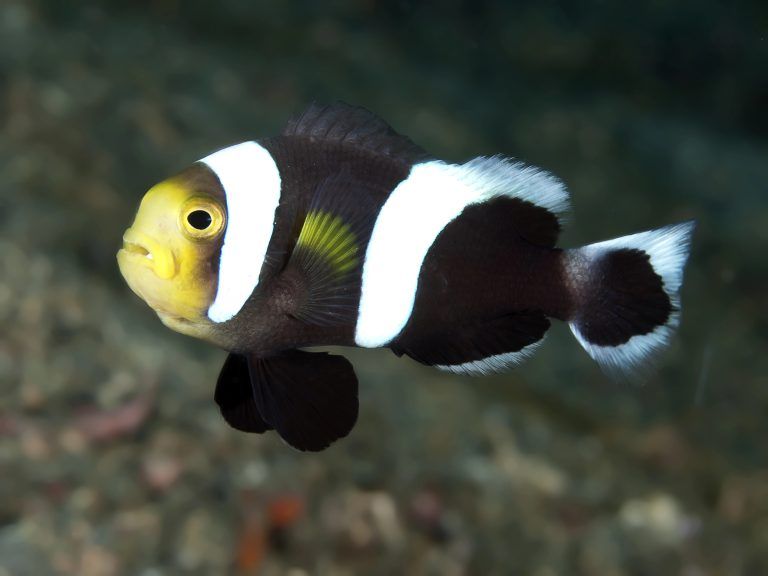

Skunk Clownfish are another species of anemonefish in the genus Amphiprion. You can find orange (Amphiprion sandaracinos), pink (Amphiprion perideraion), and a few other species for sale. Skunk Clownfish have a white stripe that goes along their back. This line resembles the white stripe on a skunk. This species reminds me of a naked Ocellaris Clownfish, because they don’t have the exotic colorations and pattern work that Ocellaris Clownfish have due to selective breeding, but have the orange tone Ocellaris Clownfish normally have. Although they’re not as colorful, they are still excellent options for a reef tank.
These Clownfish grow to about four inches. They do not get as large as Clarkii Clownfish, but will get about the same size as Ocellaris Clowns. Many fishkeepers claim Skunk Clownfish are a little more docile compared to other Clownfish. This makes them really great options for community fish tanks. It also makes them a great choice if you are afraid of getting nipped and bitten by Clownfish. This article will discuss the aquarium requirements, dietary needs, and much more of the Skunk Clownfish.
Aquarium Requirements
As stated earlier, Skunk Clownfish grow to about four inches at their maximum. This makes them great options for aquariums that are 30 gallons or larger. A pair should be easily kept in a 30-gallon fish tank. Larger aquariums provide more water volume, which usually brings more stability in water parameters. Skunk Clowns do not require an anemone in a fish tank, but it’s a bonus to watch them exhibit natural behaviors while being hosted by an anemone. If no anemone is present, you’ll see them hover around live rock, or they may find a coral to use in place of the anemone. Live rock is recommended for Skunk Clownfish for cover and filtration. I also recommend providing a lid for your aquarium because I have seen my fair share of Clownfish jump out of open-top aquariums.
Are Skunk Clownfish Reef Safe?
Generally speaking, yes, the Skunk Clownfish are reef compatible. They should not bother coral or invertebrates in your aquarium. However, like other Clownfish species, they may pester coral if they choose it as a host. They won’t go out of their way to damage coral, but they may stress corals that are not used to a fish using them for protection.
Water Parameters
Skunk Clownfish (Amphiprion perideraion) thrive in stable, well-maintained marine environments that closely replicate their natural reef habitat. To ensure their health and well-being, key water parameters should be carefully monitored and maintained. The ideal pH range for Skunk Clownfish is between 8.1 and 8.4. The carbonate hardness (dKH) of 8 to 12 should be maintained to support proper biological functions and buffer stability. Salinity levels should be kept between 1.020 and 1.025 specific gravity. Additionally, maintaining a consistent temperature between 72°F and 78°F is crucial to prevent stress and support a healthy immune system. Regular testing and gradual adjustments are recommended to keep these parameters within optimal ranges. For reading salinity levels in your aquarium, consider looking at “Different Salinity Reading Tools for Saltwater Fish Tanks” to learn about some of the different tools available to keep track of your aquarium’s salinity.
Food & Diet
Skunk Clownfish are quite hardy and readily accept most foods offered. They’re omnivorous, so providing them a range and variety of foods is important. I have had no issues feeding this species pellet food, flake food, and frozen foods. If your Clownfish is a new tank mate, it may take it a day or two to get comfortable enough to accept food. Once settled, the fish should start eating without issue.
Tank Mates
Compatible tank mates include small, non-aggressive fish such as Anthias, Blennies, Dartfish, Gobies, Jawfish, and Dragonets, which tend to occupy different areas of the fish tank. More robust but still compatible species like Damsels, Dwarf Angels, Tangs, and Wrasses can also be good companions. Additionally, Foxfaces and Hawkfish are generally well-suited for cohabitation with Skunk Clownfish. Certain species of Pufferfish may also work well in an aquarium with Clownfish. A large enough aquarium and plenty of hiding spaces will often deter a lot of aggression from fish. Clownfish are known to protect their anemone to the best of their ability. They will chase all types of fish away to keep their space safe.
Large and more aggressive fish are not recommended to be kept with Skunk Clownfish. These fish include Triggers, Eels, Groupers, Sharks, to name a few. I would be very wary of adding other Clownfish species or more than two Clownfish into an aquarium together. Keeping pairs is usually the best option. You may see aggression between the two until one asserts dominance. Clownfish females become larger than males to give you an indication of who is the dominant of the pair.
Anemones For Skunk Clownfish
Your Skunk Clownfish may or may not choose to be hosted by an anemone. It’s more challenging to get captive-bred fish to perform this behavior, but it is not impossible. Some are more inclined to do so, and some will require some patience and tricks to get them to possibly get into an anemone. Regardless of the challenge, I still recommend purchasing captive-bred Clownfish instead of wild-caught. The following anemones are excellent options for Skunk Clownfish: Long Tentacle Anemone (Macrodactyla doreensis), Ritteri Sea Anemone (Heteractis magnifica), Leathery Sea Anemone (Heteractis crispa), Giant Carpet Anemone (Stichodactyla gigantea), and Bubble Tip Anemones (Entacmaea quadricolor). There are many Clownfish and anemone compatibility charts out there. Fish Lore has a fantastic list of Clownfish and Anemone species that are compatible with one another.
Breeding
I have not bred Skunk Clownfish. However, from the bit of research I have conducted on the topic, they are more challenging to breed than Ocellaris Clownfish. Regardless, it is very possible to breed them in captivity.
Final Notes
Skunk Clownfish are hardy, but semi-aggressive marine fish that make an excellent choice for both beginner and experienced aquarists. With proper attention to water quality, a stable and appropriately sized tank, and a compatible mix of tank mates, these vibrant fish can thrive and display their natural behaviors. Their relatively easy care requirements make them a rewarding addition to any saltwater aquarium. By providing a stress-free, well-maintained environment, hobbyists can enjoy the beauty and personality of Skunk Clownfish for many years. There is an additional thrill if you choose to add an anemone into their enclosure that they pick as their home. Not many things are more enjoyable in this hobby than watching Clownfish swim in, out, and around an anemone.
Thanks for clicking this tab, this is planned for a future feature of this website!