Category: Freshwater Fish

  • 12 Yellow Tropical Fish for a Freshwater Aquarium

    12 Yellow Tropical Fish for a Freshwater Aquarium

    A splash of bright color can bring any aquarium to life, and few choices are as eye-catching as yellow freshwater aquarium fish. From subtle golden hues to bold contrasts like yellow and black freshwater fish, these species are a favorite among aquarists for their beauty and lively presence. Whether you’re looking for vibrant blue and yellow tropical fish or want to highlight the natural glow of fish that are yellow, there are plenty of options that thrive in a home tank. Adding a yellow fish in aquarium setups not only enhances visual appeal but can also create a stunning contrast against plants, driftwood, and other tank mates, making them an excellent choice for beginners and seasoned hobbyists alike.

    These fish are fantastic options for freshwater aquariums. Be advised that not all of these fish are compatible with one another. It’s important to do research on each fish and learning about their compatibility with other fish before purchasing. Also, consider taking a look at my other article, 10 Red Tropical Fish for Your Freshwater Fish Tank, for more unique fish coloration options.

    1. Gold Barb

    The Gold Barb is an excellent choice as a yellow freshwater aquarium fish. That’s because it combines beauty, hardiness, and peaceful behavior. Its shimmering golden-yellow body adds a striking pop of color. This is especially true when kept in small schools where their group swimming creates an impressive display. Gold Barbs are hardy and adaptable, and tolerate a wide range of water conditions. This makes them ideal for both beginners and experienced aquarists. They are also peaceful community fish that coexist well with other non-aggressive species. Their vibrant appearance and easy care make Gold Barbs great choices for freshwater aquariums.

    2. Marigold Swordtail

    Marigold swordtails are a fantastic choice for a freshwater aquarium because of their striking golden-yellow coloration. They are also accented by bright orange tones that make them stand out beautifully in community tanks. Their active swimming behavior and elegant sword-like tail add visual appeal. This makes them a centerpiece fish that are not usually overly aggressive. They’re also hardy, adaptable to a wide range of water parameters, and generally easy to care for. This makes them suitable for both beginners and experienced aquarists. Another advantage is their livebearing nature, which can be fascinating to observe for hobbyists interested in breeding and raising fry.

    There are a few downsides to keeping Marigold Swordtails. Males can sometimes display territorial or aggressive behavior, especially if there are too many in a confined space. A good male-to-female ratio is important to maintain harmony in the aquarium. Being livebearers, Swordtails tend to breed rapidly, which can become an annoyance. This is because the population in the tank may quickly outgrow the available space. Additionally, they require ample swimming room and benefit from a well-filtered tank. They may not be the best fit for very small aquariums. Despite these considerations, with proper care and planning, Marigold Swordtails are a lively, colorful, and rewarding addition to a freshwater setup.

    3. Yellow Lab Cichlid

    Yellow Lab Cichlids are among the most popular African cichlids thanks to their vivid, solid yellow coloration. Their bright lemon color brings a splash of contrast to freshwater aquariums, especially in rocky aquascapes that mimic their natural Lake Malawi habitat. Yellow Labs are hardy and long-lived when properly cared for. This makes them a good choice for hobbyists who want a showy yet manageable African cichlid.

    Unlike many of their more aggressive cousins, Yellow Labs can coexist fairly well with other Mbuna cichlids, provided the tank has enough space and hiding spots. Their strong personality and engaging behavior also make them fascinating to watch. If you’re looking for the ultimate splash of yellow, consider setting up a species-only Yellow Lab Cichlid aquarium.

    On the downside, Yellow Lab Cichlids still share some of the territorial tendencies common to cichlids. Males, in particular, may chase or harass others, especially in smaller aquariums. They also require harder, alkaline water that mimics Lake Malawi conditions, so they may not thrive in softer or acidic water without adjustments.

    Their diet needs to be carefully managed as well, since too much protein-rich food can lead to digestive issues like Malawi bloat. Finally, they generally require larger tanks (ideally 55 gallons or more for a small group). This will help reduce aggression and provide enough swimming and territory space. With proper care and setup, though, Yellow Lab Cichlids are one of the most rewarding and visually stunning yellow fish species available for freshwater aquariums.

    4. Gold Nugget Plecostomus

    Gold Nugget Plecos are highly prized freshwater aquarium fish. This is thanks to their striking black bodies covered in bright golden-yellow spots and edged fins. Their unique coloration and armored body make them an instant centerpiece in any tank. This is especially true in aquascapes with driftwood and caves, where they can show off their natural beauty.

    This fish species also serves a functional role. Golden Nugget Plecos help control algae growth while scavenging uneaten food, contributing to tank cleanliness. They’re generally peaceful bottom-dwellers. This makes them suitable companions for a variety of tankmates as long as water quality and space are maintained. For aquarists who enjoy unique and rare species, they’re considered a true “show fish” that adds both beauty and function.

    On the downside, Gold Nugget Plecos do come with challenges. They can grow quite large (up to 8–10 inches), which means they require a spacious aquarium, ideally 55 gallons or more, to thrive. They’re also more sensitive than many pleco species, needing excellent filtration, high oxygen levels, and stable water conditions to stay healthy. Their diet must include more than just algae. They need supplemental foods such as sinking wafers, blanched vegetables, and occasional protein to avoid malnutrition.

    Another consideration is cost. Gold Nugget Plecos are often expensive compared to many other plecos, and their specialized care makes them less suitable for beginners. Despite these drawbacks, for aquarists willing to meet their needs, Gold Nugget Plecos are a stunning and rewarding investment that can become a true highlight of a freshwater setup.

    5. Pineapple Platy

    Pineapple Platies are a vibrant and hardy freshwater fish, named for their fiery yellow-to-reddish-orange gradient that resembles the colors of a ripe pineapple. They’re small, peaceful, and active, making them excellent additions to community aquariums with other non-aggressive fish. Their manageable size (about 2–3 inches) and adaptability to a wide range of water conditions make them beginner-friendly while still being appreciated by experienced aquarists. Like other platies, they’re livebearers, which means they reproduce easily. This is something many aquarists find exciting. Their bright colors, energetic swimming, and ease of care all combine to make Pineapple Platies a cheerful, low-maintenance highlight in freshwater setups.

    The downsides, however, are worth considering. Similarily to Marigold Swordtails, Pineapple Platies breed incredibly easily. This can make overpopulation a problem in smaller tanks if fry aren’t managed or rehomed. Males may occasionally chase females excessively if there isn’t a proper ratio of females to males. This can stress the females over time. A ratio of 3 females to 1 male is recommended. However, more females means more breeding, which is a double-edged sword with these fish.

    While hardy, they still require good water quality and a balanced diet to maintain their color vibrancy and health. They also aren’t as long-lived as some other species. Pineapple Platies typically live 2–3 years, so hobbyists looking for a longer-term companion might find them relatively short-lived. Still, with their brilliant pineapple coloration, peaceful nature, and easy care requirements, Pineapple Platies are a fantastic choice for aquarists who want a splash of tropical color without a lot of fuss.

    6. Gold Doubloon Molly

    Gold Doubloon Mollies are striking yellow and black freshwater fish that instantly stand out with their bold two-tone coloration. They usually showcase a vibrant golden-yellow front half fading into a deep black back half. This contrast makes them a true showpiece in community aquariums, and like other mollies, they’re hardy, adaptable, and beginner-friendly.

    They thrive in a variety of freshwater setups, tolerate a wide range of water conditions, and are peaceful enough to be kept with many other community species. Their livebearing nature can be fun for hobbyists who enjoy breeding. Also, their constant activity and light schooling behavior bring lively energy to the aquarium. The combination of beauty, hardiness, and personality makes Gold Doubloon Mollies a very rewarding option for yellow fish in a freshwater aquarium.

    On the downside, mollies, including the Gold Doubloon variety, come with some challenges. They are sensitive to poor water quality and benefit from slightly brackish conditions (a touch of aquarium salt), which not all community fish can tolerate. Like other livebearers, they breed rapidly, so population control can become an issue if you don’t separate sexes or manage fry. Males may also occasionally harass females if the male-to-female ratio is off, so keeping multiple females per male is recommended.

    Additionally, mollies are prone to diseases such as ich or fin rot if stressed. While generally hardy, they do require attentive care and a stable environment to truly thrive. For aquarists willing to meet their needs, Gold Doubloon Mollies offer an eye-catching mix of color and activity that can really elevate a freshwater tank.

    7. Gold Dojo Loach

    Gold Dojo Loaches, also called Weather Loaches, are fascinating freshwater fish with long, eel-like bodies and a beautiful golden-yellow coloration that makes them stand out in aquariums. They’re known for their quirky, playful behavior. They’ll often burrow into substrate, wriggling around decor, and even swim up to the surface for air thanks to their ability to breathe atmospheric oxygen.

    Many aquarists love them because they’re interactive and seem to have personalities. They may recognize you and become active at feeding time. They’re also hardy, adaptable to a wide range of water conditions, and long-lived (sometimes over 10 years with proper care). Their unique appearance and behavior make them both a conversation starter and a useful addition to tanks, as they help clean up leftover food on the substrate.

    On the downside, Gold Dojo Loaches are not ideal for every aquarium. They grow fairly large, often reaching 8–12 inches in length. This means they require a spacious tank, ideally 55 gallons or more, with a soft substrate that allows them to burrow without injury. They’re also quite active, which means small tanks can stress them and lead to stunted growth. Because they’re opportunistic eaters, very small tankmates (like baby shrimp or fry) may get eaten.

    Another quirk is that they can be escape artists, sometimes jumping out of tanks without secure lids. Finally, they prefer cooler water than many tropical species (around 65–75°F), so they’re not always compatible with standard tropical community setups. Despite these challenges, Gold Dojo Loaches are hardy, fun, and rewarding fish for aquarists who can meet their space and temperature needs. Be advised that Dojo Loaches/Weather Loaches are considered invasive in many parts of the United States. It is illegal to keep them in certain locations.

    8. Golden Wonder Killifish

    Golden Wonder Killifish are gorgeous freshwater fish known for their shimmering golden-yellow bodies paired with iridescent blue and red highlights. They’re surface-dwelling fish with an elegant, elongated shape and large, expressive eyes that give them a lot of personality. Their striking appearance makes them an eye-catching addition to community aquariums, especially since they tend to stay near the top where many other species don’t occupy. Golden Wonders are hardy, adaptable to a range of water conditions, and relatively undemanding in terms of care, making them accessible to both beginners and experienced aquarists. They also display fascinating hunting behavior where they hover near the surface and dart for food with precision.

    On the downside, Golden Wonder Killifish have some traits that require consideration. They are predatory by nature and will happily eat small tank mates such as Neon Tetras, shrimp, or fry. They’re best kept with medium to larger community fish. They’re also excellent jumpers, which means a tight-fitting lid is a must to prevent escapes.

    While generally peaceful, males can sometimes be territorial, especially in smaller tanks or when competing for females. They also prefer calm or moderately filtered tanks rather than strong currents, so their setup needs to be considered carefully. With proper tankmates and a secure environment, though, Golden Wonder Killifish are hardy, striking, and unique fish that add brilliance and activity to the top levels of an aquarium.

    9. Albino Silver Hatchet

    Another top dwelling aquarium fish is the Albino Silver Hatchetfish. They are a striking and unusual freshwater species, instantly recognizable by their unique hatchet-shaped bodies. They also showcase shimmering white-silver coloration with a subtle pinkish hue from their albino genetics. Their body shape and tendency to occupy the very top of the water column make them fascinating fish to observe. This is true when they’re in groups where they display their dynamic behavior.

    They’re peaceful and generally get along well in community aquariums with other small, non-aggressive fish. This makes them an excellent choice for aquarists who want activity in the upper levels of their tank. Their unusual look, rarity compared to standard silver hatchetfish, and schooling nature make them a real conversation piece and a way to add variety to an aquarium.

    On the downside, Albino Silver Hatchetfish can be more delicate than many other community species. They’re highly prone to jumping, often leaping out of tanks when startled, so a tightly fitting lid is essential. They also require excellent water quality, a calm environment, and plenty of swimming space near the surface, which makes them less forgiving for beginners.

    Albino Hatchetfish need appropriately sized foods (like baby brine shrimp, daphnia, or crushed flakes) because of their small mouths. They may not compete well against more aggressive feeders. They’re also best kept in groups of six or more, which means a larger tank is necessary to keep them comfortable and reduce stress. Despite these challenges, Albino Silver Hatchetfish are a rewarding and visually stunning addition to a peaceful, well-maintained community aquarium.

    10. Sunset Guppy

    Sunset Guppies are a vibrant and popular variety of guppy, named for their gradient coloration that often shifts from bright yellow and orange to deeper red tones. This resembles a glowing sunset. They’re small, peaceful, and incredibly active, making them a lively centerpiece in community aquariums. They adapt well to a wide range of freshwater conditions, making them perfect for both beginners and experienced aquarists. Guppies, including the Sunset variety, are also prolific livebearers, so hobbyists can easily breed them and enjoy the excitement of raising fry. Their dazzling colors, playful personalities, and ease of care make Sunset Guppies one of the most rewarding and accessible fish for aquariums of all sizes.

    The downsides mostly revolve around their breeding habits and fragility. Since they reproduce rapidly, tanks can become overcrowded if fry aren’t managed or rehomed. Males may also pester females relentlessly, so keeping more females than males is necessary to reduce stress. While generally hardy, guppies can be vulnerable to common freshwater diseases like fin rot and ich, particularly if kept in poor water conditions or overcrowded tanks. They also have relatively short lifespans (often 2–3 years), which can be disappointing for aquarists looking for long-term pets. Despite these challenges, Sunset Guppies bring unmatched color, activity, and charm to community tanks, making them a staple choice for aquarists who love vibrant, easy-to-keep fish.

    11. Yellow Honey Gourami

    Yellow Honey Gouramis are peaceful, elegant freshwater fish that shine with their soft golden-yellow coloration. Unlike many gourami species, they stay relatively small (about 2 inches), making them ideal for smaller community aquariums or as centerpiece fish in nano setups. Their calm temperament, gentle swimming style, and tendency to explore plants and decorations make them soothing to watch. They’re also labyrinth fish, meaning they can breathe atmospheric air, so you’ll often see them rise to the surface in a charming, deliberate way. Their bright yellow hue, paired with their peaceful nature, makes them a perfect choice for aquarists looking for a splash of warm color without aggression.

    On the downside, Yellow Honey Gouramis can be a little shy, especially when first introduced to a tank, and they may get bullied by more boisterous or fin-nipping species. While hardy overall, they do require stable, clean water conditions and can be sensitive to sudden parameter changes. Males, though less aggressive than many other gouramis, may still show territorial behavior during breeding.

    Because they’re small and somewhat delicate, they’re best housed with gentle tank mates rather than larger or fast-moving species that might outcompete them for food. Despite these considerations, Yellow Honey Gouramis are an excellent, beginner-friendly fish that bring color, tranquility, and personality to a freshwater community tank.

    12. Yellow Marlboro Discus

    Yellow Marlboro Discus are among the most striking and prized freshwater fish, especially for aquarists who love centerpiece species. Their bold, solid golden-yellow coloration contrasted with a red-orange face makes them truly stand out, even in tanks with other colorful fish. They have a graceful, disc-shaped body and a slow, elegant swimming style that gives aquariums a calm and majestic presence. Discus are also highly social and thrive in groups. They create a dynamic yet peaceful display when kept in a proper school. For aquarists with some experience, Yellow Marlboro Discus are the ultimate show fish.

    On the downside, they are considered one of the more demanding freshwater fish to keep. Discus require very clean, warm water (82–86°F), stable parameters. Low nitrate levels are also needed to thrive, making them less suitable for beginners. They are sensitive to stress and can be prone to disease if water quality drops. Because they prefer to live in groups of at least five or six, they need a spacious tank (75 gallons or larger). This increases the cost and level of care required.

    Their specialized diet, often including high-quality frozen or live foods, also makes feeding more involved than with hardier community species. Lastly, Yellow Marlboro Discus are expensive compared to most freshwater fish, both to purchase and to maintain. Despite these challenges, for aquarists ready to meet their needs, they are one of the most rewarding and breathtaking fish available in the hobby.

    Final Notes

    Yellow tropical fish bring a unique vibrancy and warmth to freshwater aquariums, acting as living rays of sunshine that immediately draw the eye. Whether it’s the bold, regal presence of a Yellow Marlboro Discus, the energetic playfulness of a Sunset Guppy, or the tranquil grace of a Yellow Honey Gourami, these golden-toned species add both beauty and character to a tank.

    Beyond their colors, yellow fish often fill different roles in the aquarium. Some are centerpiece fish while others are active schoolers, and hardworking bottom-dwellers. This makes them versatile choices for aquarists of all experience levels. While some yellow tropical fish are hardy and beginner-friendly, others require more advanced care, stable water conditions, and specialized setups. This means aquarists can find a yellow species suited to nearly any skill level. Altogether, yellow fish provide not just visual appeal but also variety, personality, and even functionality, making them an enduring favorite in the aquarium hobby.

  • How To Set up Aquarium For Betta Fish

    How To Set up Aquarium For Betta Fish

    Betta Fish are gorgeous, colorful freshwater fish that are filled with incredible personalities. These fish don’t belong in tiny vases or in a cold, dark room. They should be kept in warm and filtered water with space to stretch their fins and swim around. This article will discuss the equipment and supplies I recommend to set up an aquarium for Betta Fish.

    I always encourage fishkeepers to go to their local fish store to purchase supplies. Many small and local fish stores have a great selection of plants, driftwood, fish, and, best of all, knowledge. Many do their best to provide great information to care for their animals. Unfortunately, shopping in a store is not always possible, so online shopping is the next best thing. I have curated a list of equipment and supplies you can purchase online to set up an aquarium for Betta Fish.

    Affiliate Link Disclaimer

    This page contains links to affiliate products. Click on this box to learn more.

    List Of Equipment and Supplies

    There’s a lot that goes into an aquarium, and it could get a little intimidating for first-time aquarists. I’ll try to make this setup guide as straightforward as possible. All the equipment and supplies I recommend for keeping a Betta Fish will be listed. It’ll be a beginner-friendly fish tank and will utilize live plants that are easy to care for. An explanation will be provided for why I recommend equipment and supplies. The following is what you’ll need to get your fish tank up and running before even thinking of adding a fish.

    The following are supplies, decorations, and other items I highly recommend to help increase your chance of keeping a successfully running fish tank. These items include things to monitor your water parameters and to make tank maintenance a little easier.

    You can pick and choose what equipment you’ll need, but these are my highly suggested items. If there is a brand you prefer using, by all means, use that brand. I am sharing what has worked well for me. I also recommend always buying from your local fish store if possible. They work hard to keep this hobby available to us. If you do not have a mom-and-pop fish store near you, then consider picking up equipment and supplies online. I will always appreciate your support if you click and purchase items from the affiliate links provided.

    Aquarium, Aquarium Stand, Lid, & Background

    Technically speaking, Betta Fish can be kept in a minimum of 5 gallons of water. However, more space for a fish is always recommended. I suggest keeping a Betta in at least 10 gallons of water. They move a lot more than you might think, and larger water volumes often mean more stable water parameters. For this setup, we will be using the Aqueon 10-gallon fish tank. I have used Aqueon fish tanks all my life. They are sturdy and have a track record of being great aquariums (at least for me).

    Many aquariums can be purchased with a stand. The important thing when putting a fish tank on a stand, table, or other furniture is knowing the limitations of what you’re putting it on. The water volume of a 10-gallon fish tank will weigh at least 80 lbs, and not all furniture is built to hold that kind of weight.

    For example, you can put the fish tank on a dresser, just make sure the dresser can hold the weight, won’t sag over time due to the weight, and won’t warp and transform if you accidentally spill water on it. If you’re questioning the weight and durability of the furniture you plan on using, it’s probably a good idea not to use it. Damage from an aquarium blowout can be expensive, so it’s not worth risking it.

    Aquarium lids and backgrounds are pretty straightforward. Betta Fish can jump out of an aquarium, so a lid is recommended. Aqueon has glass lids made to fit their frame, but you can also make or purchase a custom lid. Floating plants are sometimes used instead of lids, but it’s not guaranteed they’ll stop a fish from jumping out. I make very simple backgrounds with black paper purchased from a dollar store. I simply cut it to size and tape it to the back. It’s easily replaceable if it gets wet, and it is negligible in cost. However, use whatever background makes you happy.

    Aquarium Filter

    For a Betta Fish aquarium, especially for one that will be set up with aquarium plants, I recommend a sponge filter. There are a few reasons for this. Betta Fish have nice flowy fins that can theoretically get sucked into the intake of a hang-on back or canister filter. A sponge filter removes that possibility almost entirely. Sponge filters move air through a tube. That’s literally all they do. So a Betta cannot get sucked into one. You can learn a few things about sponge filters by checking out Sponge Filter Use, Cleaning, and Extra Tips.

    Downside to Sponge Filters

    There are a few downsides to a sponge filter (in my opinion). The first being that they only provide biological filtration. Bacteria will populate the sponge, which is fantastic, but that’s all it’ll do. There is no mechanical or chemical filtration. Regardless, bacteria are really important in keeping your nitrogen cycle in check, so it’s fantastic that bacteria colonize the surface area of a sponge. Luckily for this setup, plants and water changes should fill the gap of not having mechanical or chemical filtration.

    The other downside is the size. I personally don’t like how much space a sponge filter uses in an aquarium. I prefer a small tube of a hang-on back filter over a sponge that takes up space. For the sake of a Betta, I’ll look passed it and use a sponge filter.

    Aquarium Heater

    Heaters are the pieces of equipment that are likely to malfunction in an aquarium. When you mix a device that produces a lot of heat at short intervals, it’s bound to happen. Regardless, they are often a necessary aspect of fish keeping. My go-to heaters are the Fluval M-Series Heaters and the Aqueon Pro Heaters. These have treated me well in the past, but I understand that everyone has a different story with the quality of heaters, and what has worked for me may not be the same for someone else. You can learn about some of my favorite heaters by reading 6 Best Aquarium Heaters for Freshwater & Saltwater Fish Tanks.

    Aquarium Light & Power Strip

    Since we are growing plants in this enclosure, it will need a light that can help plants grow. Luckily, we will be sticking to beginner-friendly plants that won’t require high-intensity lighting. For an aquarium like this, a budget-friendly NICREW 20″ SkyLED light might do the trick. If you’re looking for something on the higher end, with more versatility and customization, consider the FZONE LED Aquarium Light. This light has an app that allows you to customize colors and intensities, which really lets you nerd out with your fish tank.

    This aquarium will have at least three pieces of equipment that consume electricity. I suggest getting a good power strip for it. I listed the Amazon Basics Power Strip above. They are generally reliable and rated quite high in quality. You might have a good power strip lying around your house that’ll work for this setup. When running electrical cords and wires around aquariums, remember to set them up with a drip loop to prevent water from reaching the outlet.

    Substrate

    Sandy substrate or gravel is what I recommend for most aquariums, especially ones with plants growing in them. I provided CaribSea Eco-Complete Black Gravel as a suggestion, but most brands will work. The black gravel should make your fish and plants pop in color compared to lighter gravels that reflect color and wash out the surroundings. If you’re a beginner aquarist, gravel may be the better choice. Gravel does a better job of anchoring plants in place. Sand is just a little harder to work with when putting in plants.

    I have gone a very cheap route and set up an aquarium with pool filter sand. You can get a 50 lb bag of HTH Pool Filter Sand for roughly 15$, which is quite cheap compared to other substrates. Not all sands are made the same. Certain ones have high levels of silicates and are not as clean. Play sand is a great example of this, and I would not use that for an aquarium. If you decide to use pool filter sand, thoroughly rinse the sand before adding it to an aquarium. Otherwise, it may take a long time for your aquarium to clear up.

    Live Plants & Driftwood

    Aquarium plants chosen for this setup will be easy to care for. Most of these don’t require anything besides fish waste and decent lighting to prosper. I have an article devoted to beginner-friendly aquarium plants, it’s called 10 Best Aquarium Plants For Beginners. For this fish tank, I’d use Anubias, Crypts, Java Fern, Salvinia minima, and a species of moss to grow on driftwood.

    Betta Fish love to rest on or under leaves, which makes Anubias and Java Fern a perfect option. Crypts grow fairly quickly and often form large bunches, which is great for filling up space. Salvinia minima is a floating plant that is great at soaking up nutrients and also provides a barrier between the surface and water. This will hopefully lower the risk of your Betta jumping out of an aquarium. The moss is self-explanatory; glue it or tie it to a piece of driftwood and watch it grow. There are many plant options; choose which catches your eye, but look into the plant’s needs before purchasing.

    Most driftwood found in a fish store should be good to go. The only precaution I would advise is to be careful about sharper-edged pieces of driftwood. It’s unlikely, but the sharp edges can snag a Betta’s fin and damage them. Driftwood also has a strong possibility of releasing tannins into the water. They aren’t dangerous and instead are beneficial to a fish tank. The downside to tannins is that they change your aquarium into a brown, tea color.

    API Freshwater Master Test Kit & Water Conditioner

    A freshwater test kit will be a necessity for your brand-new aquarium. Your fish tank will go through the nitrogen cycle. The cycle essentially creates a “safe” habitat for your fish. The cycle typically progresses through an ammonia stage, a nitrite stage, and concludes with a nitrate stage. Nitrite-producing bacteria consume ammonia, and nitrite-consuming bacteria produce nitrates. Ammonia and nitrites are toxic to fish. Nitrates can also be dangerous to fish at high levels. This is why it’s important to have a test kit on hand to make sure you’re not adding fish into an aquarium actively going through the nitrogen cycle.

    After your fish tank is cycled, the solution to removing nitrates is simply water changes. Usually, a 10-20% water change will help lower nitrates. I do not recommend doing 100% water changes, and do not take everything out of your fish tank to “clean it”. This will more than likely crash your fish tank’s bacterial colony, completely crashing your aquarium. The only thing you’ll likely need to take out of the fish tank when cleaning is the sponge. Either when it gets gunked up or is falling apart. Gunked-up sponges can be rinsed through old aquarium water, or some people suggest simply running them through the tap for a quick rinse.

    Many of us live in cities with municipal water. The water from this kind of tap water likely has chlorines and chloramines, which are good for us but bad for fish. A water conditioner is designed to remove harmful chemicals like chlorine and chloramine. SeaChem Prime is generally easy to use and will help us achieve the goal of removing chlorine and chloramine from the water. Use a water conditioner every time you add water to your fish tank.

    Fish Net & Fish Food

    Fish nets and fish food are self-explanatory. The net will be used to put the fish into the aquarium or to remove it, if needed. Your Betta will need to be fed, and that’s where the fish food comes in. Having a variety of food is important to give your fish a range of nutrition. I recommend a combination of flake food, bloodworms, Fluval Bug Bites, or any combination that fits your style.

    Gravel Vacuum & Buckets

    A few other things that are fairly straightforward are the gravel vacuum and buckets. I suggest getting at least two buckets. One to remove water and one to add clean water. The gravel vacuum will be used to conduct water changes. The end of the gravel vacuum will sift gunk out of the substrate and remove it from the aquarium.

    Putting it all Together

    So we have all our supplies. It’s time to put it all together. If you have an aquarium stand for your fish tank, put it where you think it should go. I suggest keeping your aquarium away from doors that lead to the outside and windows. Drafts from open doors in the winter aren’t good for the temperature stability of a fish tank, and an aquarium near a window sounds like an algae nightmare waiting to happen.

    Even though it’s only a 10-gallon aquarium, it could do some damage if it springs a leak or is defective. Some people might suggest filling the aquarium up with only water and having it sit for a day or two to see if it is defective. I usually do this with larger aquariums, and I haven’t done it with small aquariums. A leak can happen at any moment, and from what I have seen, it’s more common in larger fish tanks. If you’re testing your fish tank, consider doing it somewhere outside, in a garage, or somewhere where floor damage is not possible.

    Decorations & Equipment Setup

    Once the stand and aquarium are in place, I usually start adding the rinsed (if rinsing is applicable) substrate. While this is happening, I am simultaneously thinking about how I plan on decorating the aquarium. I don’t bother putting on the lights and lid yet because that will likely get moved around while decorating.

    You can connect your sponge filter to the airline tube and check valve, and put it in its place. You can connect it to the air pump and test to see if it works. Put the heater into its permanent location, but do not turn it on until you have water in the fish tank. You’re asking for trouble if you plug your heater in with no water.

    Add your other decorations, such as driftwood and rocks. Do this after adding enough water to saturate the substrate, and begin adding your plants. I recommend placing taller plants, such as Java Fern and Crypts in the back and shorter plants in the front. If you purchased floating plants, don’t add them until the aquarium is filled with water.

    Wrap it all up

    Finish filling the fish tank up with water, if you haven’t done so, dial your heater to the temperature you want it set at and turn it on. Place your thermometer, and add water conditioner into the aquarium. Now you can place your lid (if you have one) and light on top.

    If you have an older and more established fish tank, you can add filter media from that fish tank into the new one to help jump-start the nitrogen cycle. It could cut the cycle down by weeks, so you can hopefully add your betta sooner. If you don’t have an older aquarium, I usually sprinkle some food into the fish tank to give bacteria something to feed on. This is the start of your nitrogen cycle. It usually lasts around 6 weeks, but it’s important to monitor the progress with the Freshwater Master Test Kit.

    Final Notes

    Setting up a 10-gallon betta tank is all about creating a balanced, comfortable, and enriching environment where your fish can thrive. By choosing the right equipment, maintaining stable water parameters, adding safe décor and live plants, and allowing the tank to cycle before introducing your betta, you’re setting the stage for a healthy and vibrant aquarium. With consistent care and attention, your 10-gallon tank will not only showcase your betta’s natural beauty and personality but also provide a stable home where it can live a long, active life.

  • How to Setup an Aquarium For Neolamprologus multifasciatus

    Neolamprologus multifasciatus is a unique freshwater fish and is one of the smallest species of cichlid that can be kept in an aquarium. What makes these fish incredibly unique is their behavior. Multis are a shell dweller cichlid species normally found in Lake Tanganyika, which is a lake located in Africa. Their behaviors and hardy personalities make them fantastic for fishkeepers looking to keep something a little different. This article will discuss the process of setting up an aquarium for multifasciatus cichlids. I’ll provide a list of equipment and supplies they will likely need, and discuss more about these incredible fish.

    Affiliate Link Disclaimer

    This page contains links to affiliate products. Click on this box to learn more.

    List of Supplies & Equipment

    Multis are not an incredibly challenging fish to keep. These fish are fairly hardy and do not require elaborate aquarium setups. Also, once settled in a fish tank, you’ll likely see them breed. You might get tired of them breeding, similarly to how we get tired of Guppies breeding in a fish tank. The following is a list of equipment I suggest for these shell dwellers. You’ll likely want to have all of these supplies and equipment before assembling the entire aquarium.

    There are additional supplies that are highly recommended when setting up an aquarium and are essential for keeping it running smoothly. The following are supplies, decorations, and other things I recommend for your shell dweller fish tank. I’ll discuss the musts (in my opinion) and things you could get by without.

    As you can see, the list of supplies is pretty extensive. If you’re currently a fishkeeper, you may already have a good portion of these supplies. However, if you’re not, you will likely be spending some money to get everything you need.

    Aquarium & Aquarium Stand

    The first thing you’ll need to acquire for this setup is an aquarium and an aquarium stand. The aquariums that are easiest for me to acquire are Aqueon aquariums. They are generally great quality and a good price. I highly suggest picking up a fish tank from a fish store, instead of online. Glass and shipping don’t mix well together, so it’s better to buy one at the store. For shell dwellers, I recommend providing at least a 20-gallon long fish tank. Shell dwellers do better with more length and width in an aquarium than height. This is because they spend most of their time around the sandbed with their shells.

    Buying a used aquarium and stand is also an option. You’ll have to be careful with used aquariums because they may have issues due to previous use and age. You’ll also want to make sure whatever you use for a stand can hold a 20-gallon aquarium. Remember, 20 gallons of water will weigh about 160 lbs. Whatever you put the aquarium on will have to be able to hold that weight for a long time. Cheap material may bend and bow under the weight of the fish tank, which may eventually lead the aquarium to collapse. Also, make sure your aquarium is level to lower the chance of a blowout.

    Aquarium Lid & Light

    Shellies are not inherently known to jump, but technically, just about all fish can jump out of an aquarium. A glass top can do wonders to help prevent that. A glass top will also lower evaporation in the fish tank, which will also lower how much you have to top off the water. If you’re into custom lids, consider checking out GCInnovations’ custom 20-gallon long lid on Etsy. They currently make a lid for Aqueon and Imagitarium. Be sure to purchase the correct one if you go this route.

    Due to the harshness of the water parameters, many plants will not prosper in this aquarium. Shellies enjoy alkaline water with higher levels of water hardness and increased pH levels. Most plants prefer soft and acidic waters. So they are, for the most part, incompatible. Shell Dweller Cichlids, like Multis, also move shells and sand around. This will make the substrate a pretty inhospitable place for plants, and you’ll likely see them get uprooted constantly. What I am trying to explain is that these fish don’t need the fanciest lights to be happy because you probably won’t be growing plants in the aquarium. Any aquarium light should do perfectly fine over the fish tank. However, if you’re inclined to add some kind of plants, consider trying any of the 10 Best Aquarium Plants For Beginners. These plants are hardy, robust, and can handle some neglect. If any plants will succeed in this setup, it’s floating plants.

    Aquarium Backgrounds

    I am a cheap person and do what I can to save costs where possible in this hobby. Aquarium backgrounds are one of the things I usually go cheap on. I usually go to the Dollar Store or craft store and buy a large piece of black paper for the background. I then use scotch tape to tape the paper to the back of the fish tank. This has worked well for me, and I suggest you give it a try if you’re trying to save some money. However, don’t let me stop you from buying a background that’s better suited for your setup.

    Aquarium Heaters

    Shell Dwellers enjoy nice warm water. They do best under water temperatures ranging between 75°F and 80°F. Having a heater in the aquarium is crucial for keeping these fish healthy and happy. There are many heater options available. Take a look at the 6 Best Aquarium Heaters for Freshwater & Saltwater Fish Tanks to see some of the best options out there. I provided a link to the Fluval M-Series Heater earlier in this article. I enjoy using these, and they’re often my go-to choice for heaters. The 100W version of this heater is rated for aquariums up to 30 gallons, so it should provide plenty of power to keep your aquarium warm. Don’t forget to pick up an internal thermometer as well to keep an eye on the temperature.

    Aquarium Filter Options

    For aquarium filters, we can go two different routes. The first option that many people take is using a sponge filter. The reason many people use sponge filters for shell dweller aquariums is that fry (baby fish) cannot get sucked up into a sponge filter, unlike with a hang-on-back filter. Multis also tend to move sand around, and a sponge filter will not get clogged up from the sand because it does not have a motor. If you choose to go the sponge filter route, take a look at Sponge Filter Use, Cleaning, and Extra Tips for some information on them. If you purchase a sponge filter, you will also need to purchase an air pump to allow water to move through it.

    The other route that I recommend for a 20-gallon long shell dweller aquarium is to use a hang-on back filter with a prefilter covering the intake tube. I have grown to love the Seachem Tidal line of aquarium filters. They come loaded with a bunch of features that put them on top of my list of best aquarium power filters. Choose a filter that works best for you. I enjoy all the bells and whistles that come with filters. However, you may be someone who enjoys a more basic filter setup and do not need all the features. Check out the 7 Best Hang On the Back Power Filters for Freshwater Aquariums to see some of the best HOB filters on the market. You can purchase 12 pieces of Black Prefilter Sponge (affiliate link) to cover your filter intake tube. The Seachem Tidal 35 is the smallest size you can purchase. Luckily, the filter has adjustable flow rates, so you can slow down how much water gets pushed through the aquarium.

    Substrate For Aquarium, Escargot Shells, and Texas Holey Rock

    I chose the CaribSea Ivory Coast Sand for a few reasons. It looks cool with the black and white grains of sand, and it adds a unique touch of color to the aquarium. The main reason I chose this sand over other sands is that it aids in buffering your fish tank. This sand helps keep pH levels from dropping and assists in maintaining proper water parameters for your shellies. Some fishkeepers mix this sand with other Aragonite sands for the look and additional buffering capacity. 20 lbs of this sand may or may not be enough for your needs. I added one bag into a 20-gallon long, and felt like I could use more sand.

    Escargot shells are not the natural shells of shellies. The native shell species that shell dwellers use are incredibly expensive and hard to find. These are the next best thing. Regardless, shells are a must-have for your shellies. This is what they use for their home. They guard, fight, and constantly battle and switch shells. Without them, they’ll be incredibly stressed and will suffer. I recommend having at least 3 shells per fish. Covering the bottom of your aquarium with shells is probably the best route for this setup.

    Texas Holey Rock is technically not necessary for this setup. I added some into mine for some structure, to hide equipment, and to provide additional buffering. My goal is to try and buffer the water to the proper pH and hardness levels without having to use too many chemicals. Using rock and sand will help with this.

    Seachem Equilibrium & Water Test Kits

    If you have naturally occurring hard water, you may not need to buffer your aquarium water at all. I use RO water for all my fish tanks because I do not have the cleanest water out of the tap. This means buffering for pH and hardness will likely be a necessity. Seachem Equilibrium is the mineral buffer that I recommend to achieve proper GH levels for your aquarium.

    It’s important to test your aquarium water, tap water, and water after buffering agents are added to make sure you’re adding the proper amounts. I use the API Freshwater Master Test Kit for this with the GH test kit to keep an eye on my water parameters.

    Other Accessories & Supplies

    One thing you’ll need is fish food. Multis are predominantly carnivorous, so protein-rich foods are the way to go for them. Fluval Bug Bites, Bloodworms, and micropellets are good options. I would also provide them with crushed-up flake food as a supplement. Giving fish a variety of foods will help provide them with an umbrella of nutrients. One food might lack a certain nutrient that another may provide.

    There are a few other things you’ll need if this is your first time setting up an aquarium. You’ll need nets, buckets, a gravel vacuum, and consider looking into medications and aquarium salt for your fish in case they get sick. One other thing that is often overlooked is a battery-powered air pump. These are useful if you live in an area that loses power often. Fish can handle days without food, but a lack of oxygen due to no water movement can be detrimental to your fish tank.

    What’s Next?

    Before you add any fish into your aquarium, you’ll have to allow your aquarium to go through the nitrogen cycle. This cycle essentially creates the environment for your fish to live in. Your aquarium will go through 3 stages during this cycle. An ammonia stage, nitrite stage, and the nitrate stage, where we want to be. At the end of the cycle, we’ll want to see 0 ammonia, 0 nitrites, and a hint of nitrates. You’ll use the API Freshwater Master Test Kit to keep an eye on the water parameters.

    Stages can take anywhere between 6 to 8 weeks. You’ll need to give bacteria something to feed on. I usually drop some fish food into the aquarium to jump-start the cycle, but this is not a very scientific method of doing things. If you have an aquarium or know someone with an aquarium, ask them for some filter media to help seed your fish tank with bacteria. Seeding the fish tank could help speed up the nitrogen cycle.

    Final Notes

    Shell dwellers are fascinating little fish. At the time of this writing, I am setting up a 20-gallon long for Multis, and I cannot wait to get it stocked. If you’re entering the world of fishkeeping and are looking for a single-species aquarium, consider getting these fish. If not, check out 10 Best Fish For a 20 Gallon Tank – Freshwater Edition to see some other really cool fish that can be kept in a 20-gallon aquarium.

  • 10 Best Fish For a 20 Gallon Tank – Freshwater Edition

    10 Best Fish For a 20 Gallon Tank – Freshwater Edition

    Let’s be honest, there are countless fish that are available in this hobby, and it can get overwhelming deciding which to purchase. I have the hardest time choosing fish for my aquariums because I like different ones for different reasons. This article contains fish that I personally love and would recommend adding to a 20-gallon freshwater fish tank.

    You’ll have to research stocking limitations and the compatibility of these fish. I do not recommend adding all of these fish into one fish tank. They’re not all compatible with one another, or you might need a larger fish tank to keep different species. This list simply showcases what could possibly be kept in a 20-gallon aquarium.

    Cherry Barb

    Cherry Barbs are fantastic additions to 20 gallon freshwater aquariums. Males add an additional pop of red, while females introduce a nice subtle, red/brown combination into the mix. For the most part, Cherry Barbs keep to themselves. Most people agree that they don’t usually bother other fish. If you choose to have a group, consider getting at least 2-3 females for each male. Males could bother females relentlessly, which is similar to what male guppies do to females. So having a larger ratio of females will help disperse the pestering. Regardless, if you’re looking for a barb for your 20 gallon fish tank, consider picking up Cherry Barbs.

    Cardinal Tetra

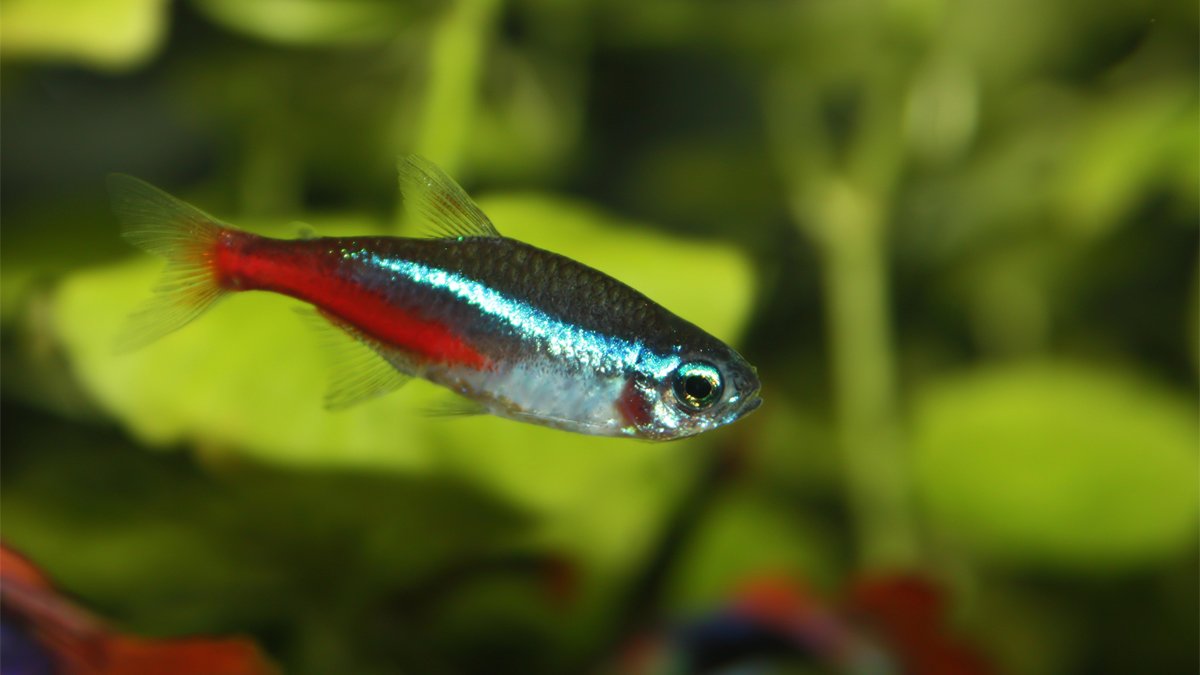
    Personally, I prefer the look of Cardinal Tetras over Neon Tetras. That horizontal red streak on the Cardinal Tetra’s belly can’t be beat. Their reds and blues balance beautifully with a well-planted aquarium, and the vibrance grows if you choose to keep them in a blackwater aquarium. Cardinal Tetras generally seem more vibrant compared to Neon Tetras. I highly recommend them for a 20-gallon aquarium because they stay relatively small, do great in groups, and have spectacular red and blue colors. If you’re looking for a centerpiece schooling fish, look no further than a Cardinal Tetra.

    Celestial Pearl Danio

    Celestial Pearl Danio in plants

    Just looking at a Celestial Pearl Danio should be reason enough to know why they made this list. They are gorgeous looking fish with vibrant colors and white spots throughout their bodies. Celestial Pearl Danios (CPD) are also very peaceful and great options for heavily planted fish tanks. Also known as Galaxy Rasboras, these fish have an additional perk to them. They do well in aquariums with water tempereatures ranging between 72° and 76°F. If you live in an area where the ambient temperature of the home sits in that range, you may be able to keep this fish thriving without a heater. I highly recommend checking this fish out if you’re looking for a peaceful community fish, and you can likely keep anywhere between 10 and 12 individuals in a 20 gallon aquarium.

    Harlequin Rasbora

    Harlequin Rasboras are probably one of my favorite schooling fish. I love the orange, white, and black colorations on their bodies. Harlequin Rasboras will really stand out in a well-planted fish tank. They also have a bulkier build to them, compared to other fish that are streamlined in appearance. These Rasboras are also fairly hardy and generally do well in community tanks. However, use caution because some aquarists do say Harlequin Rasboras can become a little nippy. Not to the same extent as Tiger Barbs, but there are reports of these fish bothering Corycats and other incredibly peaceful fish.

    Neolamprologus multifasciatus

    Many cichlids get enormous and/or incredibly aggressive. Luckily, there are a few species that stay small and are generally peaceful. This includes the Neolamprologus multifasciatus, also known as Multis. They are shell dwelling cichlids from Lake Tanganyika. They spend most of their days patrolling and defending their shell from other Multis. They bring a unique personality to the aquarium world that you don’t often see. It’s really fun and exciting watching them defend their space or search for a new one.

    Keeping Multis is a bit different because you will more than likely devote an aquarium to them. They are often kept in a species-only aquarium. This is perfectly fine for me, because watching them fight and defend their shells all day is enough entertainment. If you’re looking for a unique experience in the freshwater world consider setting a fish tank up for Neolamprologus multifasciatus. They are hardy, fun to watch, and breed fairly easily.

    Rummynose Tetra

    I love the torpedo appearance of Rummynose Tetras. They look amazing in a well-planted aquarium, especially if you have a decently sized school. The black and white tail with red face gives them a very unique appearance, which stands out in a fish tank.

    Rummynose Tetras are a great choice for a 20-gallon aquarium. However, I have to point out that they are incredibly sensitive. If anything goes wrong in the aquarium, they are usually the first to suffer or perish. Regardless, they’re a fantastic fish that look great in 20-gallon fish tanks. If you have a larger fish tank, and are looking for something that looks similar to Rummynose Tetras, consider checking out Denison Barbs, also known as Roseline Sharks. They grow to be a bit larger, but have a similar shape and coloration.

    Bristlenose Pleco

    Many plecos grow to massive sizes, but fortunately, there are a few species that remain pretty small. Bristlenose Plecos are one of those, and only grow to about 6 inches at their maximum. This makes them great candidates for a 20-gallon aquarium. They’re great at eating food at the bottom of the aquarium, and will keep up with algae for the most part. Males have showy bristles over their face, which adds to their charm when they mature. Unfortunately, females have small whiskers. If there is enough decor for them in the fish tank, these fish may disappear in the aquarium for days to weeks at a time.

    Bristlenose Plecos eat algae and food that falls to the bottom of the fish tank. However, you will likely need to supplement their diet with more food. If not, they run the risk of starving in a fish tank. Algae wafers are an excellent option for Bristlenose Plecos, and some aquarists feed them cucumbers and zucchini.

    Peacock Gudgeon

    If you’re looking for a unique fish with striking colors, check out Peacock Gudgeons. The dominating colors on this fish include red, yellow, and blue. Peacock Gudgeons are a member of the goby family and are perfectly fine being kept in freshwater aquariums. They’re incredibly peaceful fish and only grow to about 2 inches when fully grown. Peacock Gudgeons are micro predators that do great as a pair or in groups of 6 to 8. They should easily accept dry pellet food, but being predators, I highly recommend providing them with protein-rich frozen foods as well.

    Care must be taken when keeping Peacock Gudgeons. Being related to gobies, they’re known jumpers. A well-fitted lid will likely be a must because not only are they jumpers, they’re also quite skittish, which increases the likelihood of them jumping.

    Clown Pleco

    If you’re looking for something a little smaller than a Bristlenose Pleco and don’t care as much for the algae eating aspect of a pleco, consider checking out Clown Plecos. They max out at about 4 inches and have incredible colorations. Some people may get turned away from them because they are wood eaters and can make a mess because of their diet. I enjoy the unique behavior, and will happily deal with the mess to get a chance of hearing the crunching sounds when this fish munches on driftwood.

    The key to their success is providing plenty of hiding spaces and driftwood for their diet. If you are not planning to provide both in the aquarium, don’t get this fish. They’ll graze on algae but they aren’t the algae eating powerhouses other clean up crews provide.

    Killifish

    There are many different species of Killifish, and their colorations, small size, and peaceful temperament make them great options for 20 gallon aquariums. They are especially eye-catching in well planted aquariums.

    Killifish may also be a great option for those who enjoy changing the stocking of an aquarium often. Certain Killifish species have incredibly short lifespans. These Killifish only live for anywhere between 6 to 12 months. They often spawn to continue populating the aquarium but they may not which allows you to replace them knowing they moved on naturally instead of being sent back to the pet store.

    Final Notes

    This list contains the 10 Best Fish For a 20 Gallon Tank, from my perspective. This list is completely opinionated, and I know many of you have your own top 10 fish list. When formulating my list, I try to provide fish with unique characteristics, habits, and behaviors. This list is much different than my 10 Best Fish For a 10 Gallon Tank – Freshwater Edition, which I advise you check out as well. If you have your personal list of fish you’d like to contribute to this website, consider reaching out!

  • 10 Best Fish For a No Heater Freshwater Fish Tank

    10 Best Fish For a No Heater Freshwater Fish Tank

    Many of us in the freshwater fishkeeping hobby have been taught to keep our aquariums between 72 and 80 degrees Fahrenheit. Some fish need warmer water, but others will thrive between these temperature ranges. Many fish are considered tropical and need warm water to be successful in an aquarium. Others are more tolerant of both warm and cooler water temperatures. When researching fish stocking for an aquarium, it is important to learn which fish can be kept under what conditions. This article will discuss a handful of fish that can be kept under cool water parameter conditions, likely not requiring a heater.

    Aquarium heaters aren’t always used to maintain warm water temperatures. At times, they are used to keep water temperatures stable. If your home has fluctuating temperatures, it might be a good idea to keep an aquarium heater running to assist in reaching stable water parameters. Check out the 6 Best Aquarium Heaters for Freshwater & Saltwater Fish Tanks to see a handful of different companies that make heaters to help warm your aquarium water or help keep your water temperatures stable.

    1. White Cloud Mountain Minnow

    White Cloud

    Many newcomers in this hobby have likely seen or heard of White Cloud Mountain Minnows. They are often suggested to new fish keepers because of their hardiness, beautiful colorations, and active personalities. White Cloud Mountain Minnows are also excellent options for aquariums that do not run heaters. They do best in cooler water conditions, and it’s recommended to keep them between 65-75° F. White Clouds come in two varieties. You can find “normal” White Cloud Mountain Minnows and the “gold” version, which is essentially an albino version of the fish. Both types are gorgeous options for a planted aquarium.

    If you’re shopping for these fish online, consider purchasing White Cloud Mountain Minnows (affiliate link) from TheShrimpFarm. Also, check out the White Cloud Mountain Minnow – Complete Care Guide to learn more about this fish.

    2. Zebra Danio

    Zebra Danio

    If you’re looking for another incredibly hardy, active fish that does well in cool water, look no further than Zebra Danios. They tolerate water temperatures between 65 and 75° F. Calling them active is an understatement. Zebra Danios spend most of their time moving throughout the aquarium. They do best in groups of at least 6, but more is always recommended. Zebra Danios are not as flashy as many other freshwater fish but have unique horizontal stripes running across their body.

    The Zebra Danio is a fairly common fish that can be found at fish stores. They come in silver and gray colorations, albino, and Glofish® has a colorful line of Zebra Danios.

    3. Guppy

    Guppy

    Anyone who has kept freshwater aquariums likely knows about Guppies. These fish come in an assortment of colors, are generally easy to keep, and are quite active. They are quite tolerant of many different water temperatures and will succeed in aquarium water temperatures between 65 and 82° F. From experience, most people do keep them in warmer water, but it should not be challenging to acclimate them to cooler aquarium temperatures.

    For those of you who have not kept guppies, use caution because these are live-bearing fish. They produce live offspring instead of laying eggs and are prolific breeders. If you let these fish breed without intervention, your aquarium may slowly get overrun with Guppies.

    4. Rainbow Shiner

    Rainbow Shiner

    Rainbow Shiners are cold-loving freshwater fish. They will do great in aquariums with temperatures as low as 60° F and as high as 72° F. They do best in cooler waters that are highly oxygenated. In the wild, they are found in slow to moderately moving streams, which bring ample oxygen from the surface. Rainbow Shiners’ colors change throughout the year. During the breeding season, the colorations on this fish are incredible. You’ll see them with an array of blues, pinks, and purples. However, they do lose quite a bit of color outside of their breeding season.

    This fish species does best in groups of at least 6 individuals. They are social fish and do a fair amount of interacting when kept in larger groups. Check out their behavior in the beautiful stream aquarium.

    5. Paradise Fish

    Paradise Fish

    Paradise Fish are gorgeous freshwater fish that come in an assortment of colors and can do great in a cool water aquarium. There are a few different species of Paradise Fish, but each species is a Gourami. Like other Gouramis, Paradise Fish have a labyrinth organ, which allows them to breathe air from the surface. Paradise Fish do well in aquarium temperatures ranging between 64°F and 78°F.

    Use caution because Paradise Fish are known to be semi-aggressive to aggressive. Larger and heavily planted aquariums may help mitigate some aggression, but they are more than happy to terrorize an aquarium. Each person who has kept Paradise Fish likely has a different experience with them, because each fish has a unique personality.

    6. American Flagfish

    American Flagfish are fantastic algae eaters and very tolerant of cool-water aquarium setups. This fish species will do perfectly fine in tanks with temperatures between 66 ° F and 75° F. American Flagfish can display some aggression when kept in an enclosure that is too small or overpopulated, or during spawning periods. Otherwise, they are usually fairly peaceful and do not bother other tank mates. I recommend keeping them in small groups. If possible, they should be kept in a ratio of 1 male to 2-3 females.

    7. Medaka Ricefish

    Madeka Ricefish

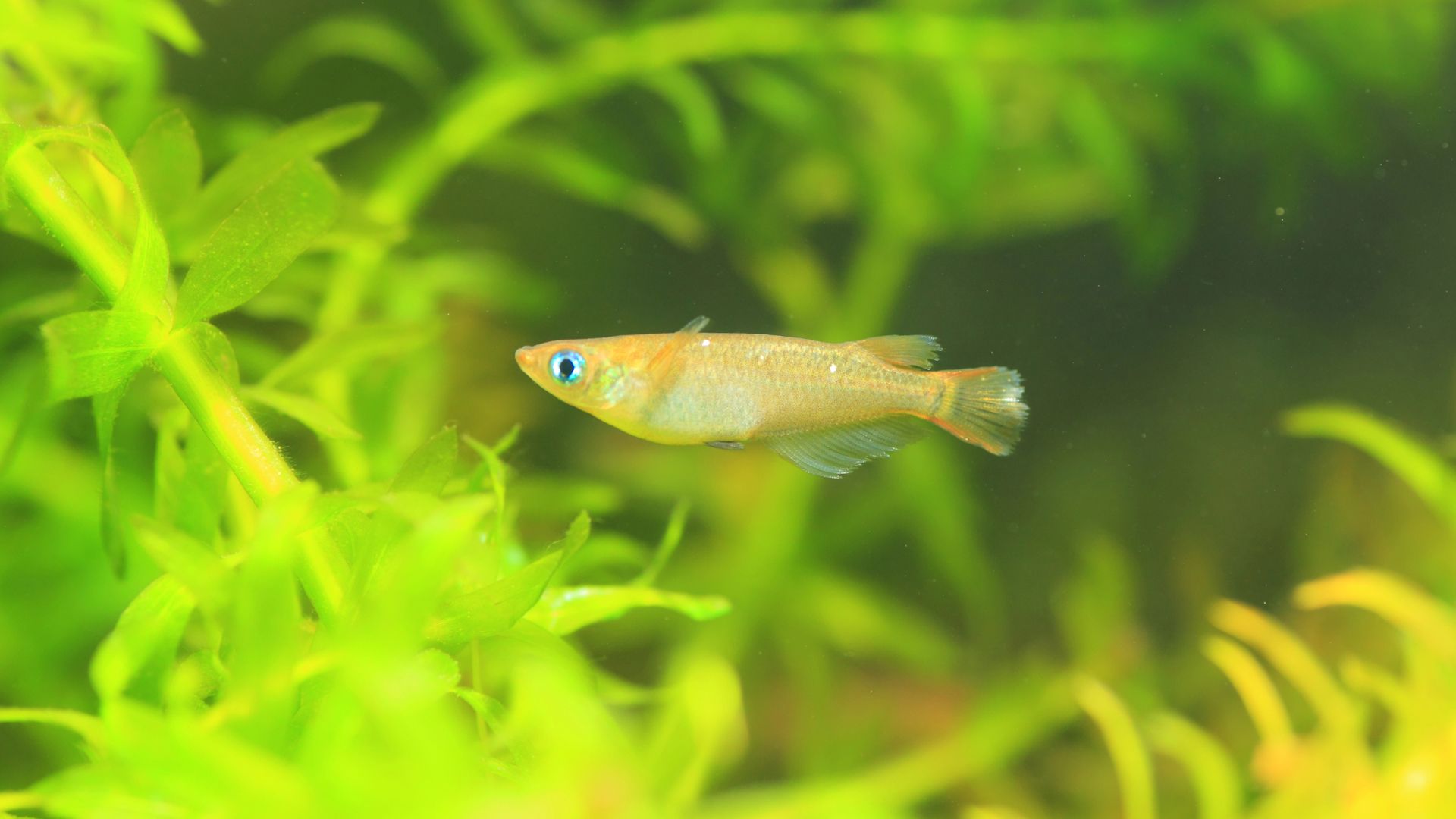
    Medaka Ricefish, also known as Japanese Ricefish, are fantastic nano fish for no heater aquariums. They do great in temperatures between 60 and 75°F. Medaka Ricefish should be kept in small groups of at least six individuals. A small group should have no issue being kept in a 10-gallon aquarium or mini-pond. This is because they should not grow more than 1.5″.

    TheShrimpFarm has Galaxy Medaka Ricefish (affiliate link), which are white in color with a vibrant blue around their eyes. However, you can find Japanese Ricefish in different shades and colorations.

    8. Dojo Loach

    Like many other Loaches, Dojo Loaches exhibit a noodle-like appearance when they’re small. As they grow, they begin to change shape and look more like a hotdog. Their unique appearance goes perfectly with their interesting personalities. They often sleep on their side, bulldoze through the aquarium, and do other weird things. They’re really enjoyable fish to keep and do best in fish tanks with temperatures ranging between 65 and 75°F. Dojo Loaches do best in aquariums with a softer/rounded substrate that they can burrow into. They’re also considered escape artists and do best in fish tanks with well-fitted lids.

    9. Hillstream Loach

    Hillstream Loach

    The Hillstream Loach is a fish with a unique appearance. It has a flattened body to handle the fast-flowing streams of its natural habitat. These fish are gorgeous with black and yellow patternwork throughout their bodies. Reticulated Hillstream Loaches should not be kept in aquariums warmer than 75°F, but can be kept in temperatures as low as 64°F without issue. They can be fantastic tank mates for Rainbow Shiner, in appropriately sized fish tanks.

    You can often find Reticulated Hillstream Loaches (affiliate link) for sale on TheShrimpFarm. They’re fantastic fish to keep in a properly designed enclosure. They will spend much of their time consuming algae and detritus on rocks and other surfaces, but should readily accept most foods provided.

    10. Goldfish

    Goldfish

    If you have a very large aquarium or an outdoor pond, then Goldfish might be the right cool-water fish for you. Fancy Goldfish such as the Ranchu, Ryukin, and Oranda usually do great in temperatures between 68 and 78°F. Common Goldfish are often kept in outdoor ponds with fluctuating temperatures and seasons. If you decide to choose these fish, you have to understand that they get massive and are incredibly messy. They do best in larger volumes of water with excellent filtration to keep up with their waste production. Learn more about Goldfish by looking at the Goldfish – Complete Care Guide.

    Final Notes

    There are many cold-water enjoying fish out there, but these are my favorite choices based on shape, color, and behavior. This list is purely opinion-based, and other fish keepers may have different choices for their favorite coldwater freshwater fish. Let me know if you have experience with any of these fish or have a fish that you think should have made this list. Lastly, this list is in no particular order. Each fish is great in its own way.

  • Are Tetras Good Tank Mates For Goldfish?

    Are Tetras Good Tank Mates For Goldfish?

    Fish compatibility is a topic that always comes up in this hobby. Choosing what fish to keep together can be challenging, but part of being successful in keeping fish is learning which fish species will do well together. This article will cover whether tetras are good tank mates for goldfish.

    I’ll start by answering the question and then going into more detail about why. goldfish and tetras are not good tank mates for one another. I do not recommend mixing these two types of fish. They are incompatible in many different ways which will be listed below.

    1. Physical Incompatibility

    Goldfish grow to be very large; on the other end, many tetra species remain fairly small. Fish are opportunistic animals, if there is a possibility of one fish eating another, the larger fish will likely attempt to eat the smaller one. With this logic in mind, most tetra species become physically incompatible with goldfish.

    Although it’s not too common, tetras can and will nip the fins of other fish. Certain species of tetra are known to nip fins more than other species. Goldfish often have long-flowing fins and also move slowly. This makes their fins easy targets for fin-nipping by tetras.

    Goldfish can be brutes and will likely bully other fish during feeding time. Their large bodies can easily push away or scare away tetras from being able to get food.

    2. Different Water Parameter Requirements

    Tetras and goldfish have two different types of water parameter requirements. Tetras do best in tropical water conditions. I recommend keeping them in water temperatures at or above 76°F in most cases. On the other hand, goldfish have a larger tolerance for water temperatures. They are considered cold-water fish because they often do better being kept in cooler water. Goldfish do better in water temperatures below 74°F.

    3. Goldfish are Messy

    Goldfish are carp and they’re not known for their tidiness and clean eating habits. Goldfish poop often and constantly want food. Because of their personalities and lifestyles, the water parameters in the aquarium may swing. Although it’s not great for them, goldfish are more tolerant of swinging water parameters compared to tetras. Goldfish require better filtration systems, larger water volume, and more water changes because of their size, digestive system, and messiness.

    Final Notes

    There are likely more but less common reasons why tetras are not good tank mates for goldfish, but I hope the reasons listed above steer you away from trying. Goldfish do best in aquariums with other goldfish or koi and ideally should be kept in a pond outdoors when they get larger. Most aquariums are not made to house goldfish throughout their whole lives.

  • 10 Best Fish For a 10 Gallon Tank – Freshwater Edition

    10 Best Fish For a 10 Gallon Tank – Freshwater Edition

    Freshwater aquariums are probably the first things you dip your toes into when entering this hobby. Researching and learning about the many fish out there can be quite intimidating. This article will hopefully help cut down on the search by sharing ten fish I think are fantastic choices for a 10-gallon community tank. This list is comprised of my favorite fish for 10-gallon aquariums, The fish listed here are my personal choices and I understand there may be varying opinions depending on who you ask.

    1. Ember Tetra

    The Ember Tetra is a fantastic option for a 10-gallon fish tank. They’re incredibly small and will stay about 1.25 inches when fully grown. Ember Tetras have a very small bio-load and you can easily add 10-15 of them into a well-planted aquarium.

    Ember Tetras are on this list because they remain incredibly small. They’re easy fish to keep, and you can add a good handful of them into a 10-gallon aquarium without issue.

    2. Lambchop Rasbora

    Lambchop Rasboras (Trigonostigma espei) are peaceful and generally easy to care for freshwater fish. They’ll grow to about 1.5 inches at their maximum size which makes them a great choice for 10-gallon aquariums. Lambchop Rasboras have a nice orange color throughout their bodies, with a lambchop-shaped black splotch near their belly. They’re great additions to a well-planted tank and will lay eggs underneath broadleaf plants.

    This fish species also made it to this list mostly due to their size. Lambchop Rasboras don’t get much bigger than the Ember Tetra. If you enjoy the look of Lambchop Rasboras but are looking for something a little more robust, consider checking out Harlequin Rasboras.

    3. Threadfin Rainbowfish

    Threadfin Rainbowfish are often overlooked as a stocking option. Large rainbows seem to get most of the love. However, these fish have a unique look to them and have beautiful blue and gray colors throughout their bodies. Threadfin Rainbows stay quite small, only growing to about 2 inches. They’re also peaceful and do best in schools of at least 6 individuals.

    The unique look and beautiful colors of the Threadfin Rainbow are why I felt they deserve to be on this list. They are gorgeous fish with a streamlined-looking body.

    4. Gold Tetra

    Gold Tetras are probably one of my favorite species of tetra and are a fantastic option for a 10-gallon fish tank. They have a great shimmer and are quite flashy in aquariums due to their vibrant gold/silver colors. They’re very peaceful and will not bother other fish in the aquarium. Gold Tetras do best in schools of at least 6 individuals. A 10-gallon aquarium should easily house 10 Gold Tetras.

    The Gold Tetras are a wonderful addition to a 10-gallon tank. I enjoy the contrast they have to a heavily planted aquarium. Their gold/silver glimmer as they move gives them a spot on this list.

    5. Betta Fish

    Betta Fish are really fun fish to keep. They have remarkable colors and we can’t forget about their incredibly long fins. Contrary to what you may have been taught, Betta Fish should not be kept in cups, small vases, or other small containers. However, they are a fantastic choice for 10-gallon community tanks. Bettas love to explore, and will likely utilize every part of the fish tank.

    Most people know the charm of Bettas. Their personalities are some of the best in freshwater fish. Besides their wonderful personalities, Bettafish come in an assortment of colors. You can likely find a color that will match your style.

    6. Pygmy Cory

    Pygmy Corys are exactly what you might expect. They’re a bite-sized version of a Corycat and only grow to about 1 inch. They will spend a lot of time shoaling with other Pygmy Corycats, but they’ll break away from the group and explore on their own.

    I added them to this list because of their small size and many fishkeepers simply adore them. 10-gallon aquariums are fairly small, and this species of fish won’t take up the spotlight in the aquarium, but you may spend most of your time observing your goofy Pygmy Cory over other fish.

    7. Otocinclus

    If you’re looking for a small clean-up crew for your 10-gallon aquarium, check out Otocinclus. They’re social algae eaters that do best in small groups. One might not keep algae at bay, but a team may be able to do great things to eradicate algae growing in your fish tank. Use caution because this fish species is a little harder to keep. They may be a little more difficult to acclimate to a new environment.

    Otocinclus are on this list because they’re small algae eaters that are also fun to watch. In small groups that can assist in keeping an aquarium tidy. Snails and shrimp can do the job of an Oto, but the option to have a small algae eater is good to have.

    8. Neon Tetra

    Neon Tetras are a classic fish. Anyone can recognize the blue and red colorations on this fish. They also make great candidates for 10-gallon aquariums. Depending on filtration and how densely planted the aquarium is, you can easily add between 6 and 10 individuals.

    Neon Tetras made it into this list because they’re classic fish with beautiful blue and red colors. The biggest downside to Neon Tetras is that they can be finicky. You can get a great batch of them that will love for years, but you may also get some that don’t do very well.

    9. Scarlet Badis

    Scarlet Badis are an incredibly vibrant freshwater micro predator. They spend their days hunting for small shrimp, copepods, scuds, and other small inhabitants. They’re great for a 10-gallon aquarium setup that is heavily planted and might do best in a species-only fish tank because they can be incredibly shy.

    I added them to this list because of their bright colors, which will pop in a 10-gallon fish tank. They are great for more experienced fishkeepers because of their picky diet and elusive personalities.

    10. Sparkling Gourami

    The Sparkling Gourami is a fish I don’t see often, but they’re great for 10-gallon community tanks. They only grow to about 1.5 inches and have incredible colors. The most eye-catching part for me is the blue ring Sparkling Gouramis have around their eyes. They can get a little territorial, but a male/female pair should do perfectly fine in a 10-gallon aquarium.

    Another reason I suggest Sparkling Gouramis is because they make noises. During breeding season you may hear this fish make croaking noises. It’s a very odd feature in an already beautiful fish.

    Final Notes

    These ten fish are fantastic for a variety of reasons. They’re some of the best options in my eyes, but I know not everyone will agree with the fish I chose. If you own or have kept any of these fish, I’d be happy to hear your stories in keeping them. Let me know how you feel about this top 10 list! Check out 10 Best Fish for 55 Gallon Fish Tank if you’re looking for stocking ideas for a larger fish tank.

  • Top 10 Worst Community Fish For Freshwater Aquariums

    Top 10 Worst Community Fish For Freshwater Aquariums

    Finding the best tank mates for your aquarium can be a challenge. Not all fish get along well, some get incredibly large, and some are downright aggressive. This list contains what I believe are some of the worst fish that people add to their community tank. Many of these fish are mistaken for community fish, or start off without issue but become problematic in an aquarium as they grow. This list is just my opinion, others may have different experiences which differ from mine.

    1. Red Tail Shark

    red tail shark

    The Red Tail Shark is the first on the list that many incorrectly identify as a community fish. After years of working at a fish store, I have learned that people radiate towards Red Tail Sharks. Many people love the unique coloration of this fish.

    Red Tail Sharks are fantastic fish. They’ll happily search for and find food that’s on the substrate and they’ll also consume algae on different surfaces including plants. The problem with Red Tails is their temperament. They can be territorial and will bully fish. They do better in a semi-aggressive aquarium. I’ve seen them succeed with peaceful fish, but I do not recommend taking the risk of adding them into one.

    Alternative to Red Tail Sharks

    Not many fish can replace a Red Tail Shark’s unique red and black color. However, plenty of fish utilize the same space as this fish that are also peaceful. The following are two fish examples that may fill the same space that a Red Tail Shark uses in an aquarium.

    Corydoras

    Corycats are fantastic bottom-dwelling fish. There are many different species of Corydoras, but they’re all peaceful fish that do best in shoals. They won’t bother other fish and will spend most of their time perched at the bottom of the fish tank waiting for food. I don’t think I have met anyone who regretted adding Corydoras to their community aquarium.

    Siamese Algae Eater

    If you’re looking for a fish that has a similar shape to a Red Tail Shark, check out the Siamese Algae Eater. It’s an active but great fish to add to a community fish tank. Siamese Algae Eaters are a fantastic choice for fighting algae and can be a great addition to your community tank’s clean-up crew. They’ll grow to about 6 inches when fully grown but don’t often bother other fish. If algae issues are plaguing your aquarium, take a look at Common Causes of Algae Blooms in a Freshwater Aquarium. There might be something going on in the fish tank that should be taken care of before adding more fish, and it’s important to diagnose what is happening.

    2. Bala Shark

    bala shark

    The appearance and personality of a small Bala Shark can be misleading. They do great in schools, have a bright silver color, and are very active. These are all fantastic criteria in a fish. The downside is the size they reach when they’re fully grown. Bala Sharks grow to be about 14 inches (35 cm) when they’re adults. With this size comes a great appetite and small community fish will likely become food. Besides the appetite, you’ll need a large aquarium once your Bala Sharks grow. I recommend at least a 150-gallon fish tank to provide room for a school of them.

    Bala Sharks are gentle giants. They shouldn’t bother fish that they don’t see as food. They can technically be kept with larger tetras and other large peaceful fish. If it doesn’t fit into their mouth, the Bala Shark should leave it alone.

    Alternative to Bala Sharks

    There are many fish that are vibrant in color, are active, but are more peaceful and won’t get nearly as large as this fish.

    Denison Barbs

    Denison Barbs are peaceful fish that will do great in a larger community aquarium. They only grow to around 4.5 inches which is much easier to handle for your average fishkeeper. They also enjoy swimming in schools of at least 6 individuals.

    Rainbowfish

    There are a variety of rainbowfish to choose from. My favorites are the Neon Dwarf Rainbow and the Boesemani Rainbow. Both are very active fish, great schoolers, and very vibrant in color.

    3. Common Pleco (Suckermouth Catfish)

    I do not recommend purchasing Common Plecos unless you know someone with a large fish tank or plan on setting up a larger aquarium soon. They’re great at eating algae but they will be just shy of 2 feet in length when they’re fully grown. Many fish tanks cannot appropriately house them their whole lives. Unfortunately, this fish often finds its way into lakes, rivers, and streams because negligent aquarium keepers release them once they get too large. They can dominate waterways because they are an invasive species in certain parts of the world and wreak havoc on the fish populations.

    Alternative to Common Pleco

    There are plenty of fish that will happily eat algae. There are also great invertebrates that help control algae in a fish tank. If possible, try to avoid getting a Common Pleco and look to other avenues for algae-eating fish. Besides the options listed below, check out 9 Best Bottom Feeders Fish For Freshwater Aquariums.

    Bristlenose Pleco

    Bristlenose Plecos are a classic alternative to the enormous Common Pleco. This fish species grows to about 6 inches when it’s fully grown. Male Bristlenose Plecos also acquire a face full of “bristles” which adds to their charm. They’re great fish to have to keep algae away.

    Freshwater Invertebrates

    You may get away with a clean-up crew of freshwater invertebrates. In large numbers, different species of shrimp and snails may fill the niche that a Common Pleco usually holds.

    4. African Cichlids

    african cichlid

    Many people see the vibrant colors of African Cichlids and want them in their community tank. I do not recommend keeping African Cichlids in a peaceful community aquarium. They are aggressive and can dominate most fish that are in the aquarium. African Cichlid’s water parameter needs do not match what is commonly put into a community aquarium. Most African Cichlids require very hard water with high pH levels. The African Cichlid does best with other African Cichlids.

    Alternative to African Cichlids

    The colorations of African Cichlids compete with the vibrant colors of saltwater fish. Finding an alternative to these fish’s color is incredibly hard in a freshwater aquarium. A lot of cichlid species are also deemed semi-aggressive and are not often suggested for community fish tanks. You’ll often run the risk of having your cichlids become aggressive in an aquarium, especially if they decide to spawn.

    Scarlett Badis

    One alternative that resembles a cichlid without aggressive tendencies is the Scarlett Badis. This fish species is quite peaceful and is considered to be timid. They’re micro-predators and will spend their day searching for small shrimp, scuds, copepods, and other tiny invertebrates. Scarlet Badis have vibrant red colors and make for an eye-catching addition to a peaceful community tank.

    5. Pea Puffers

    Pea Puffer

    Pea Puffers are amazing fish. They have wonderful personalities and (in my opinion) display a different type of intellect compared to other fish. It’s hard to explain Pea Puffers unless you’ve kept them. Unfortunately, this fish species can be aggressive and are notorious fin nippers. I’ve seen them nip on small, big, peaceful, and aggressive fish. They just don’t care which makes them less than ideal candidates for community fish tanks.

    Besides their nippy personalities, Pea Puffers are often filled with parasites, partly because of the foods they eat. The parasites must be treated otherwise your Pea Puffer will slowly lose the battle to the parasite. Also, Pea Puffers can be challenging to keep due to their picky diets. I’ve had some that eat live snails and shrimp. I’ve had others that only eat live shrimp and different ones that only eat live snails. The goal is to get them to eat frozen bloodworms, but that’s not always possible.

    Alternative to Pea Puffers

    It’s hard for me to think of an alternative for Pea Puffers. The amount of personality and quirks you get in such a small package is hard to replicate. The following fish are just suggestions that might vaguely replace the charm of this fish.

    Betta Fish

    The Betta is much bigger than a Pea Puffer and they look nothing alike. I chose them solely as an alternative to Pea Puffers due to their personalities. I love the personality of Betta Fish. They explore the aquarium, are curious, seem to recognize you when you’re around the fish tank, and are all-around great fish to keep.

    Bumblebee Goby

    If you’re looking for something small, that stays small like a Pea Puffer, check out the Bumblebee Gobies. They’re incredibly tiny, bottom-dwelling fish that are usually peaceful and great candidates for a community tank. They will claim a spot in the aquarium and defend it from other fish. Be mindful because they can get mischievous and nip long-finned fish like Bettas.

    6. Tiger Barbs

    tiger barb

    I remember growing up, and not knowing much about Tiger Barbs and mistakingly adding a handful into an aquarium. Little did I know that Tiger Barbs would chase and pester other fish for an assortment of reasons. They’re beautiful fish, and I love seeing aquariums with large schools of them, but they’re not a great choice for community tanks because of their fin-nipping habits.

    Alternative To Tiger Barbs

    The color and stripe patterns of the Tiger Barb are iconic and it’s there aren’t many fish that can match that. I have listed a handful of fish that should do well in community aquariums but are not as aggressive as Tiger Barbs.

    Other Barbs

    There are quite a few barbs that are considered peaceful and aren’t as nippy as Tiger Barbs. Hexazon Barbs look the most similar and should not bother other species of fish if they’re in large enough schools. Besides that, Rosy Barbs, Gold Barbs, Snakeskin Barbs, and Cherry Barbs are other species of barbs that are excellent options for community tanks.

    Medium Sized Tetras

    If you like the shape of Tiger Barbs, there are a few medium-sized tetras that vaguely resemble them. Check out Black/White Skirt Tetras, Bleeding Heart Tetra, Candycane Tetras, and Pristella Tetras. These five options slightly resemble Tiger Barbs, are great schooling fish, but they’re far more peaceful.

    7. Goldfish

    Goldfish come in a variety of shapes, sizes, and colors. At the end of the day, most goldfish have similar traits. First, Goldfish get big and require large fish tanks or ponds to be happy long-term. Second, Goldfish are great candidates for cool water aquariums. Lastly, Goldfish are incredibly messy fish. They produce more poop than one can imagine and need great filtration and water changes to keep the water parameters in check.

    Alternative to Goldfish

    If you’re looking for large orange fish that can do well in community tanks, you might want to consider Swordtails. They’re peaceful fish that come in many colors, including vibrant orange. Males have a beautiful “sword” on their tail which adds to their charm. Be mindful because they are livebearers and if males and females are present, you may get a plethora of Swordtails over a short period.

    8. Columbian Shark

    I’ve seen quite a few people who wanted to add Columbian Sharks to their community tanks. Columbian Sharks are one fish that I believe should not be kept in the hobby. I say this because many novice fishkeepers get these fish without knowing how to fully care for them.

    Columbian Sharks have a unique quirk. They’re technically brackish water fish but are often sold as freshwater fish. They might be fine in freshwater aquariums when they’re small. However, they slowly need to be transitioned from freshwater to brackish water, and converted to full saltwater as they get larger.

    9. Giant Danio

    Giant Danios aren’t necessarily bad options for a community fish tank. They’re great fish that bring a different energy into an enclosure. Their charm is how active they are in the fish tank. They swim, all the time. I’m not sure if they ever stop. Unfortunately, their charm is also their downfall. Giant Danios’ active personalities can passively scare other fish, especially during feeding time. They hog food so you’ll have to spend time distracting these fish to feed your other fish.

    Alternative to Giant Danio

    Giant Danios can be kept successfully in freshwater community tanks. They’re not necessarily my go-to option because of their incredibly active personalities. However, it’s all about preference in this hobby, and there is no single correct option. If you enjoy Giant Danios, it never hurts to give them a try in your fish tank.

    Small Danio Species

    If you’re looking for an active fish that won’t be as big of a bully as the Giant Danio, consider getting Zebra Danios. They’re much smaller and are very active. As a bonus, they are often incredibly cheap at fish stores.

    10. Dwarf Gourami

    dwarf gourami

    Dwarf Gouramis have jaw-dropping colors and have a very unique appearance to them. They’re probably one of my favorite freshwater fish, but I don’t keep them. They can be great in a community tank, but I avoid them because they are sensitive. Sadly, a combination of inbreeding and a virus (Iridovirus) is wreaking havoc on the species making them incredibly hard to keep for long periods. You may get a great specimen that does great its full life, but most often, you’ll get one that slowly fades away and dies over time.

    Alternative to Dwarf Gourami

    It’s unfortunate that Dwarf Gouramis can be affected by such a detrimental disease. Luckily for us, there is a smaller species of Gourami that is not affected by the virus. The Honey Gourami is the species I usually choose when shopping around for Gouramis.

    Honey Gourami

    Honey Gouramis are pretty much a bite-sized version of the Dwarf Gourami. They have shy personalities but are an excellent choice for a community tank. Honey Gouramis can do well with others of their species and are often kept in pairs. However, I recommend avoiding keeping them with other types of Gouramis, like Dwarf Gouramis and fin-nipping fish.

    Final Notes

    There are countless freshwater fish that are available to choose for your aquarium. Researching a fish’s husbandry needs and compatibility with other fish is incredibly important. Unfortunately, the internet is loaded with a range of opinions. This includes the information I am providing. I am fairly knowledgeable about many fish due to my long history of keeping fish and time spent working at fish stores. I do my best to research fish I may not have a complete understanding of. If you have experiences with fish and would like to share don’t hesitate to reach out. I am always looking to add more content to this website.

  • How To Setup Planted Aquarium for Neon Tetra

    How To Setup Planted Aquarium for Neon Tetra

    Neon Tetras are some of the most iconic fish in this hobby. Anyone who has walked into a pet store can probably identify that familiar red and blue coloration. Many people choose Neon Tetras because they are commonly found in pet stores, are vibrant in color, and are incredibly cheap. It makes sense why they are so popular. This guide will discuss what you need to set up a planted aquarium for Neon Tetras.

    Aquarium For Neon Tetras

    To set up an enclosure for Neon Tetras, you’ll first want to start with acquiring a fish tank. A small school of Neon Tetras will do great in a 10-gallon fish tank. You’re always welcome to go for a larger aquarium, but I do not recommend going smaller. If you have an aquarium stored away that you’re thinking of using but don’t remember how many gallons of water it holds, check out some of the Standard Aquarium Sizes to figure out what size it is. If you’re planning on only keeping Neon Tetras, and perhaps a few snails or shrimp, 10 Neons should do great in a 10-gallon aquarium.

    Filtration For Aquarium

    The next thing you’ll want to consider when setting up a planted aquarium for Neon Tetras is what type of filtration to use. The most common ones I suggest are sponge filters or power filters, especially for smaller fish tanks. In most cases, Neon Tetra’s bioloads are minimal so a combination of plants, filtration, and water changes should be plenty to keep your aquarium clean.

    Sponge filters will take up some real estate in the fish tank, but are fairly cheap to set up, use a very small amount of electricity, and provide a lot of surface area for beneficial bacteria. All you’ll need to set up a sponge filter, is an air pump, airline tubing, and the sponge filter. Most air pumps come included with airline tubing. If you’re new to the hobby, check out Sponge Filter Use Cleaning and Extra Tips to learn a few things about this type of filtration.

    Sponge Filter Zoomed

    If you want a more in-depth filtration experience consider getting a power filter. There are many types of power filters available to choose from. Most will get the job done but my favorites are the Fluval – Aquaclear Power Filters or the Seachem – Tidal Power Aquarium Filters. I love these filters mostly because of their customizable and large media baskets. You can swap filter media to whatever you desire and they’ll continue to work well. Neon Tetras don’t have an incredibly large bio-load, but it never hurts to have a good filter running on the fish tank. If you’re shopping around for power filters and are not sold on these, take a look at 7 Best Hang-On Back Power Filters For Freshwater Aquariums to see many other options.

    Lights For Plants

    You’ll need to purchase lights for your aquarium that will complement the plants you’re planning on growing. Some plants do better under more intense light while others do great under medium to low light conditions. If you’re new, I’d start with plants that are very tolerant of lower light conditions and that are not incredibly demanding. I have gotten great results growing plants such as vals, crypts, and anubias with the NICREW Full Spectrum Planted LED Light. It’s a great budget light and a solid introduction to LED aquarium lighting.

    Aquarium Heater

    Unless you live in an area where the ambient temperature is always between 72° and 78°F, you’ll likely need an aquarium heater. You’ll have to pick out the one that will work best for your aquarium’s dimensions. There are a lot of brands that make fantastic heaters. If you’re in the market for a heater, take a look at 6 Best Aquarium Heaters for Your Fish Tank. There are many different options to choose from, I have always had good results from the Fluval M-Series Heaters but I have also used many other brands like the Aqueon Pro Series Heaters that have worked great. Remember, that heaters are the pieces of equipment that are likely to fault out in your fish tank.

    You can take precautions by purchasing an Inkbird Temperature Controller to help keep the heater from causing irreversible damage to your fish if it were to malfunction. An internal aquarium thermostat will also give you a good idea of your water temperature.

    Decorations and Plants

    There are plenty of different decorations to choose from when setting up an aquarium. You can add rocks, live plants, driftwood, artificial decor, and more. What type of decorations you choose is entirely up to you. The most important thing is that what you put in the aquarium is fish-safe. I love aquariums that look and feel like a slice of nature, so my fish tanks are usually dominated by plants, wood, and rockwork.

    Substrate

    A substrate is essentially the “ground” of your aquarium. I have seen many different brands, types, colors, and textures of substrates in my years of fishkeeping. However, if you’re considering setting up a planted tank, I assume you’re looking for a natural look to your aquarium. For planted fish tanks, my go-to substrate is CaribSea Eco-Complete. This substrate is nice because its dark color makes the decorations and fish swimming above pop in color. The opposite occurs when you use a white-colored substrate.

    Another great substrate used for planted aquariums is the Fluval Stratum for Freshwater Fish Tanks. I don’t use this one too often, but many fishkeepers and hobbyists love the quality and look it provides. It also comes with the perks of being very porous to help plants root faster and it helps maintain neutral to acidic water parameters. Before choosing a substrate, consider doing some research on the effects it may have on your plants.

    Rocks, Driftwood, etc.

    Adding rocks and driftwood to your fish tank will surely add a natural-looking touch. Some species of plants and mosses can be grown off of driftwood, and plants growing around stones can make your fish tank look incredible. I recommend giving your driftwood and rocks a good rinse before adding them to an aquarium. However, do not use any household chemicals because those can be dangerous for fish and invertebrates.

    Many aquarists boil their driftwood to help remove the tannins they will likely release into your fish tank. Tannins aren’t dangerous, they are actually beneficial for your fish. However, tannins will cause your fish tank water to turn tea color or sometimes even darker than that.

    Certain rocks can alter the water parameters in your fish tank. For example, limestone or Texas Holey Rock will increase your fish tank’s water hardness and pH level. This is fantastic for high pH, hard water-loving fish, but that’s not the case for Neon Tetras. Lava rock and slate are pretty safe options, but there are plenty of rocks out there that won’t alter your water parameters. Unlike driftwood, do not boil or bake your rocks.

    Plants

    This article is specific to setting up a planted tank for Neon Tetras, so I’ll list a handful of plants that are very easy to care for to get someone started.

    • Anubias are a fantastic option for a planted aquarium. They are very tolerant of low light conditions and have beautiful broad leaves. You can wedge them in between driftwood and grow them out of the substrate. If you plant them in substrate, ensure part of its rhizome is exposed. Otherwise, the rhizome will likely rot and eventually kill off the plant.
    • Java Fern is another great option for a planted aquarium, especially when you’re first starting out. It has a lance-shaped leaf and is usually a nice vibrant green color. This plant is also fairly tolerant of lower light conditions. It’s a great choice for a background plant
    • There are many different species of crypts. You’ll see some that’ll grow much taller than others, and you’ll also see a few color variations. This plant usually grows very well in an aquarium and may even dominate parts of a fish tank if you let them grow out. After breaking down an aquarium, i had a singular root run the full length of my fish tank. The aquarium was about 30″ long.
    • You can’t go wrong with attaching mosses to driftwood. The most common you’ll likely see are java moss or Christmas moss. Moss is a great way to grow something green in an aquarium without losing much open swimming space.
    • There are quite a few different species of Val. The most common i see are Jungle Vals, Italian Vals, and Corkscrew Vals. From experience, they grow very easily and they’ll grow to the top of your fish tank. Once they’re acclimated, they will quickly begin growing vertically and horizontally, taking over much of the background of your aquarium.
    • Pearlweed are very easy-to-grow plants that can be added to a planted fish tank. They’re great for backgrounds and will often propagate quickly. A few sometimes can turn into a jungle.
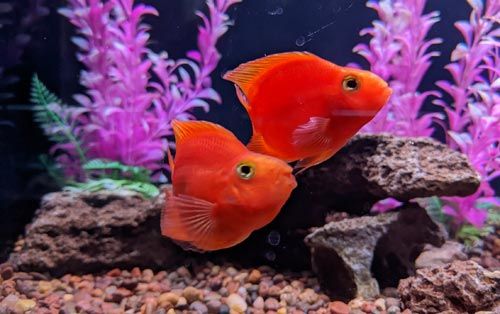
    Adding Neon Tetras into the Aquarium

    Before adding Neon Tetras to your aquarium, guarantee that your fish tank is established and has gone through the Nitrogen Cycle. The Aquarium Co-Op does a great job explaining what the Nitrogen Cycle is. As a quick summary, your aquarium has to go through a nitrogen cycle when it’s first set up. There are different ways to do it, but I suggest a fishless cycle if possible. Even better, if you know someone with an established fish tank, or own one yourself, you can take filter media, substrate, a rock, or any other hard surface (where bacteria can colonize) and put it into the new fish tank. This will seed the new aquarium with beneficial bacteria. Although it will not fully cycle the new fish tank, it should at least speed up the Nitrogen Cycle process.

    The result of your nitrogen cycle will result in your aquarium reading 0 ammonia, and 0 nitrites, and you’ll likely have a hint of nitrates. You can test for these with the API Freshwater Master Test Kit.

    Final Notes

    Neon Tetras are fantastic fish to add to a freshwater aquarium. They look even better in a freshwater planted tank. Their magnificent blue and red color pops in an aquarium full of plants. Due to inbreeding, they’re a little more sensitive than other fish but are still a very sought-after species.

  • 6 Large Peaceful Freshwater Fish

    6 Large Peaceful Freshwater Fish

    There are countless fish species available in this hobby. Many new hobbyists start with small aquariums and grow into larger ones as time progresses. It seems like nano tanks have an unlimited amount of peaceful fish that can occupy them. The opposite seems true for larger fish and big aquariums. Luckily, there are large peaceful freshwater fish out there. This article will discuss a handful of large fish, that have a good chance of being peaceful.

    Before we start, I want to add a disclaimer. Fish are opportunists and there is a saying “If it fits into its mouth, it’s likely to become food.” This saying holds for both peaceful and aggressive fish. The fish on this list may be peaceful but that won’t stop them from eating anything that fits into their mouth. Keep that in mind when you are planning on stocking your fish tank.

    1. Silver Dollars

    Silver Dollars are freshwater fish that get big, but are incredibly peaceful. They are an excellent choice for a large community tank. This fish species does best in a school of at least 6 individuals but more is always recommended. Silver Dollars become bolder and less fearful when in a larger school. They enjoy having a long aquarium when fully grown due to their active personalities. Ideally, they will do best in an aquarium that is at least 125 gallons or larger when fully grown.

    The unique trait of Silver Dollars is that they are primarily herbivorous fish. I do not recommend putting them into a planted aquarium because the plants will quickly become a salad buffet. Silver Dollars will graze the plants down to the roots within a few hours to a few days, depending on plant density. Various rock, driftwood, and plastic plants will be ideal decor for this fish.

    2. Rainbowfish

    There are many different species of rainbowfish and all species are generally peaceful and keep to themselves. You may see fighting for dominance within a school, but they should not bother other species of fish. I recommend forming a large school of the same species of rainbowish over mixing many different species. This is to mimic the large schools they have in the wild. Some of my favorite rainbowfish are the Dwarf Neon Rainbowfish, Boesemani Rainbowfish, and Irian Red Rainbowfish.

    One quirk of most rainbowfish species is that they are active and aggressive eaters. They can become bullies when food is present and scare away slower-moving fish by accident. This isn’t true aggression, they are just passionate about food. Once the food is gone, they will likely go back to their peaceful behaviors.

    3. Elephant Nose

    The Elephantnose Fish have a unique appearance as well as an interesting quirk to them. They have a trunk-like appendage that sticks out from their face. The trunk emits an electrical pulse that helps them navigate through the fish tank and also assists them with hunting for food. This species of fish is nocturnal but may come out of hiding at times when the lights are on. Elephantnose requires very pristine water conditions to thrive. They are very sensitive to water quality. Soft gravel and sand are needed for the Elephantnose so it does not damage its trunk while exploring.

    Elephantnose Fish will be aggressive towards others of the same species. I do not recommend keeping more than one in the same aquarium. The more dominant of the two will bully and stress the less dominant one.

    4. Severums

    I am stretching the term “peaceful” for this next fish. Severums can be peaceful, for cichlid standards. There are many species of Severum and each fish has a unique temperament. Your Severem can be a model fish, but another hobbyist may have purchased a Severum that completely dominates an aquarium.

    To help keep the aggression down for Severums, I recommend keeping them in at least a 125-gallon aquarium as they mature. On top of that, they do best with rocks, driftwood, and plants that break their line of sight. The more decorations you can provide, the better. If you have a male and female, you’ll see territorial aggression when they are trying to spawn. You can avoid this by keeping a lone Severum.

    5. Goldfish

    Goldfish that are kept with similar-sized Goldfish or Koi can be incredibly peaceful. Most Goldfish lumber around and wait for food, or churn through gravel looking for food. Feeding time may be the only time you’ll spot aggression from these fish.

    There are a few drawbacks to Goldfish. They’re prolific poopers, messy eaters, get very large, and require large aquariums and filtration systems to thrive. Large filters are needed mostly because of their messiness. Common Goldfish do best in outdoor ponds over aquariums because of their husbandry needs. They’re great fish, with vibrant colors, but do best with other Goldfish and Koi in incredibly large fish tanks or ponds.

    6. Discus

    I was on the fence about adding Discus to this list. Similar to Severums, they can be peaceful compared to many other cichlids. However, Discus are not compatible with many fish species. They do best with high temperature, low pH, and pristine water conditions. The high temperature alone knocks off most fish from being compatible with Discus.

    Discus enjoy being in schools of at least 4 individuals, but 6 or more are highly recommended. Being cichlids, you may see fighting within the school over dominance. 6 should do fine in a 75-gallon aquarium, but I recommend a larger aquarium. Due to the high-temperature needs, Discus’s metabolism is very high. This means a lot of feedings and water changes will be needed. More water volume will help prevent large swings in water parameters.

    Final Notes

    There are probably many more large and peaceful freshwater fish available, but these few are the first that come to mind. Everyone has different experiences with fish and not everyone will agree with the ones listed. From experience, discussing with hobbyists, and researching the subject, the fish listed above seem to fit the category of peaceful fish. If you have experience with any of these fish, or think others would do well on this list, please let me know!

  • White Cloud Mountain Minnow – Complete Care Guide

    White Cloud Mountain Minnows are beautiful and easy to care for freshwater fish. This species comes in three different variants which are, White Cloud Minnow, Gold White Cloud Minnow, and Longfin White Cloud Minnow. Each of these could be kept together and they will likely school together with no problems. Unlike, many other fish that you come across in this hobby, White Clouds prefer living in cooler water. This guide will discuss their temperature needs as well as other aquarium requirements, food and diet, compatible tank mates, and breeding habits.

    Aquarium Requirements

    White Cloud Minnows will grow to a max size of 2″. This makes them great candidates for a 10-gallon aquarium. Keep in mind that they do best in schools of at least 6 individuals, but more is always preferred. If your aquarium is well planted and they are the only fish in the aquarium, you should be fine with keeping between 6 – 12 individuals. A larger school will help the fish feel more comfortable and less shy in the aquarium.

    They’re not known to be jumpers, however, I do recommend providing a well-fitted lid on your aquarium to be on the safe side. Any fish can jump out of the aquarium if they are determined enough.

    How Many White Cloud Minnows in a 20 Gallon Tank?

    With a good filter and a well-planted aquarium, you should be able to keep up to 20 White Cloud Mountain Minnows in a 20-gallon aquarium. This is only if this species of fish is the only fish in the fish tank. You will need to lower the total White Clouds if you plan on adding plecos, cory cats, or other fish into the fish tank.

    Water Parameters

    The water parameters, specifically temperature, make them a little harder to keep with other tropical fish. White Cloud Mountain Minnows are very hardy fish but we will need cooler water to help them thrive in your aquarium. The following are the water parameters that White Clouds do best in.

    • Temperature: 64°F – 72°F
    • Water Hardness: 10 – 15 KH
    • pH: 6.0 – 8.0

    As you can see, they do best in waters that are at their warmest 72°F. Most tropical fish require water usually between 74°F – 78°F. There are a few fish species that will do well in cooler water. You may not require a heater for this aquarium, but a thermostat is still recommended just to keep an eye on the temperature. You can pick up this fancy PAIZOO Digital Thermometer from Amazon or keep it simple with the Marina Floating Thermometer.

    Food & Diet

    This species of fish is omnivorous, and they are generally not picky eaters. White Cloud Mountain Minnows will easily accept frozen foods such as Tubifex Worms and Bloodworms. I would also recommend providing them with high-quality flake food, such as the Omega One Super Color Flakes, and small pellet foods like the New Life Spectrum Tropical Pellets. Giving them a variety of food will provide them with a well-rounded diet which will help keep them healthy.

    Tank Mates

    Although there aren’t as many fish that have the same water parameter needs as White Cloud Mountain Minnows, there are still plenty to choose from. In appropriately sized aquariums White Clouds can be kept with Zebra Danios, Gold Ring Burmese Danio, Platys, Paradise Fish, and/or Guppies. You can also strengthen the size of your White Cloud Minnow population. They will also do fine with Red Cherry Shrimp, Ghost Shrimp, Mystery Snails, Rabbit Snails, and many more invertebrates.

    Although White Clouds and Goldfish have similar water parameter requirements, I would not recommend keeping them together. Goldfish will be able to make a nice meal out of your White Clouds. Also, Goldfish are very messy and get incredibly large. They do best with other Goldfish and Koi, preferably in an outdoor pond. You can learn more about Goldfish by checking out the Goldfish – Complete Care Guide.

    Breeding

    White Cloud Minnows should easily breed in the aquarium on their own. They lay eggs which will probably get eaten by many different species of fish including the White Cloud Minnows themselves. You can try to imitate a transition from spring to summer by increasing the temperature a degree or two in the fish tank. Also, increasing feeding may create a breeding response in your fish. If you want to increase the success of the eggs and fry without setting up a breeding tank, I would recommend providing a variety of plants in your aquarium. Denser populations of plants will give your fry more places to hide. Moss, floating plants, and Hornwort are good options for this.

    Fry may figure out how to survive on their own, but if you see fry moving about the tank, you may need to feed them live baby brine shrimp to help promote growth. Feeding them live foods will help them successfully reach adulthood.

    Final Notes

    White Cloud Minnows are fantastic and hardy cool water freshwater fish. If you are getting into this hobby, they’re a great fish to start with. They are fairly cheap, very colorful for the type of fish they are, and very active. You will likely not be disappointed in keeping this fish.

  • Red Phantom Tetra – Complete Care Guide

    Red Phantom Tetra Facts

    Red Phantom Tetras, as the name suggests, are beautiful red fish with a black-tipped dorsal fin. They are freshwater schooling fish and great additions to many community aquariums. They look similar to other tetra species such as the Bleeding Heart Tetra and Serpae Tetra. It is best to keep this species in groups of 6 or more. This guide will detail the Red Phantom Tetra’s aquarium requirements, dietary needs, compatible tank mates, and more.

    How Big Do Red Phantom Tetras Get?

    The Red Phantom Tetra will be about 1.5″ – 2″ in length when fully grown.

    Are Red Phantom Tetras Fin Nippers?

    Red Phantom Tetras should not nip on other fish species when they are in large enough groups, but there is always a possibility. If their school is too small, they may resort to bullying and nipping on the fins of other fish. Red Phantoms are also less commonly known as fin nippers compared to the similarly looking Serpae Tetra, which has a reputation for nipping on the fins of other fish.

    Aquarium Requirements

    To make them comfortable and give them the best chance at thriving in your fish tank, Red Phantom Tetras should be kept in 20-gallon aquariums or larger. They will also do best in a well-planted fish tank with a variety of rocks and driftwood to provide cover when stressed. Driftwood also releases tannins over time which can help soften your water and lower its pH. The side effect is that it may also tint your aquarium brown. Consider checking out Coral Driftwood and/or Spiderwood which are some of my favorite looking types of wood. You can follow the link which will take you to their store page on Amazon!

    Although Red Phantom Tetras aren’t commonly known as jumpers, I would still recommend placing a well-fitted lid on the fish tank to truly prevent it from happening. Most fish can potentially jump out of the aquarium when they are startled.

    Water Parameters

    Water parameters are an important aspect of keeping your fish happy. Every fish species has specific water parameters they do best with. The following are the parameter ranges for the Red Phantom Tetra.

    • Temperature: 72°F – 78°F
    • Water Hardness: 4 – 8 KH
    • pH: 5.5 – 7.5

    Keeping your water parameters within this range doesn’t always guarantee your fish will succeed in your aquarium, but it will help give it the best chance. You can keep your temperature stable with a heater and thermostat. Check out what are in my opinion, the 6 best Heaters for Freshwater and Saltwater Aquariums! Furthermore, to know what kind of water you have, you’ll have to purchase testing kits. My go-to testing kits are the API Freshwater Master Test Kit and API GH & KH Test Kit. The master test kit lets you test for pH, ammonia, nitrites, and nitrates. The GH & KH test kits will help you figure out what the hardness levels of your aquarium are.

    Food & Diet

    Red Phantom Tetras are omnivores and often readily consume any type of food introduced into the aquarium. I would recommend providing a variety of different food to give them a well-rounded diet. They should consume frozen daphnia, bloodworms, and brine shrimp with no problems. I would also provide them with flake foods such as the New Life Spectrum All Purpose Flakes and Omega One Mini Pellets.

    Tank Mates

    This species of fish is generally very peaceful and will mostly spend time tightly and loosely schooling with other Red Phantom Tetras. They should do perfectly fine with most other community fish like Neon Tetras, Mollies, Platies, Rasboras, Corydoras, and many other peaceful fish. In a large enough aquarium, they should also be fine with different species of Ram, Angelfish, Rainbowfish, and Barbs.

    I would not recommend keeping them with African Cichlids, and other aggressive and large fish like Oscars, Jack Dempsey, Pike Cichlid, and other similar types of fish. Anything that can easily fit a Red Phantom Tetra into its mouth should be avoided.

    Can I Keep Red Phantom Tetras With Shrimp?

    Red Phantom Tetras will not actively hunt shrimp. However, many fish are opportunistic eaters so there is a possibility that they may try. Most adult shrimp’s exoskeletons will protect them from becoming a meal, but they are vulnerable when they molt because they shed their hard battle armor. Also, newborn shrimp and very small shrimp can become food for Red Phantom Tetras.

    If you’re looking to mix these two, I would recommend providing an abundance of hiding spots like caves and well-planted sections where the shrimp can take refuge.

    Breeding

    Before discussing breeding, you have to know how to tell the difference between male and female Red Phantom Tetras. The easiest way to do this with this species it to look at their dorsal fins. Males will have a much large dorsal fin compared to the female. During spawning, the males should also pop in color more than the female does.

    This fish species should breed on their own in a well-established aquarium. It is best to keep them in slightly acidic water to encourage breeding. You will see males courting the females in the aquarium when it’s time to breed. They do not care for their eggs. Instead, they scatter them throughout the aquarium and leave the eggs to develop on their own. Some aquarists will put their spawning Red Phantom Tetras into a breeding tank to release their eggs. Once the eggs are released, the breeders are removed from the breeding fish tank. This way, the eggs have the highest chance of survival because the parents and other fish will not prey on the eggs.

    Final Notes

    Red Phantom Tetras are wonderful fish and likely the peaceful counterpart of the Serpae Tetra. They’re fantastic fish to add to a community aquarium and will add a striking red color to the environment. Larger schools of these are always preferred to get the full effect of this fish species. However, if the Red Phantom Tetra isn’t for you, consider checking out a few other Red Tropical Fish for your Freshwater Aquarium!

  • Ember Tetra – Complete Care Guide

    Ember Tetra – Complete Care Guide

    Ember Tetras are beautiful red/orange freshwater fish that can be kept as a pet. They are perfect choices for nano fish tanks due to their small size. They’re peaceful schooling fish that greatly add to most community aquariums. This fish species is excellent if you’re looking to fill your aquarium with tiny fish. This guide will cover Ember Tetra care. It will discuss this specie’s aquarium requirements, food & diet, compatible tank mates, and breeding habits.

    Aquarium Requirements

    Ember Tetras are very peaceful fish that stay very small. They will be about an inch in length when fully grown. This makes them excellent candidates for nano aquariums as a centerpiece schooling fish or a schooling fish that blends into the background of a large aquarium. A well-planted aquarium with various rocks and driftwood makes the perfect enclosure for Ember Tetras.

    How Many Ember Tetras in a 10 Gallon Tank?

    A minimum of 6 fish are recommended to be considered a school. You should be able to successfully keep between 10 to 15 Ember Tetras in a 10-gallon fish tank. The max size of Ember Tetras and their incredibly small bio load gives you some flexibility regarding population sizes in a fish tank.

    Water Parameters

    Learning the water parameters for your aquarium is important to its success. Fish like the Ember Tetra are found in the tropical waterways of South America. This type of water is much different than what can be found in Lake Tanganyika, which has much harder and calcium-rich water. The following are water parameter ranges that will help you successfully keep Ember Tetras.

    • Temperature: 72° – 77°F
    • pH: 5.5 – 7.0
    • Water Hardness: 4 – 8 KH

    Based on the water parameters you can see that Ember Tetras do best in softer and acidic water. Some homes have naturally soft and acidic water, but there are many homes such as ones with wells that do not. Often well water is rich in calcium and other minerals that cause a spike in pH levels and hardness. An easy way to test for this is through the use of an aquarium test kit. I recommend purchasing an API Freshwater Master Test Kit and API GH & KH test kit. With these test kits, you can keep an eye on your aquarium’s pH, General Hardness (GH), Carbonate Hardness (KH), ammonia, nitrites, and nitrates.

    Food & Diet

    Ember Tetras stay incredibly small, they may not be able to consume the large fish food that is often provided. They will do great with frozen daphnia, brine shrimp, and Mysis Shrimp. Traditional pellet food may be a little large for them to consume, so I recommend feeding them Ultra Fresh Tropical Micro Pellets and flake food such as New Life Spectrum All Purpose Flake Food. In the wild Ember Tetras eat a variety of foods so it is important to provide the same experiences in the aquarium.

    Tank Mates

    Ember Tetras, like most peaceful fish, will do fantastic with most other peaceful community fish. Keeping them with Tetras, Rasboras, Corycats, Honey Gouramis, Endlers Livebearers, Guppies, and other community species, should be successful.

    Due to their size, I would not recommend keeping Ember Tetras with large fish, fish with large mouths, and fin nippers. Their small size and peaceful temperament do not allow them to hold their own against more aggressive fish. You will want to keep them with community fish that will not harass Ember Tetras.

    Breeding

    A large enough school will provide you with both males and females. In a well-established and healthy aquarium, Ember Tetras should breed on their own without much intervention. However, getting eggs to hatch before getting eaten and having your fry develop into adulthood will be the challenge.

    Ember Tetras scatter their eggs throughout the aquarium after spawning. The eggs are adhesive and will stick to many different surfaces in the fish tank. To provide the best chance for the eggs, a heavily planted aquarium will be needed to provide hiding places for the eggs to adhere to. I recommend many different plant species, especially things like java moss that grow dense which may create cover for eggs. A lot of plants will also benefit from providing cover for the fry once they hatch.

    Eggs and fry are likely to get eaten by most other inhabitants of the aquarium. Keeping your Ember Tetras in a species-only aquarium will help cut down on the die-off. For more information on breeding, check out real life experiences of breeding Ember Tetras on Fishforums.

    Final Notes

    If you enjoy nano fish tanks and micro fish, Ember Tetras might be an excellent choice for you. They are small, stay small, have a nearly non-existent bio-load, and generally are great fish to keep. Their red/orange colorations will pop in a well-planted aquarium and maybe just the final touch you need for your fish tank. If you’re not sold on Ember Tetras, consider checking out other Red Tropical Fish for your Freshwater Fish Tank.

  • Red Honey Gourami – Complete Care Guide

    Red Honey Gourami is a beautiful freshwater fish that is found with red/orange colorations. Their color makes them pop in most aquariums, which makes them great centerpiece fish for smaller aquariums. The Red Honey Gourami size at adulthood will be about 2 inches, which means they will do great in nano fish tanks. This guide is meant to provide general care for this species of fish. The article will cover Red Honey Gourami aquarium requirements, dietary needs, tank mates, and breeding habits.

    Aquarium Requirements

    As stated above, Red Honey Gourami size will max out around 2 inches. A single Honey Gourami should do well in a 5 or 10-gallon aquarium, but a small group of 3 individuals should be in at least 20 gallons. They will do well solitarily, or in a small group, as long as their aquarium needs are met.

    Red Honey Gouramis do best in well-planted aquariums with plenty of hiding places. I suggest adding rocks and driftwood into your aquarium for hiding places. Also, floating plants, such as Salvinia minima or dwarf water lettuce will help comfort your fish and assist with bubble nest building if you choose to breed the species.

    Water Parameters

    Honey Gouramis are quite versatile when it comes to water parameter needs. The following are the parameters they do best in:

    • Temperature: 74° – 82° F
    • pH: 6.0 – 8.0
    • Water Hardness: 4 – 10 KH

    Stable water parameters will be the key to keeping this fish happy and healthy in the aquarium. They are generally easy to care for animals, but providing them with a healthy diet and stable/clean water will really allow them to flourish. Consider getting an API Freshwater Master Test Kit, which will help you monitor your water parameters. The API GH & KH Test Kit will be needed to keep an eye on your water hardness.

    Food & Diet

    Red Honey Gouramis are omnivores, this means that they consume both plant and animal matter. They will do best being fed a variety of food such as bloodworms, Mysis shrimp, Daphnia, and Brine Shrimp. A high-quality pellet food and/or flake food should also be introduced to provide a varied diet. Some of my favorite pellet foods are the New Life Spectrum brand and you can’t go wrong with the Omega One Super Color Flakes. The Red Honey Gourami will also enjoy algae wafers, zucchini, and cucumbers for grazing from time to time.

    Are Red Honey Gouramis Aggressive?

    Red Honey Gouramis are incredibly peaceful fish. Most other gourami species are known to be more territorial and a bit more aggressive. The Red Honey Gourami may become shy when more active fish are introduced into the aquarium. Providing a lot of hiding places for this fish species will help alleviate some stress from active tank mates.

    Tank Mates

    Red Honey Gouramis should do well with most freshwater community fish. They will do great with Tetras, Rasboras, Guppies, Corycats, Platies, Rainbows, and many other peaceful freshwater fish. However, I would avoid keeping them with larger, more aggressive fish, such as larger cichlids. Also, I would avoid very fast-moving fish, such as Danios, mostly because they will likely outcompete this species for food.

    Breeding

    If you have a pair, Red Honey Gouramis will likely breed in your aquarium. Males and females are fairly easy to tell apart. Adult females are usually larger than males, but the males should have more vibrant colorations than the females. When breeding, a bubble nest will be formed and the eggs will be within the bubble nest. The aquarium should have little to zero water flow to help with the success of the bubble nest. Floating plants are also recommended to help the bubble nest’s success.

    The male Red Honey Gourami will tend to the nest until the eggs hatch. If possible, it is recommended to separate the female from the aquarium. Gourami offspring are incredibly small after hatching. Small live foods will be a necessity in keeping the babies alive. They will unfortunately likely be preyed upon by other tank inhabitants unless they are separated.

    Final Notes

    Red Honey Gouramis are gorgeous fish that will stand out in your planted aquarium. Their peaceful personalities make them fantastic for community aquariums. They are also perfect for nano fish tanks due to their generally small size. If Red Honey Gouramis are not for you, check out 9 other Red Tropical Fish for Your Freshwater Fish Tank. Hopefully, one fish from that list will spark your interest!

  • Red Irian Rainbow – Complete Care Guide

    Red Irian Rainbow – Complete Care Guide

    The Red Irian Rainbow is a gorgeous freshwater fish with red, orange, gold, and silver colorations throughout its body. Males will have more pronounced colorations when females are present and will dull in color when no females are in the aquarium. Sometimes called the Red Rainbow Fish, this fish is incredibly peaceful and should generally keep to itself.

    This article will focus on general care for the Red Irian Rainbow Fish. It will cover aquarium requirements, food & diet needs, suggested tank mates, and potential breeding requirements.

    Aquarium Requirements

    Red Irian Rainbows grow to be about 4″ – 4.5″ in length. Because of their schooling requirements, max length, and active personalities, they will do best in 55 gallon aquariums or larger. Check out my list of Standard Glass Aquariums to get an idea of how big and how heavy a 55 gallon fish tank will be. This fish species also does best in planted aquariums that have a fair amount of open space to swim in.

    Water Parameters

    Stable water parameters are an important aspect of keeping your fish healthy and happy. Many water parameters need to be monitored while keeping fish. After your aquarium goes through its nitrogen cycle, nitrates, phosphates, pH, temperature, KH (carbonate hardness), and GH (general hardness) are probably the most important to keep your eye on. Red Irian Rainbows do best in the following conditions:

    • Temperature: 72° – 77° F
    • KH: 9 – 19
    • pH: 7.0 – 8.0

    Nitrates and phosphates should generally be kept as low as possible. This is possible through scheduled water changes, not overfeeding, and growing live plants in the aquarium. Red Rainbows have a fairly wide range of water parameters they will do well in, which is great for newer fish keepers. You can test for most of your water parameters with the API Freshwater Master Test Kit. Unfortunately, the API GH & KH Test Kits are not included but can be purchased separately by following this link.

    Food & Diet

    The Red Irian Rainbow Fish is omnivorous, and it is recommended to provide them with a variety of food types. I recommend feeding them brine shrimp, Mysis shrimp, and bloodworms to fulfill their protein needs. I would also supplement their diet with flake foods and pellet food. I personally enjoy feeding my fish the New Life Spectrum All Purpose Flakes.

    Tank Mates

    Most community fish will do perfectly fine with Red Rainbow Fish. However, I would start by creating a strong school of this fish species, which will likely become the aquarium centerpiece. In an appropriately sized fish tank, other rainbow fish species can be mixed with Red Rainbows. Otherwise, tetras, rasboras, peaceful barb species, cory cats, livebearers, and angelfish are a few types of fish that should do well with Red Rainbows. I would avoid mixing Red Rainbow Fish with aggressive fish such as large aggressive cichlids or fin-nipping barbs.

    Breeding

    Irian Red Rainbow Fish may breed in the aquarium without human intervention. They will typically release eggs on moss. To get the most success, eggs should be hatched separately from adult fish. Once the eggs hatch, it’s recommended to feed them very small live food such as live baby brine shrimp, or you can try feeding them this Ultra Fresh Baby Fish Food from Amazon.

    If you cannot separate adults from the eggs, you can increase your chances of success by providing areas in the aquarium that are very heavily planted. This will create a lot of cover and refuge areas for your newly hatched fry.

    Final Notes

    Overall, the pop of color and life the Red Irian Rainbow brings to an aquarium, cannot be beaten. They’re great schooling fish for many larger community fish tanks. Remember, the male’s color will pop the most when females are present in the aquarium. I have seen Red Irian Rainbow Fish for sale both in-store and online from prices ranging from $9.99 to $18.99. If you are looking for a pop of red color in your aquarium, consider checking out 10 Red Tropical Fish for Your Freshwater Fish Tank.

    Image by Hectonichus on wikiMedia

  • 10 Red Tropical Fish for Your Freshwater Fish Tank

    10 Red Tropical Fish for Your Freshwater Fish Tank

    Freshwater fish come in many different colors, shapes, and temperaments. There is a red freshwater fish to fill every niche in this hobby whether you want to fill a planted community tank or a large aggressive predatory aquarium. This guide will discuss some fantastic red tropical fish that are available for freshwater aquariums. As a disclaimer, I will not be covering a lot of the care needed for these fish, but I will showcase the many different species out there.

    1. Cherry Barb

    Cherry Barbs are beautiful freshwater fish and are first on this list of red freshwater fish. Unlike many other barbs, this is a very peaceful fish that will do great in a freshwater community tank. The males usually showcase a dark red color, which becomes a vibrant cherry red when breeding, and females are usually a mixture of brown and dull red.

    How Many Cherry Barbs in a 10 Gallon Tank?

    I personally would not recommend keeping Cherry Barbs in a 10 Gallon Tank. I would recommend for aquariums that are 20 gallons or larger. Although they do not tightly school, it is recommended to keep them in groups of 5 or more. On top of that, this species of fish enjoys exploring the whole fish tank. A 10 gallon aquarium does not provide enough space for your Cherry Barb to explore.

    How Big Do Cherry Barbs Get?

    Cherry Barbs get to about 2″ when fully grown. They do not get very large so they should not dominate other community fish during feedings.

    2. Ember Tetra

    Ember Tetras are beautiful little fish with vibrant red colors, that do great in freshwater aquariums. Similarly to many other tetras, this species does best in groups. This species is great if you’re looking for a very small fish to add into a freshwater aquarium. They should not get larger than 1″ when fully grown. They’re very peaceful and will keep to themselves so they will be great in a species aquarium, or a community fish tank with similarly sized fish.

    How Many Ember Tetras in a 10 Gallon Tank?

    If you’re just keeping only Ember Tetras in your aquarium, you should be able to stock the fish tank with about anywhere between 8 and 14. Someone with more experience, excellent water conditions, and a fish tank full of plants will likely keep 14 successfully. On the other hand, I would recommend 8 if you’re newer to fishkeeping or don’t always keep up with water changes/keeping water parameters in check.

    How Many Ember Tetras in a 20 Gallon Tank?

    Ember Tetra size and small bio-load allow you to stock a 20-gallon with anywhere between 16 and 24 individuals. Like a 10-gallon, a well-kept aquarium should hold 24 individuals. 16 Ember Tetras are recommended for aquariums that may have a few other fish or that may not always have the best water parameters. Every aquarium is unique, so I cannot definitively answer how many fish can be kept in a fish tank. These are merely suggestions.

    3. Red Phantom Tetra

    If you love Ember Tetras but want something that’s a little bigger, then you have to check out Red Phantom Tetras. The Red Phantom Tetra is slightly transparent with different red tones on its body. This species grows to about 2″ as an adult, and will do great in aquariums that are 20 gallons or larger. Like many other tetra species, Red Phantom Tetras do best in schools of 6 individuals or more.

    How Many Red Phantom Tetras in a 10 Gallon Tank?

    To have a properly sized school, I would not recommend keeping Red Phantom Tetras in a 10-gallon tank. A 20-gallon or larger will be more suitable for this fish species. The extra aquarium space will allow you to keep anywhere between 6 and 9 Red Phantoms.

    Can I Keep Red Phantom Tetras with Shrimp?

    Red Phantom Tetras should not normally bother adult shrimp. However, they may try to make a snack out of recently molted shrimp due to them temporarily having a soft body. Also, baby shrimp may become food for this species of fish. If you are interested in keeping shrimp with Red Phantom Tetras, consider providing many hiding places and heavily plant your aquarium to provide cover for your shrimp.

    4. Betta Fish

    colorful betta

    Betta fish come in a wide assortment of colors. There are fully red bettas or betta fish with red mixed with different types of colors. There is a choice for pretty much anyone. Also, Betta fish are fantastic fish to have due to their wonderful personalities. I have seen aquarists go so far as to teach their betta tricks. I will cover a few things about bettas below, but consider checking out the Betta Complete Care Guide for more information.

    How Long Do Betta Fish Live?

    A Betta Fish can live anywhere between 2 and 5 years. Excellent water parameters and a properly sized aquarium should help this fish live a stress-free life which should help it live longer.

    Do Betta Fish Need a Filter?

    From personal experience, I do recommend providing a filter for your Betta Fish. The filter, whether it’s a Hang-on back or sponge filter, holds a lot of beneficial bacteria that help keep your water parameters stable. Although bettas can acquire oxygen from the atmosphere, filters will assist in oxygenating your water to make your life easier for your fish.

    There are a few things to keep an eye on when running a filter with a Betta Fish. The biggest is probably the flow rate, especially in smaller aquariums. Many Bettas have long showy fins, and a filter with a high flow rate can toss the fish around. This can damage the fish’s fins and stress it out. You may see this happen more often with hang-on back filters. Also, a hang-on back filter’s suction could potentially be deemed a hazard for your fish. I feel a healthy fish should not generally get caught in a filter’s suction, but a Betta Fish has long fins that may get pulled in.

    I recommend using either a sponge filter for a betta fish tank or putting a sponge over the filter intake to slow the flow of water. If you cover the intake, debris may build up on the sponge, which will need to be cleaned out from time to time.

    5. Red Blood Parrot

    Blood Parrots are hybrid fish made from breeding certain types of cichlids. They have gotten a lot of popularity due to their unique shape and vibrant red colorations. They can grow to about 8″ and will do best singularly in a 30-gallon aquarium. If you would like to keep more, keeping them in groups of 3 or more is recommended. However, you will also need a larger fish tank to house more Blood Parrots. Keeping a pair will likely cause one to be much more dominant and aggressive toward the other.

    Are Blood Red Parrot Cichlids Aggressive?

    From experiences with Blood Parrots, they can be aggressive, but they are much less aggressive than other cichlids like Jack Dempsey, Convict Cichlid, or Oscar. They can hold their own and are sometimes kept with Oscars and will also do well with Angelfish, larger Tetras, and other Blood Parrot Cichlids.

    Can African Cichlids Live with Blood Red Parrots?

    I would not recommend keeping African Cichlids with Blood Parrots, due to the Blood Parrot’s docile nature. Also, Blood Parrot Cichlids are more commonly kept in planted aquariums because they do not destroy plants or dig in the substrate like many other cichlids do, and prefer more acidic and softer water.

    6. Red Oscar

    Red Oscars are a gorgeous species of cichlid that has a variation of colors on its body, with vibrant red being one of them. As beautiful as they are, this species of fish is not for everyone, due to their large size as adults. Working with fish for most of my life, I have seen vast amounts of neglect on Oscars (and other fish) due to improper husbandry. If you love large species aquariums and are on top of filtration/water changes, consider picking up a Red Oscar Cichlid.

    Are Red Oscar Cichlids Aggressive?

    Yes, like most other cichlids, the Red Oscar fish is an aggressive species. They are also a larger species of cichlid and grow to around a foot long. Due to this size, they should be kept in aquariums that are 75 gallons or larger for one Oscar fish. If you are interested in keeping two, they will likely need anywhere between a 125 or 150-gallon aquarium. If you’re looking for common aquarium sizes, check out some Standard Aquarium Sizes.

    7. Red Honey Gourami

    The Red Honey Gourami is a great addition to a community tank. They are usually a dull red/yellow color that stands out from a planted aquarium background. This fish can do well in a 10-gallon aquarium singularly, but a group of 3 can be kept in 20-gallon aquariums. They’re an excellent choice if you have a nano aquarium, or are looking for a single fish that does not need to school.

    Are Red Honey Gouramis Aggressive?

    Red Honey Gouramis should not be aggressive. This species of fish may become shy if there are highly active or semi-aggressive fish in the aquarium.

    8. Red Livebearers

    For the sake of this article’s length, I am grouping Mollies, Platies, Guppies, and Swordtails into just livebearers. They all come in many different flavors but each can be found with red colorations. Each of these fish should do well in community fish tanks. Guppies are the smallest livebearer fish in this group, with males having long flowy fins.

    As a disclaimer, live bearers do just that, they have live offspring. If you are not careful, they may plague your aquarium with offspring which may become a headache to control.

    9. Red Irian Rainbow

    Red Irian Rainbow Fish is next on this list with their vibrant red, orange, silver, and gold coloration. Their colors pop the most when there are both males and females in the aquarium. This Red Rainbow Fish does well with a combination of both densely planted and open swimming areas.

    Aquarium Size for Irian Red Rainbow

    This species of fish will grow to be about 4-5 inches, and on top of that they’re schooling fish. I would recommend keeping them in at least a 55 gallon aquarium to provide optimal space. You may get away by starting them off in a 30 gallon, but eventually upgrading to a 55 gallon aquarium is highly recommended.

    10. Celestial Pearl Danio

    Celestial Pearl Danios, sometimes called Galaxy Rasboras, are not as red as most other fish on this list, but their red fins explode in color and I felt they would be a great addition to this list. This species has a predominately blue/silver body, orange/yellow spots, and vibrant red fins. It is a gorgeous fish to keep in a heavily planted fish tank.

    Celestial Pearl Danios enjoy staying in groups and will do best in groups of 6 or more individuals. Take caution against the number of males in the group, especially in smaller aquariums. If there are many males, with too few hiding places, the less dominant of the group will be picked on. Luckily, the Celestial Pearl Danio bicker amongst themselves and should not bother any other tank mates. This species will do great in well-planted 10-gallon fish tanks or larger. Take a look at the Celestial Pearl Danio Complete Care Guide for more information on this fish species.

    Final Notes

    There is an abundance of red-colored fish available for purchase. These are just a handful that stands out to me and that you can pick up for your aquarium. Take a look at 11 Blue Freshwater Fish for Your Aquarium if you’re looking for a different burst of color in your fish tank. Please let me know if you have a red-colored fish you think should have made a list.

  • 10 Best Fish For 55 Gallon Fish Tank

    10 Best Fish For 55 Gallon Fish Tank

    Walking through the aisles looking at the countless fish available can be quite overwhelming, especially for new fish keepers. There are a lot of fish to choose from and

    This guide is a general list of freshwater fish that I find to be fantastic for 55-gallon aquariums. Not every fish listed here are compatible with the other. I would recommend conducting further research on each fish species before making a decision. This list is based on personal opinion, and there may be other fish that readers may prefer for a 55-gallon fish tank.

    1. Angelfish

    Freshwater Angelfish

    Freshwater Angelfish are a fantastic choice for a 55-gallon aquarium. They are often kept as centerpiece fish in freshwater planted aquariums, and the height of the 55-gallon makes them excellent candidates to showcase their beauty. Unlike most other fish on this list, Angelfish are often kept in pairs as adults (one male and one female). They come in an assortment of colors from silver, gray, orange, and brown, to name a few.

    How Big Do Freshwater Angelfish Get?

    The unique thing about Freshwater Angelfish is that they are much taller than longer. They can get anywhere between 6″ and 8″ tall, but will only be between 4″ long. The height of a 55-gallon is great for this reason. Larger aquariums are always recommended, but this is a great starting point.

    Are Angelfish Aggressive?

    Yes, freshwater Angelfish can be aggressive. Once they reach adulthood, males may become very territorial of their female counterparts and will fight other males for the right to breed. That is why I recommend only keeping a pair in an aquarium. They generally become aggressive when it’s time to breed.

    2. Bosemani Rainbow Fish

    The colorations on Bosemani Rainbow Fish make them excellent candidates for a 55-gallon freshwater fish tank. Dominant males are light blue and silver at the front half of their body and vibrant orange at the back half. Females do not get as vibrant colorations but are beautiful in their own way. They are peaceful schooling fish and can be a beautiful centerpiece in an aquarium when kept in larger schools. Bosemani Rainbows and other rainbowfish add a lot of extra movement in an aquarium.

    Do Bosemani Rainbows Like High Flow?

    Bosemani Rainbows can tolerate some higher flow but do best with medium to low flow because they come from lake habitats. They are not often seen around fast-moving waters. A return pump from a canister filter or flow from a hang on back filter should not bother these fish. However, be sure a rest area is provided if your aquarium has some high flow.

    Do Bosemani Rainbows Eat Plants?

    Bosemani Rainbows may nip on plants with feathery leaves. I would keep them away from plants such as Cabomba, Hornwort, and others with similar leaf shapes. They will do great with plants such as Anubias, Amazon Swords, Java Fern, and many other broadleaf plant species.

    3. Cardinal Tetra

    Cardinal Tetras are great choices for any aquarium that is 10 gallons or larger. They’re on this list because an enormous school of them in a 55 gallon aquarium would be a sight to see. Although similar to Neon Tetras, I prefer Cardinal Tetras over Neon Tetras because their blue and red colorations pop more.

    How Many Cardinal Tetras in a 55 Gallon Tank?

    The answer to this type of question is always, “It depends”. A few things must be considered before deciding how many Cardinal Tetras to add to your aquarium. Cardinal Tetras’ bio-load is very small, but having a good filtration system and live plants will benefit the health of your fish. Also, other aquarium inhabitants will determine how many Cardinal Tetras can be added. You can house between 30 and 40 Cardinal Tetras in a 55 Gallon aquarium if they’re the only fish in the fish tank. This number will decrease of course if there are other fish in the aquarium.

    Can Cardinal Tetras Live with Neon Tetras?

    Both of these species of fish are very peaceful and will do perfectly fine in an aquarium together. They are similar enough that they may decide to school with one another. I prefer the slightly more vibrant colors of the Cardinal Tetra, so I’d only add them into a fish tank, but I still love the look of Neon Tetras.

    4. Congo Tetra

    Congo Tetras are incredibly beautiful schooling fish with shimmering orange, silver, and green coloration. Words cannot describe how wonderful these fish look. Just like most tetra species, you will want to keep a minimum of 6 Congo Tetras in an aquarium to form a small school, but more is always recommended. In a 55-gallon fish tank, I would recommend anywhere between 15 and 20 to make these fish the centerpiece of the aquarium.

    How Big Do Congo Tetras Get?

    Congo Tetra size when fully grown is around 3 inches. They are one of the larger tetra species available for sale in this hobby. Other large tetra species include Black Skirt Tetra, White Skirt Tetra, Bleeding Heart Tetra, and a few others. However, in my opinion, the color of the Congo Tetra sets it apart from the others.

    Are Congo Tetras Aggressive?

    The Congo Tetra is a fairly peaceful fish. They will likely not bother other fish, but they will probably show aggression toward one another. Having larger schools is recommended to spread the aggression around which, as contradicting as it sounds, may help with alleviating overall aggression.

    5. Odessa Barb

    I have always dreamed of having a large group of Odessa Barbs in a fish tank. The contrast of the dark and deep red males and silver females would look great in a 55-gallon planted aquarium. They grow to about 3 inches and have a similar body shape and temperament to the Tiger Barb. The Odessa Barb made this list because it is not as common as Tiger Barbs, and has a very unique coloration.

    Are Odessa Barbs Aggressive?

    Odessa Barbs are considered to be semi-aggressive. Similar to Tiger Barbs, this fish species may nip on the long fins of slower-moving fish. Providing a lot of plants, and hiding spots will benefit both Odessa Barbs and other fish that may fall victim to this nipping fish.

    Do Odessa Barbs School?

    One way to help alleviate aggression towards other fish is to house Odessa Barbs in larger schools. They will be more interested in picking on each other rather than other fish. Larger schools will also spread the aggression out so one specific Odessa Barb is not being targeted.

    6. Denison Barb

    denison barb swimming
    Image by Anandarajkumar on wikiMedia

    Denison Barbs are beautiful silver-colored fish with black, and red horizontal streaks on their body. Their torpedo-shaped bodies look amazing while moving through water. Denison Barb’s max size is about 5″ when fully grown so are excellent choices for a 55-gallon fish tank. Anywhere between 4 and 6 individuals should do well in a 55-gallon fish tank, but upgrading their aquarium is always recommended.

    Are Denison Barbs Aggressive?

    Denison Barbs are one type of barb that is not aggressive. They should generally keep to themselves and aren’t known to bother other fish in a freshwater aquarium. In a well-planted 55-gallon fish tank they may outcompete other fish for food because of their active and fast-moving nature.

    Are Denison Barbs Hardy?

    When introduced into a well-established freshwater aquarium, Denison Barbs should be hardy. From experience, it seems as though larger Denison Barbs are hardier than smaller ones. However, this will differ for each fish, whether they were wild caught or captive bred, and living conditions before purchasing.

    7. Redtail Shark

    red tail shark swimming
    Image by Astellar87 on wikimedia

    If you’re looking for unique color patterns on fish, look no further than the Redtail Shark. You rarely see a fish that is almost completely black with a splash of red on its tail. The Redtail shark will do best in a 55-gallon or larger aquarium filled with a variety of plants, driftwood, and caves. Plenty of decorations will be needed to help curb the aggression of this fish species because it is known to get territorial.

    How Big do Redtail Sharks Get?

    Redtail Sharks get to a max size of about 4″. They do not get incredibly large but can get aggressive toward other tank mates. It is recommended to keep them of similar size. Also, this should be the only shark in the fish tank.

    8. Corydoras

    You could never go wrong with the bottom-dwelling Corydoras. There are just too many to choose from so they have all been lumped into a group for this article. Corycats are fantastic bottom-dwelling community fish. They love to shoal in groups of 6 or larger and come in a variety of colors and personalities.

    Do Corydoras Eat Algae?

    Corydoras do not eat algae. For this, I recommend a species of Pleco, like the bristlenose, snails, or shrimp. Corycats will need to be fed like any other fish in the aquarium. They may do well being fed sinking pellet food or algae wafers. Regardless, they are great fish to have because they will scurry around the bottom of the aquarium searching for leftover food.

    9. Agassizi Cichlid

    The Agassizi Cichlid is a striking species of cichlid with red, silver, and blue colorations throughout its body. They will do great in a 55-gallon aquarium filled with dense foliage as well as open areas for swimming. Also, providing areas with fine gravel or sand will benefit the Agassizi Cichlid. Although it grows to only about 3″, this fish species can be aggressive and will become territorial if you have a breeding pair.

    What Do Agassizi Cichlids Eat?

    This fish species is carnivorous, so they will do best with a combination of high-protein pellet food, Mysis Shrimp, Brine Shrimp, and Bloodworms. Keep in mind that these cichlids do best with great water conditions so a balance of good feeding and water changes will become crucial for their health.

    10. Kribensis Cichlid

    Similar in shape and color to the Agassizi Cichlid, the Kribensis Cichlid is also an excellent choice for a 55-gallon aquarium. This fish has vibrant blue, red, and silver colorations, and will grow to about 4″ when fully grown. Kribensis are omnivores so they will do well eating a variety of pellet food, flake food, and a mixture of frozen meats.

    Are Kribensis Aggressive?

    Like most cichlids, Kribensis Cichlids will become territorial, especially when they are breeding and laying eggs. It is important to provide a lot of dense foliage, driftwood and rocks to create boundaries in territories. Regardless of their aggression, its incredibly hard to pass on such a beautiful fish.

    Can Kribensis Live With African Cichlids?

    Due to their preference for water parameters, I would not recommend keeping Kribensis with African Cichlids. They do better in planted aquariums with lower pH and water hardness levels. Even though they can be aggressive, they will likely struggle to hold their own against most mbunas. If you’re interested in other African Cichlids, check out my list of the 10 Most Popular African Cichlids.

    Final Notes

    Hundreds of different species of fish will do great in a 55-gallon aquarium. I can cover just about all of them, but we would be here all day. This list showcases some of my favorite fish that I feel will do great in 55-gallon fish tanks. As stated earlier, not all of these species are compatible with each other. If you’re content with this list, consider taking a look at the 9 Best Bottom Feeder Fish for Freshwater Aquariums.

    Featured Image by Elma on Wikimedia

  • 11 Blue Freshwater Fish for Your Aquarium

    11 Blue Freshwater Fish for Your Aquarium

    Freshwater fish come in all sorts of shapes, sizes, and colors. From red to green, blue to yellow, there is an assortment available for every person’s style. This list contains blue freshwater fish that can be kept in an aquarium. This list does not cover all of the blue colored freshwater fish. There are many more out there, but I wanted to showcase many that are either very popular or stand out to me. As a disclaimer before we continue, not every fish on this list is compatible with one another.

    1. Neon Tetra

    Neon Tetra Closeup
    Photo by H. Krisp on wikimedia commons

    The first on our list is the Neon Tetra (Paracheirodon innesi). These small schooling freshwater fish are vibrant blue and red and do best in groups of 6 or more. They only grow to be about 1.25″ so remain incredibly small. They’re incredibly peaceful fish and should not pick on other fish, and they look amazing weaving in-between plants in an aquarium. They’re an excellent choice for an aquarium if you’re looking for a small pop of color.

    2. Neon Dwarf Rainbowfish

    Praecox Rainbows (Melanotaenia praecox), sometimes called Neon Dwarf Rainbow or Dwarf Neon Rainbow are a species of schooling fish that grow to about 3″. This blue tropical fish is incredibly peaceful and will do best in 20 gallons or larger aquariums. I would highly recommend keeping them in schools of 6 or larger. They will do best in well-planted aquariums with some open swimming areas.

    3. Guppies

    Guppies come in all sorts of colors. You’ll often see them in orange, yellow, silver, or red varieties. There are plenty of guppies that come in different shades of blue, some are the Blue Moscow Guppy, Blue Koi Guppy, Blue Dragon Guppy, and many others. If you’re not looking for specific guppy strains, you should still be able to find nice blue colored ones at your local fish store.

    Overall, guppies should be fairly easy to care for, they’re great for community tanks and do well in 10-gallon fish tanks or larger. They likely won’t bother other fish, but males may be aggressive toward one another. I would recommend keeping all males together (minimum of 6) or keeping a ratio of 1 male to 3 females. The males may chase the females around so it’s important to have more females to not stress out a single one. Keep in mind this fish species breeds very quickly, and produces live offspring so if you mix males and females you’re bound to get an overpopulation of guppies.

    4. Bettafish

    Betta Fish on Black Background

    Just like guppies, bettafish also come in an assortment of colors, blue being one of them. A minimum of 10 gallons is recommended for a male betta, and there should only be one male betta in a freshwater aquarium because they will fight others of the same species to death. Females may co-exist in a sorority-type setup, but they’re also not as “flashy” as males. Males & Female Bettas should do fine with other community fish. Check out the Betta Complete Care Guide to learn more about them.

    5. Cardinal Tetra

    cardinal tetra
    Image by Elma on Wikimedia

    The Cardinal Tetra (Paracheirodon axelrodi) is another blue freshwater aquarium fish. This fish species looks similar to the Neon Tetra but has bolder blues and reds on its body. They’re vibrant fish that grow to about 2″ in size. Cardinal Tetras love heavily planted aquariums with slow-moving waters. They’re much harder to keep successfully due to their sensitivity to water parameter fluctuations. They grow to about 2″ as adults and do best in aquariums that are 10 gallons or larger. If you’re a veteran fish keeper, I would consider checking out this fish species!

    6. Demasoni Cichlid

    The males of the Demasoni Cichlid have vibrant blue and black stripes running vertically throughout their bodies. Native to Lake Malawi in Africa, this species of fish requires higher KH & pH levels to keep them happy. Due to their aggressive personalities, Demasoni Cichlids should be kept with other Mbuna Cichlids in at least 55-gallon fish tanks. Mbunas are usually overpopulated to help deter aggression, which is counterintuitive to how you normally keep fish. Overpopulating an aquarium will require more filtration due to the increase in bio-load and waste.

    7. Discus

    Discus are slightly more niche fish that come in the blue variety. The Blue Diamond, Royal Blue, and Cobalt Blue Discus are a few that come to mind. Discus does best in waters that are in the low to mid-80s (°F). If you are on the hunt for a heater, take a look at the 6 Best Heaters for Freshwater and Saltwater Aquariums. Water quality (low nitrates and phosphates) is also incredibly important to successfully keep Discus. Some beginners to Discus opt into keeping them in bare-bottom fish tanks to prevent the buildup of uneaten food and fish waste.

    These fish can grow between 6 and 8 inches and do better in taller aquariums. I would personally avoid keeping groups of Discus in aquariums smaller than 75 gallons. Be sure to do thorough research on this fish before committing to keeping them! Their colors compete with many saltwater fish, and it’s very rewarding to keep them successfully.

    8. Gourami

    There are many different types of Gouramis. Colors range from red, silver, white, blue, and more. Common types of Blue Gouramis include the Neon Blue Dwarf Gourami, Blue Gourami, Powder Blue Dwarf Gourami, and Blue Paradise. These are all different types of Gouramis that will range in size, water parameter requirements, and temperaments. Unfortunately, this article will not deep dive into the requirements of each, but information can be easily found.

    9. German Blue Ram

    The German Blue Ram (Mikrogeophagus ramirezi) is a beautiful South American Cichlid that has vibrant blue dots speckled throughout its body. They grow to a little under 3″ in length and are often kept as a male/female pair. Like most cichlids, this species becomes incredibly territorial when laying eggs. Otherwise, they usually keep to themselves. They do well in planted aquariums no smaller than 30 gallons with plenty of nooks and hiding spots.

    10. Electric Blue Acara

    Electric Blue Acaras (Andinoacara pulcher) are large blue freshwater fish from South America. They grow to about 5″ when fully sized and have remarkable colorations. They do best in 55-gallon fish tanks or larger. They will do well in aquariums with similar-sized fish. Smaller fish may become a snack for the Blue Acara. They usually mind their own but will likely become very territorial when breeding. Both males and females work together to protect eggs after they are laid.

    11. Electric Blue Jack Dempsey

    The Electric Blue Jack Dempsey is probably one of the most vibrant blue colored freshwater fish I have seen. This large blue tropical fish grows to about 10″, and is easy to care for but is very aggressive. They will likely eat any fish smaller than them and will hold their own against many other aggressive cichlids. A single Jack Dempsey will do fine in a 55-gallon fish tank, but if you want to add any more fish, you’ll likely need an aquarium that is much larger (100+ gallons) once they grow.

    Final Notes

    Deciding what fish to keep in an aquarium is one of the hardest choices in this hobby. This list hopefully will steer anyone in the right direction to find the perfect blue colored fish! As stated before, this list does not cover every species available, but it gives a good idea on the variety out there. If you’re on a deep dive for all things freshwater, check out some really cool Bottom Feeders for Freshwater Aquariums.

  • 10 Most Popular African Cichlids for Freshwater Aquariums

    10 Most Popular African Cichlids for Freshwater Aquariums

    African Cichlid Summary

    African Cichlids are beautiful fish that range in size, beauty, and temperament. They compare very closely to saltwater fish in regards to color. These fish come in vibrant yellows, blues, reds, and much more! Keeping African Cichlids is a lot of fun and worthwhile If you can look passed their temperaments. This article will cover some of my favorite African Cichlids. This list is in no particular order and I understand that not everyone will agree with it. Hopefully, it interests you to potentially keep this wonderful fish.

    1. Yellow Lab Cichlid

    Yellow Lab Cichlids, sometimes called the Electric Yellow Cichlid is a vibrant and striking fish from Lake Malawi in Africa. This fish is part of a larger cichlid group called mbuna. Mbuna means rockfish and as the name suggests, the Electric Yellow Cichlid lives near rock formations in Lake Malawi. In a fish tank, Texas Holey Rock is often used to mimic the Yellow Lab’s natural habitat.

    Mbuna cichlids are often overstocked in aquariums to help alleviate aggression. You will need both a properly sized aquarium and adequate filtration to successfully keep an overstocked tank of yellow labs and mbuna cichlids. I would personally keep them in 75 gallon fish tank or larger but you should get by with 55 gallons.

    The Yellow Lab, like many other cichlids is semi-aggressive. It is also an omnivore, so it will require a balanced herbaceous and meaty diet. Yellow Lab Cichlids grow to a max size of 6 inches. Like many other African Cichlids, Electric Yellow Cichlids have unique water parameters compared to many other freshwater fish. They need the following water parameters:

    • Temperature: 72°-78° F
    • KH 10-15
    • pH 7.8-8.5

    As you can see, Yellow Lab Cichlids require high pH levels and high water hardness. This, along with aggression is why they do not mix well with other tropical fish. Many aquarists will create mbuna only aquariums because the fish are best kept together and others will not do well with these aggressive cichlids.

    2. Kribensis Cichlid

    Kribensis Cichlids is an African Cichlid that does incredibly well in planted aquariums. They do better with fish such as angelfish, rainbowfish, and larger tetras. Unlike mbunas, your Kribensis aquarium will likely have plants, driftwood, and rocks that will not cause pH levels to spike. There are plenty of different rocks that will not alter your water parameters.

    Kribensis are often kept in pairs, usually one male and one female. You do not want to keep two males together because they will likely fight over territory. Also, Kribensis Cichlids will often breed in a fish tank, and they may get incredibly territorial during this time. You should provide plenty of hiding spaces and structures to break up the space in your fish tank. Kribensis will grow to a max size of about 4 inches. I would not keep them in anything smaller than 20 gallons but 30 gallons or higher is preferred.

    This species of cichlid does not require very unique water parameters. They have a nice broad range of parameters they will do well in, which are:

    • Temperature: 72°-80° F
    • KH 3-10
    • pH 6.0-8.0

    Just like the Yellow Lab Cichlid, Kribensis are omnivorous and will require a good balance of herbaceous and meaty foods. I would provide them with herbaceous foods in the form of pellets and flakes, and frozen foods such as bloodworms or Mysis shrimp for the protein requirements.

    There are a few variants of this fish species, but you will commonly see Pelvicachromis pulcher and on rare occasions albino versions of the fish. Albino Kribensis care should be the same as a regular variant.

    3. Shell Dweller Cichlid (Shellies)

    Shell Dweller Cichlids are a species of Cichlid that come from Lake Tanganyika in Africa. As their name suggests, they spend most of their time in, out, and around Neothauma Snail Shells. They use shells for breeding and shelter so it’s important to provide a variety of clean shells for these fish to utilize. Shell Dwellers grow to be about 2.5 inches in length, so be sure to provide shells that match the size of the fish!

    There are a few different species of shell dwellers. They all fall under the genus Neolamprologus. A Shell Dweller fish tank should be a minimum of 10 gallons but I would recommend starting at 20 gallons to provide more horizontal space for the fish. Shellies have a unique water parameter requirement, which is:

    • Temperature: 75°-80° F
    • KH 8-25
    • pH 7.5-9.0

    Shellies should be kept in small colonies of at least 6 fish of the same species. If your aquarium is appropriately sized, you can add a few more species of fish from Lake Tanganyika that do not get incredibly large. Shell Dweller Cichlids love to eat meaty food, so I would recommend providing high quality pellet food such as New Life Spectrum Thera A, and feeding a variety of Mysis Shrimp, Brine Shrimp, and Bloodworms.

    4. Peacock Cichlid

    I am broad when speaking about Peacock Cichlids. There are many variations in colors and species, some commonly seen species are Strawberry Peacock Cichlids, Yellow Peacocks, and Blue Peacock. These fish are originally from Lake Malawi in Africa and they are the definition of vibrant colors! In an aquarium, the dominant Peacock will be the most colorful and eye-catching in the group. The lower the fish are in the hierarchy, the duller in color they often become.

    Deciding on tank mates for Peacocks is fairly simple. These fish can often be kept with other Peacocks and also Haplochromis (Haps), but I would not keep them with Mbunas because of their temperaments. Keep in mind that Peacock Cichlids can grow between 5 and 8 inches. Your fish tank should be large enough to house these large and aggressive fish. I would not keep these fish in anything smaller than 75 gallon fish tanks and that is on the small end.

    These cichlids have your typical water parameter requirements which are:

    • Temperature: 76°-82° F
    • KH 10-15
    • pH 7.8-8.6

    Peacock Cichlids are omnivorous and require a good balance of meaty and herbaceous food. I would recommend pellet food and/or algae sheets for them to graze on. I would also provide them with meaty food as a treat. Common meaty foods for cichlids are bloodworms, Mysis Shrimp and Brine Shrimp. Once they get larger, you can consider feeding them krill which may help their colors pop even more!

    5. Frontosa Cichlid

    The Frontosa Cichlid is an eye-catching Cichlid found in Lake Tanganyika. First, the colors on this fish are beautiful! It is a subtle blue, white and black color. On top of the color, once either the male or female reaches adulthood, they grow a large hump on their head that makes them stand out from the crowd. Frontosa Cichlids can grow to be over a foot long. They are not known to be as aggressive like many other African Cichlids, but their size can make them problematic. I would not consider keeping this fish in anything smaller than 125 gallons.

    Being Haplochromis, Frontosas are very tolerant of high pH waters. They do best in the following water parameters:

    • Temperature: 72°-82° F
    • KH 10-20
    • pH 7.8-9.0

    After doing some research, many aquarists have noticed that Frontosa Cichlids seem to be active at night. This can make them a little trickier to keep with other fish because they can harass other fish while they try to rest. Looking passed that, Frontosa Cichlids should do well with other large haps and are also often kept with Peacock Cichlids. Take their nocturnal habits as a caution! Also, Frontosa Cichlids are carnivorous, so it may limit you keep others with a Frontosa due to dietary restrictions.

    6. Jewel Cichlid

    Jewel Cichlids, also known as the African Jewelfish, are another species of Cichlid that is better suited for planted aquariums compared to what we normally expect with Mbunas, Peacocks, and Haps. Like most of the other fish on this list, the Jewel Cichlid’s coloration is simply remarkable. They are most commonly seen with a vibrant red body and speckled with white/blue dots. This is one of my favorite species of cichlids based on its color patterns.

    Choosing tank mates can be challenging because this species can be aggressive. I would not keep tetras or rasboras with Jewel Cichlids because they will likely become food for this fish. An African Jewelfish usually grows to be about 6 inches in an aquarium, so most smaller fish will be out of the question. Good tank mates for this fish should be larger and able to hold their own against this aggressive fish. Based on their aggression and size, I would not keep Jewel Cichlids in anything smaller than 40 gallons. Also, you should consider keeping fish with matching water parameters to the Jewel Cichlid’s, which are:

    • Temperature: 75°-80° F
    • KH 5-12
    • pH 6.5-7.5

    African Jewelfish should be kept singularly or in pairs (one male, one female). If they are kept in pairs, the two may become incredibly aggressive when they are breeding because they are very protective parents. Also, they are omnivores and their diet should reflect that. I would recommend feeding your Jewel Cichlids a high-quality pellet food, like the New Life Spectrum Cichlid Formula, and providing it with an occasional treat of bloodworms or Mysis Shrimp.

    7. Demasoni Cichlid

    Demasoni Cichlids are jaw dropping! I love their black and light blue combination of colors. Although they are gorgeous, this fish species can be very aggressive. I have seen small Demasoni Cichlids chase away Mbunas twice their size. I guess the temperament is necessary coming from Lake Malawi and being surrounded by other aggressive fish. Growing to be about 4 inches as adults, these fish are smaller than most other Mbunas but they can hold their own.

    The Demasoni Cichlid has very similar water parameter requirements compared to other fish in Lake Malawi which are:

    • Temperature: 76°-82° F
    • KH 10-15
    • pH 7.8-8.6

    Demasoni Cichlids are herbivorous. You should strive to provide high quality algae pellets, algae wafers, and algae sheets to graze on. I would do my best to avoid feeding them meaty foods because that can negatively affect them. Due to their dietary restrictions, some aquarium keepers keep Demasoni Cichlids in a species-only tank, but I have seen them in a Mbuna community as well.

    8. Venustus Cichlid

    Venustus Cichlids are another species of African Cichlid that calls Lake Malawi its home. This fish species is gorgeous, with white and brown/green patterns all over its body. a Venustus Cichlid male will have vibrant blue faces on top of the already colorful patterns. These species of freshwater fish do best with Mbuna cichlids such as the Electric Lab, Auratus Cichlid, and many more. They will have similar aquarium requirements and I would recommend using Texas Holey Rock and Substrate, such as Carib Sea African Sahara Sand which is designed to help increase the pH and water hardness in the aquarium.

    A full grown Venustus Cichlid will be about 10 inches in length. I would not recommend keeping this species of fish in anything smaller than 75 gallons of water. These fish are incredibly messy and will require great filtration to help remove food and waste from their enclosure. Consider setting up an aquarium with a sump system or use a strong canister filter, like the Fluval FX6 Canister Filter to help keep your water parameters in check! Frequent water changes will likely be a must when keeping African Cichlids. Besides keeping an eye on nitrate and phosphate levels, keep track of your temperature, KH levels and pH levels. Venustus Cichlids do best in the following:

    • Temperature: 72°-80° F
    • KH 10-15
    • pH 7.8-8.5

    Just like other Mbunas, the Venustus Cichlid does best when the aquarium is overstocked. Surprisingly an overstocked aquarium of Mbuna Cichlids helps prevent aggression. Full grown Venustus Cichlids will likely be some of the bossiest fish in the aquarium because of their size and aggression levels.

    This species of Cichlid is omnivorous and will require a good balance of meaty and herbaceous food. I recommend using high-quality pellet foods, such as New Life Spectrum AlgaeMax and/or Algae Seaweed sheets, like the Far Edge Aquatics Green Seaweed for Fish. For meaty foods, I would recommend providing this fish with a combination of brine shrimp, Mysis shrimp, and perhaps krill once it grows larger.

    9. OB Red Zebra Cichlid

    Another gorgeous Mbuna is the OB Red Zebra Cichlid. If you’re looking for a flash of red/orange color for your Mbuna fish tank, this is your fish. This fish will be a vibrant orange with splotches of dark coloring all over its body. This fish will do best with other Mbunas, such as the Demasoni Cichlid, Yellow Lab Cichlid, and Auratus Cichlid. I would recommend providing OB Red Cichlids with plenty of Texas Holey Rock to hide in.

    Full grown OB Red Cichlids will grow to be about 5 inches in length. They will do great in Mbuna aquariums that are 55 gallons or larger. Like most other African Cichlids, OB Zebras are messy and require a good filtration system and frequent water changes to keep nitrates and phosphates down. They will also do best in the following water parameters:

    • Temperature: 72°-80° F
    • KH 10-15
    • pH 7.5-8.5

    OB Red Cichlids predominantly eat herbaceous foods such as AlgaeMax pellets or Algae Seaweed Sheets. Meaty food can be provided as a treat but it should not be the main part of its diet.

    10. Auratus Cichlid

    Auratus Cichlids may be one of the more aggressive African Cichlids. I included them in this list because of their unique color patterns. This fish species has black, yellow, and white stripes running horizontally across its body. Auratus Cichlid tank mates should be Mbunas they originate from Lake Malawi.

    A full grown Auratus Cichlid will grow to around 5 inches in length. Do not let their size fool you, these fish can be mean! Regardless, they can be kept in aquariums that are 55 gallons or larger, but more space is highly recommended. Like others, good filtration and frequent water changes will be a must for this fish. Auratus Cichlids have similar water parameter requirements to other Mbunas, they are:

    • Temperature: 72°-80° F
    • KH 10-15
    • pH 7.5-8.5

    This fish has an omnivorous diet. I would recommend providing algae sheets or pellet food with large amounts of fiber. Occasionally provide frozen meaty foods such as Mysis Shrimp and Brine Shrimp to help give Auratus Cichlids a well-rounded meal.

    Final Notes

    There are many different African Cichlids that can be kept in a home aquarium. They all have their quirks and there hopefully one from this list interests you. If you have kept African Cichlids, do not hesitate to contact me and share your experiences with them!

  • Celestial Pearl Danio – Complete Care Guide

    Celestial Pearl Danio – Complete Care Guide

    Celestial Pearl Danio Information

    The Celestial Pearl Danio (Danio margaritatus) is a gorgeous freshwater fish with vibrant colorations and a fantastic personality. It is a popular fish in the hobby and a must have for a planted fish tank. Also known as the Galaxy Rasbora, this species of fish enjoys living in groups larger than 6 because of their social nature. Celestial Pearl Danio’s max size will be around 1 in. (2.5 cm) and it has a lifespan between 3 and 5 years. Overall, this is a very peaceful and fairly hardy fish but it can also be very timid! We will dive into the requirements of keeping this beautiful freshwater fish species.

    Aquarium Requirements

    This fish remains small, but will require at least a 10 gallon aquarium to be happy. You should be able to keep between 6 and 8 Celestial Pearl Danios in a 10 gallon aquarium. I would add 2 gallons of water for each additional fish added. I would not recommend keeping this fish in anything smaller, such as a 5 gallon or 1 gallon fish tank. Those are too small for shoaling fish.

    Recommended Water Parameters

    Galaxy Rasboras do well in a wide range of water parameters. They will do well with many other fish species because of this. However, Celestial Pearl Danios temperature requirements are higher than some other species of danio. This fish species will require a heater. If you are looking for cool water fish, check out White Cloud Mountain Minnows, Leopard Danios, or Zebra Danios. Those fish tolerate cooler waters. If you need suggestions on heaters, check out Aquarium Heaters for Freshwater & Saltwater Fish Tanks. The following are the water parameter requirements for this fish species:

    • Water Temperature: 72° – 78° F
    • pH: 6.5 – 7.5
    • KH: 2 – 10 dKH

    The water parameters that are required to keep Galaxy Rasboras make it an excellent candidate for a planted fish tank! The parameter requirements for this fish are fairly similar to a lot of different freshwater fish species, but I would still recommend doing research on every fish before purchase.

    Do Celestial Pearl Danios Jump?

    This, of course is a trick question. Any fish can jump out of an aquarium if they are committed and I would recommend having a lid on. However, to my knowledge Celestial Pearl Danios do not commonly jump out of fish tanks. If they do, it’s suggested that something startled them which would cause them to bolt up and jump out.

    Celestial Pearl Danio Diet

    The Galaxy Rasbora is an omnivore. This gives us plenty of different options for food! They can eat high quality flake food such as New Life Spectrum’s Optimum Flakes. At full size, they should be able to consume New Life Spectrum Thera A pellet food, which will help bring out more colors in Celestial Pearl Danios. This fish should also readily consume bloodworms, algae wafers, brine shrimp and other small frozen foods.

    Fully sized Celestial Pearl Danios should do ok with smaller species of shrimp, such as Neocaridina. Shrimp babies may get eaten but the adults should not become a snack for this fish. If you’re paranoid of losing your shrimp, consider larger species of shrimp such as the Amano Shrimp.

    Celestial Pearl Danio Tank Mates

    This species of fish are for the most part incredibly peaceful. They will more than likely leave other fish alone, but may chase after one another. The Celestial Pearl Danio should do well with most other community fish. Always consider aquarium size limitations before purchasing fish. Rasboras, Tetras, Danios, Guppies and Corydoras should do incredibly well with this fish. In a large enough and heavily planted aquarium, Celestial Pearl Danio with Dwarf Gourami can be possible but I personally prefer Honey Gouramis.

    As stated earlier, very small (baby) shrimp may become a meal for this fish. However, Celestial Pearl Danios and Cherry Shrimp, Red Crystal Shrimp, and other Neocaridina should be fine once the shrimp are adults. The fish’s mouth should be too small to consume adult shrimp.

    How to Breed Celestial Pearl Danios

    Celestial Pearl Danios will breed fairly easily in an aquarium setting. The biggest thing is finding the fish for sale and figuring out the correct ratio of Celestial Pearl Danios males and females. Usually you would want less males and more females. I often recommend 1 male for every 3-4 females. This will help deter aggression between males and increase spawning opportunities. If you’re really interested in breeding Celestial Pearl Danios, consider setting up a breeding tank that only has this species of fish. Check out this video that goes into a great level of detail on how to breed Galaxy Rasboras at home.

    Overall, Galaxy Rasboras are fairly easy to breed as long as their water parameters are inline with what they need. Otherwise, you just need to fatten them up and let nature run its course. Successfully growing fry into adults is where things may get a little more challenging.

    Final Notes

    Galaxy Rasbora are an incredibly beautiful freshwater fish. If you are looking for a colorful animal to put into your aquarium, consider this species. You will (hopefully) not be disappointed. They’re a little tough to acquire but you may be able to find Celestial Pearl Danio for sale in certain fish stores near you but more commonly online. There are plenty of online pet stores and breeders that are selling this fish!

    Image by Gedanken.welten on wikiMedia