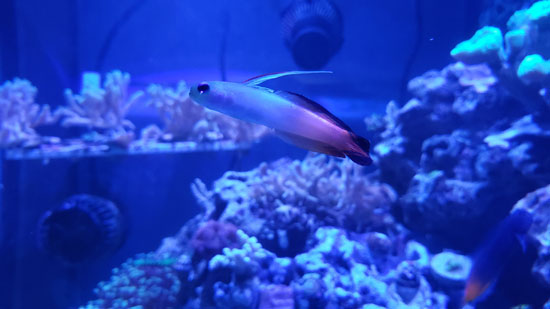
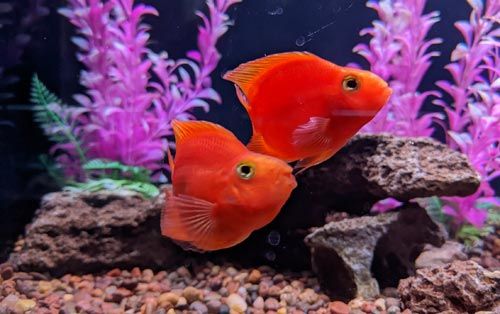
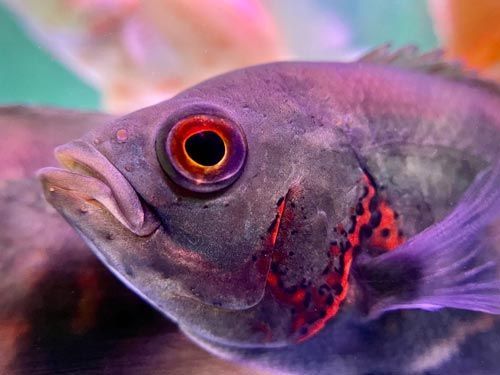
The Pink Streaked Wrasse (Pseudocheilinops ataenia) is a beautiful species of wrasse with various pink, orange, and blue colorations. As its name suggests, the Pink Streak Wrasse has horizontal “streaks” throughout its body. They’re a very peaceful fish species and are generally easy to care for. This guide will dive deeper into the Pink Streak Wrasse’s aquarium requirements, dietary needs, tank mate compatibility, and breeding.
Aquarium Requirements
Sometimes called the Pink Streaked Pygmy Wrasse, this fish species is an excellent choice for many different saltwater aquariums, including nano fish tanks because they only grow to 2.5 inches. I recommend keeping them in 20 gallons or larger aquariums, but if you have plenty of saltwater experience, they can thrive in reef tanks as small as 10 gallons. I also recommend providing them with plenty of live rock of different sizes because they are often very shy when first introduced into the aquarium.
Many wrasses are known to jump out of the fish tank. That’s no different with the Pink Streaked Wrasse. I recommend a well-fitted lid to prevent this from happening.
Water Paremeters
Having stable water parameters is an important aspect of keeping a successful saltwater aquarium. The following are water parameters this species does best under.
Water Temperature: 72°-78° F
dKH: 8 – 12
pH: 8.1 – 8.4
Salinity: 1.020 – 1.025 sg
Consider getting a High Range pH and KH test kit to test for pH & dKH. Keeping your temperature between 72° and 78° can be accomplished with a heater. Take a look at my guide which showcases some great aquarium heaters. Lastly, I would pick up a Refractometer from Amazon to keep an eye on your salinity levels. If calibrated correctly, refractometers are much more accurate compared to a hydrometer which loses accuracy due to salt buildup on the dial. Check out Different Salinity Reading Tools For Saltwater Fish Tanks to get an idea of other salinity testing devices available.
Are Pink Streaked Wrasse Reef Safe?
Pink Streaked Wrasses are reef safe. They should not bother any desirable coral or invertebrate in the aquarium. You will often see this species of fish weave in between different kinds of coral, but it will not bother them. They may nibble on nuisance inverts like bristleworms and flatworms.
Food & Diet
This species is carnivorous, so they will need a protein-rich diet. A good source of protein will be Mysis Shrimp, Brine Shrimp, and other meaty foods found at fish stores. I recommend giving them pellet food as well, to provide a well-rounded diet. For pellet food, the New Life Spectrum Marine Formula is a good choice, but many different brands can be used. Lastly, it never hurts to provide flake food for this wrasse.
Tank Mates
Pink Streak Wrasses are very peaceful. They will mostly mind to themselves and are more likely to be picked on by other fish due to their docile nature. They’re amazing for community saltwater fish tanks. They will do great with fish like Clownfish, Chromis, Gobies, Cardinalfish, Butterflies, Jawfish, Dwarf Angels, Tangs, and Blennies. I would be a little cautious when adding them with fish that use the same space in the aquarium, like Dottybacks and other Wrasses.
I would not recommend them with predatory fish or fish that get incredibly large. Keep them away from Eels, Triggers, Groupers, Large Angels, Anglers, and many other types of large aggressive fish. They will either get picked on or become food for the large fish.
Breeding
I have never bred this species of fish before, but I have read that fish keepers have kept them in small groups. There is not much information on successfully breeding Pink Streaked Wrasses, but you can distinguish between males and females fairly easily because they are sexually dichromatic. Males will have more vibrant streaks of yellow and the females will have a blue coloring over their gills. Regardless, of being able to distinguish between male and female, I feel like the Pink Streaked Wrasse, like many other saltwater fish will be incredibly difficult to breed successfully in a home aquarium.
Final Notes
There are a lot of different species of Wrasses available in this hobby. The Pink Streak Wrasse is considered one of the best for reef aquariums. They have gorgeous colorations and are incredibly peaceful. If you’re setting up a nano reef, consider getting a Pink Streaked Wrasse. If you are not sold on this species, check out other reef-safe Wrasses available in this hobby. It is a growing list of species, so stay tuned for future updates.
Many different species of fish are available to keep in a saltwater aquarium. Searching the internet to find the perfect fish can be an incredible challenge. The amount of information out there can make your head spin. This guide will help you get closer to finding the right fish for your saltwater fish tank. Although many of these fish will not be compatible with one another in such a small fish tank, you’ll at least get an idea of the many fish to choose from.
1. Firefish
Firefish are relatively common and a more popular fish found in saltwater aquariums. They are peaceful fish that hang out above live rock and will dart into the rockwork when startled. They are generally timid fish and choose to hide when stressed. They are known to be jumpers, so keeping a well-fitted lid on your fish tank is highly recommended.
There are a few different species of Firefish, the most common ones are the Firefish (Nemateleotris magnifica) and Purple Firefish (Nemateleotris decora). Less common species of Firefish are the Helfrichi Firefish (Nemateleotris helfrichi) and the Exquisite Firefish (Nemateleotris exquisita). Generally, each species will have similar water parameter requirements and grow to similar sizes.
2. Clown Goby
The Clown Goby is an interesting fish and is often found resting on corals and rockwork for minutes to hours at a time. They are generally very docile and should not bother other fish in the aquarium. However, they may battle it out amongst themselves in smaller fish tanks. They are generally reef-safe but will nip and bother many stony corals such as Acropora, and possibly others.
There are a few different types of Clown Gobies available. The Citrinis Clown Goby(Gobiodon citrinus), is also known as the Citrin Goby or the Yellow Clown Goby. This species, as the name suggests has a yellow coloration to it. Next, is the Green Clown Goby(Gobiodon atrangulatus), which has a mosaic of green, orange, and yellow colors on its body. There is also the Black Clown Goby(Gobiodon strangulatus). This species has a black/blue color to it. Last, is the Panda Goby (Paragobius lacunicolus), which has a yellow and orange body with black fins. You can click on any of their names to check out their complete care guides.
3. Neon Goby
Neon Gobies (Elactinus oceanops) are incredibly small saltwater fish that would do great in a 20-gallon aquarium. They have black, white, and vibrant blue horizontal stripes on their body. They will generally not bother other species of fish in an aquarium, but they become territorial and will likely pick fights with their own species.
In the wild, they pick parasites off other fish, but that’s not always possible in an aquarium. Because of this, the Blue Neon Goby should be fed a variety of Mysis Shrimp, Brine Shrimp, and other frozen foods made for carnivores. They should also be fed at least once a day, but twice a day is optimal.
4. Mexican Barnacle Blenny
Mexican Barnacle Blennies (Acanthemblemaria macrospilus) are communal saltwater fish and a great choice for a 20-gallon saltwater aquarium. Although they are not as active as most other fish, they’re still a fantastic option. Mexican Barnacle Blennies spend most of their time poking their heads out of crevices in rocks, waiting for food to be put into the aquarium. They will then quickly dart out of the rock and grab the food. The fun part about keeping this fish species is trying to find where they are hiding.
5. Possum Wrasse
The Possum Wrasse, sometimes called the Pygmy Wrasse, is an excellent choice for a 20-gallon aquarium because of their unique shape, coloration, and peaceful nature. On top of that, they will hunt for nuisance worms and other microorganisms that may be problematic in your aquarium. They should not bother coral in the aquarium.
There are two types of Possum Wrasse available. The Yellow Banded Possum Wrasse (Wetmorella nigropinnata) and White Banded Possum Wrasse (Wetmorella albofasciata). Both have similar temperaments and dietary needs. However, the coloration and patterns of both species are different. Check out the Yellow Banded Possum Wrasse – Complete Care Guide for more information on this fish.
6. Yasha White Shrimp Goby
The Yasha Goby (Stonogobiops yasha) is an excellent sand-sifting fish for a 20-gallon saltwater aquarium. They have beautiful white, orange, and red colors throughout their bodies and they only grow to about 2.5″. As a bonus, similar to a Watchman Goby, you can pair a Yasha Goby and Pistol Shrimp together to create a symbiotic relationship. There’s nothing better than watching a goby standing guard, while the pistol shrimp is working hard excavating.
Unfortunately, this goby isn’t as common in the hobby as many other species of goby. With patience, you’re likely to find one for sale from time to time.
7. Yellow Watchman Goby
Yellow Watchman Gobies (Cryptocentrus cinctus) are fantastic sand sifters for 20-gallon aquariums. They create burrows along rockwork and spend most of their time excavating and protecting them. The Yellow Watchman Goby is a great fish to pair with a pistol shrimp, but beware because this fish is known to jump out of aquariums. You’re welcome to learn more about this fish by taking a look at the Yellow Watchman Goby – Complete Care Guide.
8. Pink Streaked Wrasse
The Pink Streaked Wrasse (Pseudocheilinops ataenia) is another gorgeous fish that is a great choice for a saltwater aquarium. It is reef-safe and only grows to 2.5″. This species of wrasse has blue, red, and yellow colorations with horizontal streaks spread across its body. Unlike similarly looking Sixline Wrasses, this species should not be aggressive towards other fish. You can learn more about this fish by checking out the Pink Streak Wrasse – Complete Care Guide.
9. Deepwater Candy Basslet
If you have deep pockets and a cool water aquarium, check out the Deepwater Candy Basslet (Liopropoma carmabi). This gorgeous fish has predominately yellow and pink/lavender horizontal streaks. It will grow to about 2.5″ in length and will do best with varying pieces of live rock to use for cover. It is generally peaceful and is mostly reef-safe, but crustaceans that fit into its mouth may become a meal for this fish.
10. Swissguard Basslet
The Swissguard Basslet (Liopropoma rubre) is a gorgeous red, black, and orange saltwater fish with horizontal stripes throughout its body. It grows to about 3″ at full size when it is fully grown. It does best with live rock with plenty of caves and crevices to hide in because this species is known to be fairly shy. It is generally reef safe but may pick on smaller crustaceans.
11. Royal Gramma Basslet
The Royal Gramma Basslet (Gramma loreto) is a vibrant purple and yellow saltwater fish that will do great in a 20 gallon reef tank. It is considered a great beginner fish due to its hardy nature. This species of fish does best in aquariums with an assortment of live rock that it can use for cover. It will protect its territory from other fish.
Final Notes
Hopefully, this list gives you a good idea of the assortment of fish that can be kept in a 20-gallon saltwater aquarium. As a disclaimer, you cannot cram all these fish into a single 20-gallon fish tank. Many of them will not do well together in such a small fish tank, because of potential territorial disputes. This list is made to showcase what’s out there, and more research is needed to figure out what will do well together. If you already have your saltwater fish tank stocked with fish, check out some fantastic Clean Up Crew Options for Saltwater Aquariums!
The Black Clown Goby (Gobiodon strangulatus) as the name suggest, is an all black saltwater fish. It is generally a peaceful fish that spends its time perched on rocks, coral, glass, or equipment in the aquarium. It does not sift through sand like other species of goby. This carnivorous fish is fairly easy to care for, and this guide will cover the Black Clown Goby’s aquarium requirements, food and dietary needs, compatible tank mates, and more.
Aquarium Requirements
Black Clown Gobies only grow to a max size of 1.5 inches. It is possible to keep them in a 10 gallon aquarium or larger. I usually recommend at least a 20 gallon aquarium for beginners due to the sensitivity of saltwater fish and water parameters swings. The aquarium should be full of varying sized live rock that the fish can perch on. I would recommend keeping a lid on the fish tank because this species can jump out.
Water Parameters
Water parameters and keeping them stable is very important to having a healthy fish tank. Most saltwater fish have similar water parameter requirements, but there are some exceptions to this. The following are the parameters that the Black Clown Goby will need.
Water Temperature: 72°-78° F
dKH: 8 – 12
pH: 8.1 – 8.4
Salinity: 1.020 – 1.025 sg
Consider getting a High Range pH and KH test kit to test for pH & dKH. Keeping your temperature between 72° and 78° can be accomplished with a heater. Take a look at my guide which showcases some great aquarium heaters. Lastly, I would pick up a Refractometer from Amazon to keep an eye on your salinity levels. If calibrated correctly, refractometers are much more accurate compared to a hydrometer which loses accuracy due to salt buildup on the dial. Check out Different Salinity Reading Tools For Saltwater Fish Tanks to get an idea of other salinity testing devices available.
Is the Black Clown Goby Reef Safe?
Just like other species of Clown Goby, Black Clown Gobies are mostly reef safe. A single Clown Goby may not disturb SPS coral, but a breeding pair likely will. This species may lay eggs under branching stony coral, like Acropora, which may recede the skin of the coral. The only other note is that they will likely rest on coral which could cause the polyps to close, which could stress the coral out. They should not bother invertebrates in the aquarium.
Food & Diet
I mentioned earlier that this fish species is carnivorous. In the home aquarium they should be fed a variety of protein rich foods. I recommend providing them with Mysis Shrimp, Brine Shrimp, and other types of meaty foods that can be found online and at pet stores. Black Clown Gobies will also benefit from getting supplemented with a high quality flake food and a high quality pellet food. I enjoy using the New Life Spectrum All Purpose Flake Food and the New Life Spectrum Marine Pellet Formula for my saltwater aquariums.
Tank Mates
The Black Clown Goby is a peaceful fish and should not bother others in the aquarium. They will be perfectly fine with Dwarf Angels, Clownfish, Wrasses, Tangs, Foxfaces, Rabbitfish, Butterflys, Basslets, other gobies, and many other fish. However, be cautious when adding them with other rock dwelling fish. Other species may bully Black Clown Gobies away from their rocky territory.
Black Clown Gobies can also be kept in pairs, if you have an appropriately sized aquarium. Up to four individuals should work in a 40 gallon or larger aquarium. Do not keep an odd number of fish because one of the three will likely be picked on quite a bit.
Breeding
It is likely that Black Clown Gobies will breed in the aquarium. They will lay eggs on different surfaces like cables, rock, and glass, to name a few. I have not personally bred this species before, but there is a fantastic forum post on Marine Breeding Initiative, that discusses the process in great detail, mentioning things that went well, and areas that did not succeed.
Final Notes
There are many different species of goby in this hobby. Most of us are looking for a sand sifting species to help maintain a clean sand bed. If you’re looking for something different, really consider the Black Clown Goby. If this species doesn’t catch your attention, there are plenty of other saltwater fish available for you.
The Green Clown Goby (Gobiodon atrangulatus), sometimes called the Green Warpaint Clown Goby, is a gorgeous green and red saltwater fish. Similar to other species of clown goby, this one does not sift through sand but instead spends its day perched on rocks and corals waiting for food to come its way. A full grown Green Clown Goby will be about 1.75 inches, which makes them an excellent choice for a nano aquarium. This Clown Goby care guide will discuss aquarium requirements, dietary needs, tank mates, breeding, and more about the Green Clown Goby.
Aquarium Requirements
As stated earlier, this species of fish only grows to about 1.75″ when fully grown. They can be kept in saltwater fish tanks that are 10 gallons or larger. Green Clown Gobies love to perch on rocks and corals, so their aquarium should have plenty of live rock of varying sizes for them to rest on. If you can’t find any at your local fish store, consider taking a look at the Live Rock on Amazon. They will also use this rock as cover when startled or stressed. Besides live rock, I would also recommend a lid for your aquarium to prevent this fish from jumping out.
Water Parameters
The Green Warpaint Goby has similar water parameter requirements to most saltwater fish in this hobby. It is important to keep these water parameters stable and within range to keep your fish, invertebrates, and coral happy. The following parameters are what this species of fish thrive in.
Water Temperature: 72°-78° F
dKH: 8 – 12
pH: 8.1 – 8.4
Salinity: 1.020 – 1.025 sg
Consider getting a High Range pH and KH test kit to test for pH & dKH. Keeping your temperature between 72° and 78° can be accomplished with a heater. Take a look at my guide which showcases some great aquarium heaters. Lastly, I would pick up a Refractometer from Amazon to keep an eye on your salinity levels. If calibrated correctly, refractometers are much more accurate compared to a hydrometer which loses accuracy due to salt buildup on the dial. Check out Different Salinity Reading Tools For Saltwater Fish Tanks to get an idea of other salinity testing devices available.
Is the Green Clown Goby Reef Safe?
The Green Clown Goby is generally reef safe. I say generally because they can cause damage to SPS coral, especially Acropora when they are breeding. In the wild, they lay their eggs on the underside of SPS coral. This will cause the coral tissue to recede. They will likely do the same to your SPS coral in the aquarium. Otherwise, they should not bother any soft coral, zoanthids, or invertebrates.
Food & Diet
This species of fish requires a protein-heavy diet because it is carnivorous. It is up to you whether you feed these fish frozen foods or freeze-dried foods but I recommend providing them with Brine Shrimp, Mysis Shrimp, and many other types of meaty foods. They should easily accept other types of food like flake food and pellet food. I recommend feeding them New Life Spectrum All Purpose Flake Food and New Life Spectrum Marine Formula Pellet Food. Your Clown Goby and most other saltwater fish will benefit from these foods.
Tank Mates
Green Clown Gobies are very peaceful fish and should not bother anyone else in the aquarium. I recommend keeping them with many different types of fish such as Dwarf Angels, Tangs, Foxfaces, Clownfish, Rabbitfish, Basslets, Blennies, Chromis, and much more. You have to be careful with fish that use the same space of the aquarium, like Blennies, Basslets, and other rock-dwelling fish. It shouldn’t be a problem in a large enough fish tank.
They may become territorial with other Clown Gobies in smaller aquariums, but pairs can be kept together if you’re fine with them possibly breeding in the aquarium. I would not keep odd numbers of this fish species because there will likely be a lot of fighting between the three. In a 40 gallon aquarium, you could likely get away with keeping up to 4 individuals.
Breeding
Clown Gobies will likely breed in your saltwater fish tank if you keep a pair. I have not personally bred them, but there is a great forum post on Marine Breeding Initiative that discusses the process of successfully breeding your Clown Goby from egg to adulthood.
Final Notes
The Warpaint Goby is a fantastic and uniquely colored fish to add to a saltwater aquarium. They have a very docile nature and can sit on rocks and corals for minutes to hours. It’s very entertaining to observe them move about their day. It’s also not very common to see a green fish like this. However, if this fish isn’t for you, consider taking a look at many other saltwater fish available in this hobby.
The Citron Goby, sometimes called the Citrinis Clown Goby, or Citrin Goby, is a beautiful yellow and blue saltwater fish. They’re small fish that will only grow to about 2 inches. They are generally very peaceful and should not bother other fish in the aquarium, but they may fight amongst themselves. Citrin Gobies will often sit motionless on rocks, glass, and sand beds for minutes to hours. This article will go deeper into this Clown Goby’s aquarium requirements, dietary needs, tank mates, and more.
Aquarium Requirements
Due to their small size, a Citrin Goby can be kept in a 10-gallon aquarium, but I would recommend at least a 20-gallon aquarium. Unlike many species of goby, this one does not sift sand but instead hangs out on rockwork, coral, glass, and other hard surfaces. A lot of live rock of varying sizes is recommended for keeping these fish. Sometimes it is hard to find at your local fish store, so consider checking some out Live Rock on Amazon. I also recommend purchasing a well-fitted lid for your aquarium because Clown Gobies can jump out.
Water Paramaters
Most animals kept in captivity, do best when you mimic their natural habitat in their enclosure. The same stands for the Clown Goby. Providing them with proper water parameters will help them live a long and happy life. Their water parameters are similar to most saltwater fish, which are listed below.
Water Temperature: 72°-78° F
dKH: 8 – 12
pH: 8.1 – 8.4
Salinity: 1.020 – 1.025 sg
Consider getting a High Range pH and KH test kit to test for pH & dKH. Keeping your temperature between 72° and 78° can be accomplished with a heater. Take a look at my guide which showcases some great aquarium heaters. Lastly, I would pick up a Refractometer from Amazon to keep an eye on your salinity levels. If calibrated correctly, refractometers are much more accurate compared to a hydrometer which loses accuracy due to salt buildup on the dial. Check out Different Salinity Reading Tools For Saltwater Fish Tanks to get an idea of other salinity testing devices available.
Is The Citrin Goby Reef Safe?
For the most part, the Citrin Goby is reef safe. However, stony coral can be in danger of this fish when it is breeding. This goby species lay its eggs on the underside of branches of SPS coral. This can cause the tissue of the SPS coral to recede. Their favorite to do this with is Acropora, but many species of stony coral are not safe. They should be fine with soft coral and most invertebrates.
Food & Diet
This species of fish is carnivorous. Their diet should match what they consume in the wild. It is best to feed Citrin Gobies Brine Shrimp, Mysis Shrimp, and other types of protein-rich foods. My personal preference is thawed frozen fish food, but freeze-dried food can work as well. Also, I recommend providing Clown Gobies with high-quality flake food such as the New Life Spectrum All Purpose Flakes, and protein-rich pellet food like the New Life Spectrum Marine Formula, to provide a variety and cover more nutritional bases.
Tank Mates
The Citrin Goby will do well with most friendly saltwater fish species. I would recommend them with Dwarf Angels, Tangs, Foxfaces, Clownfish, Rabbitfish, Basslets, Blennies, Chromis, and much more. I would be weary of keeping them with large fish, and fish with large mouths, like Anglers, Groupers, Eels, and others. They can make lunch out of this fish very easily. Also, Citrin Gobies are often peaceful, but other fish may be territorial around rockwork. Be aware that they may get picked on when entering other fish’s territory.
In appropriately sized aquariums (minimum 40 gallons), small groups of Clown Gobies can be kept together. If you’re keeping the same species, I would recommend 2 or 4 individuals so they can pair off. I do not recommend odd numbers because one of the groups will likely get bullied, stressed, and even killed. Keep in mind that if you keep more than one in your aquarium, there’s a chance that they will breed and wreak havoc on your SPS coral.
Breeding
If you have a breeding pair of Clown Gobies in your aquarium, they may spawn on their own without any human intervention. However, getting the eggs to successfully hatch and grow into adulthood will be the bigger challenge. Especially when many other opportunistic fish are waiting to eat the eggs. I do not personally have experience breeding this species, but here is a forum post on Marine Breeding Initiative that archives the process someone took to get eggs to hatch.
Final Notes
Citrinis Clown Gobies are unique-looking fish with an interesting personality. It’s incredibly fun watching them perch on rocks and corals waiting for food to come their way. Their leisurely and peaceful personalities make them excellent candidates for community saltwater fish tanks. However, be cautious because they may mess with your Acroporas and other SPS corals. If you’re not sold on the Citrinis Clown Goby, check out other species of saltwater fish for your aquarium.
White Cloud Mountain Minnows are beautiful and easy to care for freshwater fish. This species comes in three different variants which are, White Cloud Minnow, Gold White Cloud Minnow, and Longfin White Cloud Minnow. Each of these could be kept together and they will likely school together with no problems. Unlike, many other fish that you come across in this hobby, White Clouds prefer living in cooler water. This guide will discuss their temperature needs as well as other aquarium requirements, food and diet, compatible tank mates, and breeding habits.
Aquarium Requirements
White Cloud Minnows will grow to a max size of 2″. This makes them great candidates for a 10-gallon aquarium. Keep in mind that they do best in schools of at least 6 individuals, but more is always preferred. If your aquarium is well planted and they are the only fish in the aquarium, you should be fine with keeping between 6 – 12 individuals. A larger school will help the fish feel more comfortable and less shy in the aquarium.
They’re not known to be jumpers, however, I do recommend providing a well-fitted lid on your aquarium to be on the safe side. Any fish can jump out of the aquarium if they are determined enough.
How Many White Cloud Minnows in a 20 Gallon Tank?
With a good filter and a well-planted aquarium, you should be able to keep up to 20 White Cloud Mountain Minnows in a 20-gallon aquarium. This is only if this species of fish is the only fish in the fish tank. You will need to lower the total White Clouds if you plan on adding plecos, cory cats, or other fish into the fish tank.
Water Parameters
The water parameters, specifically temperature, make them a little harder to keep with other tropical fish. White Cloud Mountain Minnows are very hardy fish but we will need cooler water to help them thrive in your aquarium. The following are the water parameters that White Clouds do best in.
Temperature: 64°F – 72°F
Water Hardness: 10 – 15 KH
pH: 6.0 – 8.0
As you can see, they do best in waters that are at their warmest 72°F. Most tropical fish require water usually between 74°F – 78°F. There are a few fish species that will do well in cooler water. You may not require a heater for this aquarium, but a thermostat is still recommended just to keep an eye on the temperature. You can pick up this fancy PAIZOO Digital Thermometer from Amazon or keep it simple with the Marina Floating Thermometer.
Food & Diet
This species of fish is omnivorous, and they are generally not picky eaters. White Cloud Mountain Minnows will easily accept frozen foods such as Tubifex Worms and Bloodworms. I would also recommend providing them with high-quality flake food, such as the Omega One Super Color Flakes, and small pellet foods like the New Life Spectrum Tropical Pellets. Giving them a variety of food will provide them with a well-rounded diet which will help keep them healthy.
Tank Mates
Although there aren’t as many fish that have the same water parameter needs as White Cloud Mountain Minnows, there are still plenty to choose from. In appropriately sized aquariums White Clouds can be kept with Zebra Danios, Gold Ring Burmese Danio, Platys, Paradise Fish, and/or Guppies. You can also strengthen the size of your White Cloud Minnow population. They will also do fine with Red Cherry Shrimp, Ghost Shrimp, Mystery Snails, Rabbit Snails, and many more invertebrates.
Although White Clouds and Goldfish have similar water parameter requirements, I would not recommend keeping them together. Goldfish will be able to make a nice meal out of your White Clouds. Also, Goldfish are very messy and get incredibly large. They do best with other Goldfish and Koi, preferably in an outdoor pond. You can learn more about Goldfish by checking out the Goldfish – Complete Care Guide.
Breeding
White Cloud Minnows should easily breed in the aquarium on their own. They lay eggs which will probably get eaten by many different species of fish including the White Cloud Minnows themselves. You can try to imitate a transition from spring to summer by increasing the temperature a degree or two in the fish tank. Also, increasing feeding may create a breeding response in your fish. If you want to increase the success of the eggs and fry without setting up a breeding tank, I would recommend providing a variety of plants in your aquarium. Denser populations of plants will give your fry more places to hide. Moss, floating plants, and Hornwort are good options for this.
Fry may figure out how to survive on their own, but if you see fry moving about the tank, you may need to feed them live baby brine shrimp to help promote growth. Feeding them live foods will help them successfully reach adulthood.
Final Notes
White Cloud Minnows are fantastic and hardy cool water freshwater fish. If you are getting into this hobby, they’re a great fish to start with. They are fairly cheap, very colorful for the type of fish they are, and very active. You will likely not be disappointed in keeping this fish.
Red Phantom Tetras, as the name suggests, are beautiful red fish with a black-tipped dorsal fin. They are freshwater schooling fish and great additions to many community aquariums. They look similar to other tetra species such as the Bleeding Heart Tetra and Serpae Tetra. It is best to keep this species in groups of 6 or more. This guide will detail the Red Phantom Tetra’s aquarium requirements, dietary needs, compatible tank mates, and more.
How Big Do Red Phantom Tetras Get?
The Red Phantom Tetra will be about 1.5″ – 2″ in length when fully grown.
Are Red Phantom Tetras Fin Nippers?
Red Phantom Tetras should not nip on other fish species when they are in large enough groups, but there is always a possibility. If their school is too small, they may resort to bullying and nipping on the fins of other fish. Red Phantoms are also less commonly known as fin nippers compared to the similarly looking Serpae Tetra, which has a reputation for nipping on the fins of other fish.
Aquarium Requirements
To make them comfortable and give them the best chance at thriving in your fish tank, Red Phantom Tetras should be kept in 20-gallon aquariums or larger. They will also do best in a well-planted fish tank with a variety of rocks and driftwood to provide cover when stressed. Driftwood also releases tannins over time which can help soften your water and lower its pH. The side effect is that it may also tint your aquarium brown. Consider checking out Coral Driftwood and/or Spiderwood which are some of my favorite looking types of wood. You can follow the link which will take you to their store page on Amazon!
Although Red Phantom Tetras aren’t commonly known as jumpers, I would still recommend placing a well-fitted lid on the fish tank to truly prevent it from happening. Most fish can potentially jump out of the aquarium when they are startled.
Water Parameters
Water parameters are an important aspect of keeping your fish happy. Every fish species has specific water parameters they do best with. The following are the parameter ranges for the Red Phantom Tetra.
Temperature: 72°F – 78°F
Water Hardness: 4 – 8 KH
pH: 5.5 – 7.5
Keeping your water parameters within this range doesn’t always guarantee your fish will succeed in your aquarium, but it will help give it the best chance. You can keep your temperature stable with a heater and thermostat. Check out what are in my opinion, the 6 best Heaters for Freshwater and Saltwater Aquariums! Furthermore, to know what kind of water you have, you’ll have to purchase testing kits. My go-to testing kits are the API Freshwater Master Test Kit and API GH & KH Test Kit. The master test kit lets you test for pH, ammonia, nitrites, and nitrates. The GH & KH test kits will help you figure out what the hardness levels of your aquarium are.
Food & Diet
Red Phantom Tetras are omnivores and often readily consume any type of food introduced into the aquarium. I would recommend providing a variety of different food to give them a well-rounded diet. They should consume frozen daphnia, bloodworms, and brine shrimp with no problems. I would also provide them with flake foods such as the New Life Spectrum All Purpose Flakes and Omega One Mini Pellets.
Tank Mates
This species of fish is generally very peaceful and will mostly spend time tightly and loosely schooling with other Red Phantom Tetras. They should do perfectly fine with most other community fish like Neon Tetras, Mollies, Platies, Rasboras, Corydoras, and many other peaceful fish. In a large enough aquarium, they should also be fine with different species of Ram, Angelfish, Rainbowfish, and Barbs.
I would not recommend keeping them with African Cichlids, and other aggressive and large fish like Oscars, Jack Dempsey, Pike Cichlid, and other similar types of fish. Anything that can easily fit a Red Phantom Tetra into its mouth should be avoided.
Can I Keep Red Phantom Tetras With Shrimp?
Red Phantom Tetras will not actively hunt shrimp. However, many fish are opportunistic eaters so there is a possibility that they may try. Most adult shrimp’s exoskeletons will protect them from becoming a meal, but they are vulnerable when they molt because they shed their hard battle armor. Also, newborn shrimp and very small shrimp can become food for Red Phantom Tetras.
If you’re looking to mix these two, I would recommend providing an abundance of hiding spots like caves and well-planted sections where the shrimp can take refuge.
Breeding
Before discussing breeding, you have to know how to tell the difference between male and female Red Phantom Tetras. The easiest way to do this with this species it to look at their dorsal fins. Males will have a much large dorsal fin compared to the female. During spawning, the males should also pop in color more than the female does.
This fish species should breed on their own in a well-established aquarium. It is best to keep them in slightly acidic water to encourage breeding. You will see males courting the females in the aquarium when it’s time to breed. They do not care for their eggs. Instead, they scatter them throughout the aquarium and leave the eggs to develop on their own. Some aquarists will put their spawning Red Phantom Tetras into a breeding tank to release their eggs. Once the eggs are released, the breeders are removed from the breeding fish tank. This way, the eggs have the highest chance of survival because the parents and other fish will not prey on the eggs.
Final Notes
Red Phantom Tetras are wonderful fish and likely the peaceful counterpart of the Serpae Tetra. They’re fantastic fish to add to a community aquarium and will add a striking red color to the environment. Larger schools of these are always preferred to get the full effect of this fish species. However, if the Red Phantom Tetra isn’t for you, consider checking out a few other Red Tropical Fish for your Freshwater Aquarium!
Ember Tetras are beautiful red/orange freshwater fish that can be kept as a pet. They are perfect choices for nano fish tanks due to their small size. They’re peaceful schooling fish that greatly add to most community aquariums. This fish species is excellent if you’re looking to fill your aquarium with tiny fish. This guide will cover Ember Tetra care. It will discuss this specie’s aquarium requirements, food & diet, compatible tank mates, and breeding habits.
Aquarium Requirements
Ember Tetras are very peaceful fish that stay very small. They will be about an inch in length when fully grown. This makes them excellent candidates for nano aquariums as a centerpiece schooling fish or a schooling fish that blends into the background of a large aquarium. A well-planted aquarium with various rocks and driftwood makes the perfect enclosure for Ember Tetras.
How Many Ember Tetras in a 10 Gallon Tank?
A minimum of 6 fish are recommended to be considered a school. You should be able to successfully keep between 10 to 15 Ember Tetras in a 10-gallon fish tank. The max size of Ember Tetras and their incredibly small bio load gives you some flexibility regarding population sizes in a fish tank.
Water Parameters
Learning the water parameters for your aquarium is important to its success. Fish like the Ember Tetra are found in the tropical waterways of South America. This type of water is much different than what can be found in Lake Tanganyika, which has much harder and calcium-rich water. The following are water parameter ranges that will help you successfully keep Ember Tetras.
Temperature: 72° – 77°F
pH: 5.5 – 7.0
Water Hardness: 4 – 8 KH
Based on the water parameters you can see that Ember Tetras do best in softer and acidic water. Some homes have naturally soft and acidic water, but there are many homes such as ones with wells that do not. Often well water is rich in calcium and other minerals that cause a spike in pH levels and hardness. An easy way to test for this is through the use of an aquarium test kit. I recommend purchasing an API Freshwater Master Test Kit and API GH & KH test kit. With these test kits, you can keep an eye on your aquarium’s pH, General Hardness (GH), Carbonate Hardness (KH), ammonia, nitrites, and nitrates.
Food & Diet
Ember Tetras stay incredibly small, they may not be able to consume the large fish food that is often provided. They will do great with frozen daphnia, brine shrimp, and Mysis Shrimp. Traditional pellet food may be a little large for them to consume, so I recommend feeding them Ultra Fresh Tropical Micro Pellets and flake food such as New Life Spectrum All Purpose Flake Food. In the wild Ember Tetras eat a variety of foods so it is important to provide the same experiences in the aquarium.
Tank Mates
Ember Tetras, like most peaceful fish, will do fantastic with most other peaceful community fish. Keeping them with Tetras, Rasboras, Corycats, Honey Gouramis, Endlers Livebearers, Guppies, and other community species, should be successful.
Due to their size, I would not recommend keeping Ember Tetras with large fish, fish with large mouths, and fin nippers. Their small size and peaceful temperament do not allow them to hold their own against more aggressive fish. You will want to keep them with community fish that will not harass Ember Tetras.
Breeding
A large enough school will provide you with both males and females. In a well-established and healthy aquarium, Ember Tetras should breed on their own without much intervention. However, getting eggs to hatch before getting eaten and having your fry develop into adulthood will be the challenge.
Ember Tetras scatter their eggs throughout the aquarium after spawning. The eggs are adhesive and will stick to many different surfaces in the fish tank. To provide the best chance for the eggs, a heavily planted aquarium will be needed to provide hiding places for the eggs to adhere to. I recommend many different plant species, especially things like java moss that grow dense which may create cover for eggs. A lot of plants will also benefit from providing cover for the fry once they hatch.
Eggs and fry are likely to get eaten by most other inhabitants of the aquarium. Keeping your Ember Tetras in a species-only aquarium will help cut down on the die-off. For more information on breeding, check out real life experiences of breeding Ember Tetras on Fishforums.
Final Notes
If you enjoy nano fish tanks and micro fish, Ember Tetras might be an excellent choice for you. They are small, stay small, have a nearly non-existent bio-load, and generally are great fish to keep. Their red/orange colorations will pop in a well-planted aquarium and maybe just the final touch you need for your fish tank. If you’re not sold on Ember Tetras, consider checking out other Red Tropical Fish for your Freshwater Fish Tank.
The Two Spot Goby, sometimes called the Twin Spot Goby, Crabeye Goby, or Signal Goby, is a beautiful sand-sifting saltwater fish. It is predominately white, brown, and tan. It gets its name from the two vibrant yellow rings on its dorsal fin. The Twin Spot Goby is a fairly peaceful fish that keeps to itself, but it is more than happy to defend its territory.
The Twin Spot Goby is considered a difficult fish to keep. This is primarily due to their finicky and niche diet and feeding requirements. Consider getting a different species of goby, like a watchman goby, if you’re looking for something easier to keep. This guide will cover Two Spot Goby’s aquarium requirements, food & diet needs, tank mates, and breeding.
Aquarium Requirements
The Two Spot Goby grows to about 3″, so it will do well in a 10-gallon aquarium or larger. Due to their dietary needs, I would recommend a much larger fish tank. If you choose to keep them in this size fish tank, it is recommended to also have a well-established refugium, with a large population of microfauna. The micro fauna will likely be their main source of food, especially when first introduced. Twin Spot Gobies sift through sand in search of food, so will require a sand bed between 1″ – 2″ deep. I recommend fine sand, such as the CaribSea Fiji Pink Sand. It is fine, but not as fine as the CaribSea Bahama Oolite Sand which gets stirred up very easily.
Live rock is also recommended for your goby fish tank. Gobies may occasionally hide in live rock when stressed or startled. It also provides a lot of surface area where beneficial bacteria will colonize. Live rock should be either touching the bottom of your glass or very close to it to guarantee the goby does not burrow under and create a rock slide. Unsecured rock is asking to be knocked over, which can hit the glass and break the fish tank.
Lastly, a well-fitted lid is recommended because most types of gobies are known to jump. Somehow fish always manage to find the smallest opening to jump out of.
Water Parameter
Keeping water parameters in check is incredibly important. The following are the water parameter requirements for the Two Spot Goby. Most saltwater fish have similar water parameter needs but there are a few exceptions.
Water Temperature: 72°-78° F
dKH: 8 – 12
pH: 8.1 – 8.4
Salinity: 1.020 – 1.025 sg
Consider getting a High Range pH and KH test kit to test for pH & dKH. Keeping your temperature between 72° and 78° can be accomplished with a heater. Take a look at my guide which showcases some great aquarium heaters. Lastly, I would pick up a Refractometer from Amazon to keep an eye on your salinity levels. If calibrated correctly, refractometers are much more accurate compared to a hydrometer which loses accuracy due to salt buildup on the dial. Check out Different Salinity Reading Tools For Saltwater Fish Tanks to get an idea of other salinity testing devices available.
Is the Two Spot Goby Reef Safe?
Yes, the Two Spot Goby is reef safe. It should not pick on any of your coral because it is too busy sifting the sand for food. Keep in mind that any coral that is growing at the bottom of your aquarium or in the rock may have sand dropped on it due to the goby.
Food & Diet
The Twin Spot Goby will spend most of its time sifting through sand in search of microscopic organisms in the sand. As stated earlier, an established aquarium, a highly productive refugium, and a sand bed will help keep your fish fed and happy. Sometimes Two Spot Gobies are stubborn and refuse to eat prepared food, but with time and patience, they may decide to eat food provided to other fish.
This fish species is carnivorous and will require a protein-rich diet. I recommend trying to feed the Two Spot Goby a variety of foods such as Mysis Shrimp, Brine Shrimp, and pellet food rich in protein. The New Life Spectrum Marine Formula has 36% Crude Protein. It’s a good choice of pellet food to supplement with other protein-rich foods.
Tricks for Feeding
A stubborn Two Spot Goby that refuses to eat prepared food may become a headache but, there are ways to help keep it alive while you attempt to train it to eat prepared food. First, you will need a long feeder syringe, and any coral food (Polyp Lab Reef-Roids, Reef Chili, Coral Feast, etc.). Next, you will have to find where your Two Spot Goby has its burrow. Lastly, mix coral food with water, suck it into the syringe, and dispense it very close to and in the sand near the goby’s burrow. This will help keep your fish fed, while attempting to train it to consume other foods.
I would also recommend turning off or cutting down on the flow of water during feeding. This will give the food a chance to settle which may help your goby eat.
Tank Mates
Most peaceful saltwater fish should do well with the Two Spot Goby. It should do great with fish such as Anthias, Dwarf Angels, Basslets, Chromis, Dottybacks, Wrasses, Foxfaces, Tangs, and many others. It doesn’t use the same space as most other fish. It spends most of its time at the bottom of the aquarium sifting through the sand. With that in mind, there may be territorial disputes between this goby and other gobies and/or jawfish. I would make sure the aquarium is appropriately sized if you plan on keeping more than one goby.
Two Spot Goby and Pistol Shrimp
The Two Spot Goby does not mix well with a Pistol Shrimp. I would recommend keeping a Pistol Shrimp with a Yellow Watchman Goby. They will readily pair and become excellent partners in an aquarium.
Breeding
If purchased small, a pair of Two Spot Gobies may become a breeding pair. However, I have personally never attempted to breed this fish but, it is possible to do so in captivity.
Final Notes
The Two Spot Goby is a gorgeous reef safe goby that could make an excellent addition to your saltwater fish tank. Keeping them may be a challenge, and is not recommended for a beginner, but with experience and patience may become a great choice. If you’re newer to saltwater fish, consider getting an easier to care for goby like a watchman.
Red Honey Gourami is a beautiful freshwater fish that is found with red/orange colorations. Their color makes them pop in most aquariums, which makes them great centerpiece fish for smaller aquariums. The Red Honey Gourami size at adulthood will be about 2 inches, which means they will do great in nano fish tanks. This guide is meant to provide general care for this species of fish. The article will cover Red Honey Gourami aquarium requirements, dietary needs, tank mates, and breeding habits.
Aquarium Requirements
As stated above, Red Honey Gourami size will max out around 2 inches. A single Honey Gourami should do well in a 5 or 10-gallon aquarium, but a small group of 3 individuals should be in at least 20 gallons. They will do well solitarily, or in a small group, as long as their aquarium needs are met.
Red Honey Gouramis do best in well-planted aquariums with plenty of hiding places. I suggest adding rocks and driftwood into your aquarium for hiding places. Also, floating plants, such as Salvinia minima or dwarf water lettuce will help comfort your fish and assist with bubble nest building if you choose to breed the species.
Water Parameters
Honey Gouramis are quite versatile when it comes to water parameter needs. The following are the parameters they do best in:
Temperature: 74° – 82° F
pH: 6.0 – 8.0
Water Hardness: 4 – 10 KH
Stable water parameters will be the key to keeping this fish happy and healthy in the aquarium. They are generally easy to care for animals, but providing them with a healthy diet and stable/clean water will really allow them to flourish. Consider getting an API Freshwater Master Test Kit, which will help you monitor your water parameters. The API GH & KH Test Kit will be needed to keep an eye on your water hardness.
Food & Diet
Red Honey Gouramis are omnivores, this means that they consume both plant and animal matter. They will do best being fed a variety of food such as bloodworms, Mysis shrimp, Daphnia, and Brine Shrimp. A high-quality pellet food and/or flake food should also be introduced to provide a varied diet. Some of my favorite pellet foods are the New Life Spectrum brand and you can’t go wrong with the Omega One Super Color Flakes. The Red Honey Gourami will also enjoy algae wafers, zucchini, and cucumbers for grazing from time to time.
Are Red Honey Gouramis Aggressive?
Red Honey Gouramis are incredibly peaceful fish. Most other gourami species are known to be more territorial and a bit more aggressive. The Red Honey Gourami may become shy when more active fish are introduced into the aquarium. Providing a lot of hiding places for this fish species will help alleviate some stress from active tank mates.
Tank Mates
Red Honey Gouramis should do well with most freshwater community fish. They will do great with Tetras, Rasboras, Guppies, Corycats, Platies, Rainbows, and many other peaceful freshwater fish. However, I would avoid keeping them with larger, more aggressive fish, such as larger cichlids. Also, I would avoid very fast-moving fish, such as Danios, mostly because they will likely outcompete this species for food.
Breeding
If you have a pair, Red Honey Gouramis will likely breed in your aquarium. Males and females are fairly easy to tell apart. Adult females are usually larger than males, but the males should have more vibrant colorations than the females. When breeding, a bubble nest will be formed and the eggs will be within the bubble nest. The aquarium should have little to zero water flow to help with the success of the bubble nest. Floating plants are also recommended to help the bubble nest’s success.
The male Red Honey Gourami will tend to the nest until the eggs hatch. If possible, it is recommended to separate the female from the aquarium. Gourami offspring are incredibly small after hatching. Small live foods will be a necessity in keeping the babies alive. They will unfortunately likely be preyed upon by other tank inhabitants unless they are separated.
Final Notes
Red Honey Gouramis are gorgeous fish that will stand out in your planted aquarium. Their peaceful personalities make them fantastic for community aquariums. They are also perfect for nano fish tanks due to their generally small size. If Red Honey Gouramis are not for you, check out 9 other Red Tropical Fish for Your Freshwater Fish Tank. Hopefully, one fish from that list will spark your interest!
The Red Irian Rainbow is a gorgeous freshwater fish with red, orange, gold, and silver colorations throughout its body. Males will have more pronounced colorations when females are present and will dull in color when no females are in the aquarium. Sometimes called the Red Rainbow Fish, this fish is incredibly peaceful and should generally keep to itself.
This article will focus on general care for the Red Irian Rainbow Fish. It will cover aquarium requirements, food & diet needs, suggested tank mates, and potential breeding requirements.
Aquarium Requirements
Red Irian Rainbows grow to be about 4″ – 4.5″ in length. Because of their schooling requirements, max length, and active personalities, they will do best in 55 gallon aquariums or larger. Check out my list of Standard Glass Aquariums to get an idea of how big and how heavy a 55 gallon fish tank will be. This fish species also does best in planted aquariums that have a fair amount of open space to swim in.
Water Parameters
Stable water parameters are an important aspect of keeping your fish healthy and happy. Many water parameters need to be monitored while keeping fish. After your aquarium goes through its nitrogen cycle, nitrates, phosphates, pH, temperature, KH (carbonate hardness), and GH (general hardness) are probably the most important to keep your eye on. Red Irian Rainbows do best in the following conditions:
Temperature: 72° – 77° F
KH: 9 – 19
pH: 7.0 – 8.0
Nitrates and phosphates should generally be kept as low as possible. This is possible through scheduled water changes, not overfeeding, and growing live plants in the aquarium. Red Rainbows have a fairly wide range of water parameters they will do well in, which is great for newer fish keepers. You can test for most of your water parameters with the API Freshwater Master Test Kit. Unfortunately, the API GH & KH Test Kits are not included but can be purchased separately by following this link.
Food & Diet
The Red Irian Rainbow Fish is omnivorous, and it is recommended to provide them with a variety of food types. I recommend feeding them brine shrimp, Mysis shrimp, and bloodworms to fulfill their protein needs. I would also supplement their diet with flake foods and pellet food. I personally enjoy feeding my fish the New Life Spectrum All Purpose Flakes.
Tank Mates
Most community fish will do perfectly fine with Red Rainbow Fish. However, I would start by creating a strong school of this fish species, which will likely become the aquarium centerpiece. In an appropriately sized fish tank, other rainbow fish species can be mixed with Red Rainbows. Otherwise, tetras, rasboras, peaceful barb species, cory cats, livebearers, and angelfish are a few types of fish that should do well with Red Rainbows. I would avoid mixing Red Rainbow Fish with aggressive fish such as large aggressive cichlids or fin-nipping barbs.
Breeding
Irian Red Rainbow Fish may breed in the aquarium without human intervention. They will typically release eggs on moss. To get the most success, eggs should be hatched separately from adult fish. Once the eggs hatch, it’s recommended to feed them very small live food such as live baby brine shrimp, or you can try feeding them this Ultra Fresh Baby Fish Food from Amazon.
If you cannot separate adults from the eggs, you can increase your chances of success by providing areas in the aquarium that are very heavily planted. This will create a lot of cover and refuge areas for your newly hatched fry.
Final Notes
Overall, the pop of color and life the Red Irian Rainbow brings to an aquarium, cannot be beaten. They’re great schooling fish for many larger community fish tanks. Remember, the male’s color will pop the most when females are present in the aquarium. I have seen Red Irian Rainbow Fish for sale both in-store and online from prices ranging from $9.99 to $18.99. If you are looking for a pop of red color in your aquarium, consider checking out 10 Red Tropical Fish for Your Freshwater Fish Tank.
Freshwater fish come in many different colors, shapes, and temperaments. There is a red freshwater fish to fill every niche in this hobby whether you want to fill a planted community tank or a large aggressive predatory aquarium. This guide will discuss some fantastic red tropical fish that are available for freshwater aquariums. As a disclaimer, I will not be covering a lot of the care needed for these fish, but I will showcase the many different species out there.
1. Cherry Barb
Cherry Barbs are beautiful freshwater fish and are first on this list of red freshwater fish. Unlike many other barbs, this is a very peaceful fish that will do great in a freshwater community tank. The males usually showcase a dark red color, which becomes a vibrant cherry red when breeding, and females are usually a mixture of brown and dull red.
How Many Cherry Barbs in a 10 Gallon Tank?
I personally would not recommend keeping Cherry Barbs in a 10 Gallon Tank. I would recommend for aquariums that are 20 gallons or larger. Although they do not tightly school, it is recommended to keep them in groups of 5 or more. On top of that, this species of fish enjoys exploring the whole fish tank. A 10 gallon aquarium does not provide enough space for your Cherry Barb to explore.
How Big Do Cherry Barbs Get?
Cherry Barbs get to about 2″ when fully grown. They do not get very large so they should not dominate other community fish during feedings.
2. Ember Tetra
Ember Tetras are beautiful little fish with vibrant red colors, that do great in freshwater aquariums. Similarly to many other tetras, this species does best in groups. This species is great if you’re looking for a very small fish to add into a freshwater aquarium. They should not get larger than 1″ when fully grown. They’re very peaceful and will keep to themselves so they will be great in a species aquarium, or a community fish tank with similarly sized fish.
How Many Ember Tetras in a 10 Gallon Tank?
If you’re just keeping only Ember Tetras in your aquarium, you should be able to stock the fish tank with about anywhere between 8 and 14. Someone with more experience, excellent water conditions, and a fish tank full of plants will likely keep 14 successfully. On the other hand, I would recommend 8 if you’re newer to fishkeeping or don’t always keep up with water changes/keeping water parameters in check.
How Many Ember Tetras in a 20 Gallon Tank?
Ember Tetra size and small bio-load allow you to stock a 20-gallon with anywhere between 16 and 24 individuals. Like a 10-gallon, a well-kept aquarium should hold 24 individuals. 16 Ember Tetras are recommended for aquariums that may have a few other fish or that may not always have the best water parameters. Every aquarium is unique, so I cannot definitively answer how many fish can be kept in a fish tank. These are merely suggestions.
3. Red Phantom Tetra
If you love Ember Tetras but want something that’s a little bigger, then you have to check out Red Phantom Tetras. The Red Phantom Tetra is slightly transparent with different red tones on its body. This species grows to about 2″ as an adult, and will do great in aquariums that are 20 gallons or larger. Like many other tetra species, Red Phantom Tetras do best in schools of 6 individuals or more.
How Many Red Phantom Tetras in a 10 Gallon Tank?
To have a properly sized school, I would not recommend keeping Red Phantom Tetras in a 10-gallon tank. A 20-gallon or larger will be more suitable for this fish species. The extra aquarium space will allow you to keep anywhere between 6 and 9 Red Phantoms.
Can I Keep Red Phantom Tetras with Shrimp?
Red Phantom Tetras should not normally bother adult shrimp. However, they may try to make a snack out of recently molted shrimp due to them temporarily having a soft body. Also, baby shrimp may become food for this species of fish. If you are interested in keeping shrimp with Red Phantom Tetras, consider providing many hiding places and heavily plant your aquarium to provide cover for your shrimp.
4. Betta Fish
Betta fish come in a wide assortment of colors. There are fully red bettas or betta fish with red mixed with different types of colors. There is a choice for pretty much anyone. Also, Betta fish are fantastic fish to have due to their wonderful personalities. I have seen aquarists go so far as to teach their betta tricks. I will cover a few things about bettas below, but consider checking out the Betta Complete Care Guide for more information.
How Long Do Betta Fish Live?
A Betta Fish can live anywhere between 2 and 5 years. Excellent water parameters and a properly sized aquarium should help this fish live a stress-free life which should help it live longer.
Do Betta Fish Need a Filter?
From personal experience, I do recommend providing a filter for your Betta Fish. The filter, whether it’s a Hang-on back or sponge filter, holds a lot of beneficial bacteria that help keep your water parameters stable. Although bettas can acquire oxygen from the atmosphere, filters will assist in oxygenating your water to make your life easier for your fish.
There are a few things to keep an eye on when running a filter with a Betta Fish. The biggest is probably the flow rate, especially in smaller aquariums. Many Bettas have long showy fins, and a filter with a high flow rate can toss the fish around. This can damage the fish’s fins and stress it out. You may see this happen more often with hang-on back filters. Also, a hang-on back filter’s suction could potentially be deemed a hazard for your fish. I feel a healthy fish should not generally get caught in a filter’s suction, but a Betta Fish has long fins that may get pulled in.
I recommend using either a sponge filter for a betta fish tank or putting a sponge over the filter intake to slow the flow of water. If you cover the intake, debris may build up on the sponge, which will need to be cleaned out from time to time.
5. Red Blood Parrot
Blood Parrots are hybrid fish made from breeding certain types of cichlids. They have gotten a lot of popularity due to their unique shape and vibrant red colorations. They can grow to about 8″ and will do best singularly in a 30-gallon aquarium. If you would like to keep more, keeping them in groups of 3 or more is recommended. However, you will also need a larger fish tank to house more Blood Parrots. Keeping a pair will likely cause one to be much more dominant and aggressive toward the other.
Are Blood Red Parrot Cichlids Aggressive?
From experiences with Blood Parrots, they can be aggressive, but they are much less aggressive than other cichlids like Jack Dempsey, Convict Cichlid, or Oscar. They can hold their own and are sometimes kept with Oscars and will also do well with Angelfish, larger Tetras, and other Blood Parrot Cichlids.
Can African Cichlids Live with Blood Red Parrots?
I would not recommend keeping African Cichlids with Blood Parrots, due to the Blood Parrot’s docile nature. Also, Blood Parrot Cichlids are more commonly kept in planted aquariums because they do not destroy plants or dig in the substrate like many other cichlids do, and prefer more acidic and softer water.
6. Red Oscar
Red Oscars are a gorgeous species of cichlid that has a variation of colors on its body, with vibrant red being one of them. As beautiful as they are, this species of fish is not for everyone, due to their large size as adults. Working with fish for most of my life, I have seen vast amounts of neglect on Oscars (and other fish) due to improper husbandry. If you love large species aquariums and are on top of filtration/water changes, consider picking up a Red Oscar Cichlid.
Are Red Oscar Cichlids Aggressive?
Yes, like most other cichlids, the Red Oscar fish is an aggressive species. They are also a larger species of cichlid and grow to around a foot long. Due to this size, they should be kept in aquariums that are 75 gallons or larger for one Oscar fish. If you are interested in keeping two, they will likely need anywhere between a 125 or 150-gallon aquarium. If you’re looking for common aquarium sizes, check out some Standard Aquarium Sizes.
7. Red Honey Gourami
The Red Honey Gourami is a great addition to a community tank. They are usually a dull red/yellow color that stands out from a planted aquarium background. This fish can do well in a 10-gallon aquarium singularly, but a group of 3 can be kept in 20-gallon aquariums. They’re an excellent choice if you have a nano aquarium, or are looking for a single fish that does not need to school.
Are Red Honey Gouramis Aggressive?
Red Honey Gouramis should not be aggressive. This species of fish may become shy if there are highly active or semi-aggressive fish in the aquarium.
8. Red Livebearers
For the sake of this article’s length, I am grouping Mollies, Platies, Guppies, and Swordtails into just livebearers. They all come in many different flavors but each can be found with red colorations. Each of these fish should do well in community fish tanks. Guppies are the smallest livebearer fish in this group, with males having long flowy fins.
As a disclaimer, live bearers do just that, they have live offspring. If you are not careful, they may plague your aquarium with offspring which may become a headache to control.
9. Red Irian Rainbow
Red Irian Rainbow Fish is next on this list with their vibrant red, orange, silver, and gold coloration. Their colors pop the most when there are both males and females in the aquarium. This Red Rainbow Fish does well with a combination of both densely planted and open swimming areas.
Aquarium Size for Irian Red Rainbow
This species of fish will grow to be about 4-5 inches, and on top of that they’re schooling fish. I would recommend keeping them in at least a 55 gallon aquarium to provide optimal space. You may get away by starting them off in a 30 gallon, but eventually upgrading to a 55 gallon aquarium is highly recommended.
10. Celestial Pearl Danio
Celestial Pearl Danios, sometimes called Galaxy Rasboras, are not as red as most other fish on this list, but their red fins explode in color and I felt they would be a great addition to this list. This species has a predominately blue/silver body, orange/yellow spots, and vibrant red fins. It is a gorgeous fish to keep in a heavily planted fish tank.
Celestial Pearl Danios enjoy staying in groups and will do best in groups of 6 or more individuals. Take caution against the number of males in the group, especially in smaller aquariums. If there are many males, with too few hiding places, the less dominant of the group will be picked on. Luckily, the Celestial Pearl Danio bicker amongst themselves and should not bother any other tank mates. This species will do great in well-planted 10-gallon fish tanks or larger. Take a look at the Celestial Pearl Danio Complete Care Guide for more information on this fish species.
Final Notes
There is an abundance of red-colored fish available for purchase. These are just a handful that stands out to me and that you can pick up for your aquarium. Take a look at 11 Blue Freshwater Fish for Your Aquarium if you’re looking for a different burst of color in your fish tank. Please let me know if you have a red-colored fish you think should have made a list.
Walking through the aisles looking at the countless fish available can be quite overwhelming, especially for new fish keepers. There are a lot of fish to choose from and
This guide is a general list of freshwater fish that I find to be fantastic for 55-gallon aquariums. Not every fish listed here are compatible with the other. I would recommend conducting further research on each fish species before making a decision. This list is based on personal opinion, and there may be other fish that readers may prefer for a 55-gallon fish tank.
1. Angelfish
Freshwater Angelfish are a fantastic choice for a 55-gallon aquarium. They are often kept as centerpiece fish in freshwater planted aquariums, and the height of the 55-gallon makes them excellent candidates to showcase their beauty. Unlike most other fish on this list, Angelfish are often kept in pairs as adults (one male and one female). They come in an assortment of colors from silver, gray, orange, and brown, to name a few.
How Big Do Freshwater Angelfish Get?
The unique thing about Freshwater Angelfish is that they are much taller than longer. They can get anywhere between 6″ and 8″ tall, but will only be between 4″ long. The height of a 55-gallon is great for this reason. Larger aquariums are always recommended, but this is a great starting point.
Are Angelfish Aggressive?
Yes, freshwater Angelfish can be aggressive. Once they reach adulthood, males may become very territorial of their female counterparts and will fight other males for the right to breed. That is why I recommend only keeping a pair in an aquarium. They generally become aggressive when it’s time to breed.
2. Bosemani Rainbow Fish
The colorations on Bosemani Rainbow Fish make them excellent candidates for a 55-gallon freshwater fish tank. Dominant males are light blue and silver at the front half of their body and vibrant orange at the back half. Females do not get as vibrant colorations but are beautiful in their own way. They are peaceful schooling fish and can be a beautiful centerpiece in an aquarium when kept in larger schools. Bosemani Rainbows and other rainbowfish add a lot of extra movement in an aquarium.
Do Bosemani Rainbows Like High Flow?
Bosemani Rainbows can tolerate some higher flow but do best with medium to low flow because they come from lake habitats. They are not often seen around fast-moving waters. A return pump from a canister filter or flow from a hang on back filter should not bother these fish. However, be sure a rest area is provided if your aquarium has some high flow.
Do Bosemani Rainbows Eat Plants?
Bosemani Rainbows may nip on plants with feathery leaves. I would keep them away from plants such as Cabomba, Hornwort, and others with similar leaf shapes. They will do great with plants such as Anubias, Amazon Swords, Java Fern, and many other broadleaf plant species.
3. Cardinal Tetra
Cardinal Tetras are great choices for any aquarium that is 10 gallons or larger. They’re on this list because an enormous school of them in a 55 gallon aquarium would be a sight to see. Although similar to Neon Tetras, I prefer Cardinal Tetras over Neon Tetras because their blue and red colorations pop more.
How Many Cardinal Tetras in a 55 Gallon Tank?
The answer to this type of question is always, “It depends”. A few things must be considered before deciding how many Cardinal Tetras to add to your aquarium. Cardinal Tetras’ bio-load is very small, but having a good filtration system and live plants will benefit the health of your fish. Also, other aquarium inhabitants will determine how many Cardinal Tetras can be added. You can house between 30 and 40 Cardinal Tetras in a 55 Gallon aquarium if they’re the only fish in the fish tank. This number will decrease of course if there are other fish in the aquarium.
Can Cardinal Tetras Live with Neon Tetras?
Both of these species of fish are very peaceful and will do perfectly fine in an aquarium together. They are similar enough that they may decide to school with one another. I prefer the slightly more vibrant colors of the Cardinal Tetra, so I’d only add them into a fish tank, but I still love the look of Neon Tetras.
4. Congo Tetra
Congo Tetras are incredibly beautiful schooling fish with shimmering orange, silver, and green coloration. Words cannot describe how wonderful these fish look. Just like most tetra species, you will want to keep a minimum of 6 Congo Tetras in an aquarium to form a small school, but more is always recommended. In a 55-gallon fish tank, I would recommend anywhere between 15 and 20 to make these fish the centerpiece of the aquarium.
How Big Do Congo Tetras Get?
Congo Tetra size when fully grown is around 3 inches. They are one of the larger tetra species available for sale in this hobby. Other large tetra species include Black Skirt Tetra, White Skirt Tetra, Bleeding Heart Tetra, and a few others. However, in my opinion, the color of the Congo Tetra sets it apart from the others.
Are Congo Tetras Aggressive?
The Congo Tetra is a fairly peaceful fish. They will likely not bother other fish, but they will probably show aggression toward one another. Having larger schools is recommended to spread the aggression around which, as contradicting as it sounds, may help with alleviating overall aggression.
5. Odessa Barb
I have always dreamed of having a large group of Odessa Barbs in a fish tank. The contrast of the dark and deep red males and silver females would look great in a 55-gallon planted aquarium. They grow to about 3 inches and have a similar body shape and temperament to the Tiger Barb. The Odessa Barb made this list because it is not as common as Tiger Barbs, and has a very unique coloration.
Are Odessa Barbs Aggressive?
Odessa Barbs are considered to be semi-aggressive. Similar to Tiger Barbs, this fish species may nip on the long fins of slower-moving fish. Providing a lot of plants, and hiding spots will benefit both Odessa Barbs and other fish that may fall victim to this nipping fish.
Do Odessa Barbs School?
One way to help alleviate aggression towards other fish is to house Odessa Barbs in larger schools. They will be more interested in picking on each other rather than other fish. Larger schools will also spread the aggression out so one specific Odessa Barb is not being targeted.
Denison Barbs are beautiful silver-colored fish with black, and red horizontal streaks on their body. Their torpedo-shaped bodies look amazing while moving through water. Denison Barb’s max size is about 5″ when fully grown so are excellent choices for a 55-gallon fish tank. Anywhere between 4 and 6 individuals should do well in a 55-gallon fish tank, but upgrading their aquarium is always recommended.
Are Denison Barbs Aggressive?
Denison Barbs are one type of barb that is not aggressive. They should generally keep to themselves and aren’t known to bother other fish in a freshwater aquarium. In a well-planted 55-gallon fish tank they may outcompete other fish for food because of their active and fast-moving nature.
Are Denison Barbs Hardy?
When introduced into a well-established freshwater aquarium, Denison Barbs should be hardy. From experience, it seems as though larger Denison Barbs are hardier than smaller ones. However, this will differ for each fish, whether they were wild caught or captive bred, and living conditions before purchasing.
If you’re looking for unique color patterns on fish, look no further than the Redtail Shark. You rarely see a fish that is almost completely black with a splash of red on its tail. The Redtail shark will do best in a 55-gallon or larger aquarium filled with a variety of plants, driftwood, and caves. Plenty of decorations will be needed to help curb the aggression of this fish species because it is known to get territorial.
How Big do Redtail Sharks Get?
Redtail Sharks get to a max size of about 4″. They do not get incredibly large but can get aggressive toward other tank mates. It is recommended to keep them of similar size. Also, this should be the only shark in the fish tank.
8. Corydoras
You could never go wrong with the bottom-dwelling Corydoras. There are just too many to choose from so they have all been lumped into a group for this article. Corycats are fantastic bottom-dwelling community fish. They love to shoal in groups of 6 or larger and come in a variety of colors and personalities.
Do Corydoras Eat Algae?
Corydoras do not eat algae. For this, I recommend a species of Pleco, like the bristlenose, snails, or shrimp. Corycats will need to be fed like any other fish in the aquarium. They may do well being fed sinking pellet food or algae wafers. Regardless, they are great fish to have because they will scurry around the bottom of the aquarium searching for leftover food.
9. Agassizi Cichlid
The Agassizi Cichlid is a striking species of cichlid with red, silver, and blue colorations throughout its body. They will do great in a 55-gallon aquarium filled with dense foliage as well as open areas for swimming. Also, providing areas with fine gravel or sand will benefit the Agassizi Cichlid. Although it grows to only about 3″, this fish species can be aggressive and will become territorial if you have a breeding pair.
What Do Agassizi Cichlids Eat?
This fish species is carnivorous, so they will do best with a combination of high-protein pellet food, Mysis Shrimp, Brine Shrimp, and Bloodworms. Keep in mind that these cichlids do best with great water conditions so a balance of good feeding and water changes will become crucial for their health.
10. Kribensis Cichlid
Similar in shape and color to the Agassizi Cichlid, the Kribensis Cichlid is also an excellent choice for a 55-gallon aquarium. This fish has vibrant blue, red, and silver colorations, and will grow to about 4″ when fully grown. Kribensis are omnivores so they will do well eating a variety of pellet food, flake food, and a mixture of frozen meats.
Are Kribensis Aggressive?
Like most cichlids, Kribensis Cichlids will become territorial, especially when they are breeding and laying eggs. It is important to provide a lot of dense foliage, driftwood and rocks to create boundaries in territories. Regardless of their aggression, its incredibly hard to pass on such a beautiful fish.
Can Kribensis Live With African Cichlids?
Due to their preference for water parameters, I would not recommend keeping Kribensis with African Cichlids. They do better in planted aquariums with lower pH and water hardness levels. Even though they can be aggressive, they will likely struggle to hold their own against most mbunas. If you’re interested in other African Cichlids, check out my list of the 10 Most Popular African Cichlids.
Final Notes
Hundreds of different species of fish will do great in a 55-gallon aquarium. I can cover just about all of them, but we would be here all day. This list showcases some of my favorite fish that I feel will do great in 55-gallon fish tanks. As stated earlier, not all of these species are compatible with each other. If you’re content with this list, consider taking a look at the 9 Best Bottom Feeder Fish for Freshwater Aquariums.
The Splendid Dottyback (Manonichthys splendens) sometimes called the Splendid Pseudochromis is a gorgeous saltwater fish with blue, yellow, and pink colorations throughout its body. There are many types of dottybacks and if you’re looking for a more peaceful one, take a look at the Orchid Dottyback. Otherwise, this article will discuss Splendid Dottyback aquarium requirements, food & diet, tank mates, and more.
Aquarium Requirements
Splendid Dottybacks grow to about 3″ in size, and will likely be more aggressive the smaller the aquarium is. With this knowledge, they should not be kept in anything smaller than 30 gallons, but bigger is always better. The aquarium should have live rock with different-sized crevices to provide cover and territory options for this fish and many others.
I highly recommend providing a well fitted lid for your aquarium This will help prevent any possibility of a fish jumping out.
Water Parameters
Splendid Dottybacks have very similar water parameter requirements to most saltwater fish kept in this hobby. Keeping them within range and stable is important to keep your aquarium system and fish happy and healthy. The following are the water parameters needed by this fish species.
Water Temperature: 72°-78° F
dKH: 8 – 12
pH: 8.1 – 8.4
Salinity: 1.020 – 1.025 sg
Is the Splendid Dottyback Reef Safe?
The Splendid Dottyback is reef safe. The only thing they are a danger to is ornamental shrimp like the Sexy Shrimp or others that it can eat. This fish should not mess with other invertebrates or corals.
Food & Diet
This species of fish has a similar diet to other types of dottyback. They are carnivorous fish so do best being fed Mysis Shrimp, Brine Shrimp, Krill, and other meaty foods. I would also provide them with protein-rich pellet food as a supplemental addition to their diet. Splendid Dottybacks should readily take food because they generally are not picky eaters.
Tank Mates
Due to their semi-aggressive tendencies, Splendid Dottybacks should be introduced into the aquarium later. Doing so will hopefully allow other fish to establish themselves before adding one that may become aggressive/territorial. The problem with finding good tank mates for this fish is that they won’t hesitate to defend themselves against fish that are 3 or 4 times larger.
They should do well with Clownfish, Damselfish, Cardinals, Dwarf Angels, Foxfaces, Gobies, and more. Just be aware that each fish has a different temperament. Some Splendid Dottybacks may be model citizens but also many fishkeepers claim this species can be very aggressive.
I would avoid keeping this fish species with others that are similar in shape and color. They will likely be aggressive towards other Dottybacks, Blennies, and Basslets.
Breeding
You can purchase captive-bred Splendid Dottybacks but I do not have experience with breeding this fish. I feel it will be generally impossible in most aquarium settings because of their aggression.
Final Notes
Splendid Dottybacks could be a great addition to your saltwater fish tank. Their aggression may get them into trouble, but their colors make up for their temperament. If you have experience with the Splendid Dottyback, let me know. Also, learn more about saltwater fish by following the link.
Yellow Watchman Gobies, also known as the Yellow Shrimp Goby, are relatively easy-to-keep and peaceful fish that are often kept in saltwater aquariums. Their vibrant yellow coloration and light speckles make them fascinating fish to keep in fish tanks. Yellow Watchman Gobies get to be about 4 inches (10.16 cm) in length when in adulthood, which is a nice medium-sized goby species. This article will go into the care required to keep a Watchman Goby.
Aquarium Requirements
The Yellow Watchman Goby spends most of its time in the sand bed or inside of its burrow. You will rarely see it come up. I only really see them leave the sand bed when chasing food or chasing fish away from their territory. Because of this, a nice deep sand bed is incredibly important for this fish. I would push to have a sand bed at least 3 inches deep. Make sure your live rock is also touching the glass or sitting on a piece of egg crate. This is recommended so that when the Watchman Goby digs, the rock does not fall on it.
This fish species is known to dart up and jump out of aquariums when startled. It is recommended to place a well-fitting lid on top of your aquarium. Somehow fish always manage to find the smallest holes to jump out of, so a good lid will help prevent that.
Water Temperature: 72°-78° F
dKH: 8 – 12
pH: 8.1 – 8.4
Salinity: 1.020 – 1.025 sg
Consider getting a High Range pH and KH test kit to test for pH & dKH. Keeping your temperature between 72° and 78° can be accomplished with a heater. Take a look at my guide which showcases some great aquarium heaters. Lastly, I would pick up a Refractometer from Amazon to keep an eye on your salinity levels. If calibrated correctly, refractometers are much more accurate compared to a hydrometer which loses accuracy due to salt buildup on the dial. Check out Different Salinity Reading Tools For Saltwater Fish Tanks to get an idea of other salinity testing devices available.
Do Watchman Gobies sift Sand?
Watchman Gobies sift sand around their burrow. They do a great job of keeping the sand around their burrows clean through sifting. Areas out of their territory will likely not be touched.
Is the Yellow Watchman Goby Reef Safe?
The Yellow Watchman Goby is reef safe. It normally keeps to itself and should not bother coral, shrimp or crabs. However, coral laying in the sand may get shifted around or could be slightly buried by this fish.
What Do Watchman Gobies Eat?
Yellow Watchman Gobies are carnivorous by nature. In an aquarium, they are not incredibly picky eaters and will eat food such as Mysis Shrimp, Brine Shrimp, and many other meaty foods. From experience, I have also seen them eat Pellet Food such as New Life Spectrum Marine Formula but they will gladly eat most that are offered. It is recommended to observe and make sure your goby eats food that is put into the fish tank. Because it is a bottom-dwelling fish, it is often outcompeted for food.
It will also consume food while it is sifting through the sand. There are often really small copepods in the sand or algae growing which the Watchman Goby will consume.
Tank Mates
The Yellow Watchman Goby should do well with most other peaceful saltwater fish. They should do great with Clownfish, Wrasses, Dwarf Angels, Chromis, and many other species of fish. They will be fine with even larger fish like Tangs, Foxfaces, and Rabbitfish. Trouble may arise if you introduce other gobies or jawfish into the aquarium. The Watchman Goby will compete with these fish for territory which is stressful on both parties.
I would recommend adding a Pistol Shrimp into your aquarium with your Watchman Goby. The Goby and Shrimp have a symbiotic relationship and it is incredibly to observe in an aquarium.
Breeding
It is possible to breed Watchman Gobies in an aquarium. However, I do not have any experience with it so cannot provide information on this topic. It is almost impossible to distinguish between males and females, but if you’re lucky, you may get a breeding pair!
Final Notes
Watchman Gobies are excellent additions to both fish-only and reef aquariums. They usually keep to themselves but are willing to defend their territory from invaders. If you are looking for a little burst of yellow, consider adding this goby to your aquarium. If not, check out more saltwater fish by following this link.
Saltwater Pufferfish are sought after in the aquarium-keeping hobby because of their amazing personalities. They’re incredibly curious and intelligent animals and are often centerpieces of saltwater aquariums because of it. Some puffers will do well in a peaceful aquarium, while others will get into mischief if kept with smaller, peaceful fish. This article is meant to be an archive of all types of saltwater puffers. This list is not complete and is expected to grow as I continue to write care guides for each puffer species.
Do Puffer Fish Have Teeth?
Before getting into each pufferfish species, I wanted to answer a very common question: Do Puffer fish have teeth? Yes, they do have teeth that are fused which creates something that resembles a beak. The teeth grow indefinitely and require hard shells, shrimp tails, clam shells, and other hard foods to help grind them down. Not providing something hard to bite on will cause the teeth to grow over their mouth over time, inevitably preventing them from eating.
Blue Spot Puffer Fish also known as the Blue Dot Toby Puffer are often brown, and yellow, in color with vibrant blue spots speckled throughout its body. They are a smaller species of puffer fish and will do well in 55 gallons or larger aquariums. They are generally peaceful but take caution when keeping them in a reef tank because they can bring trouble to coral and invertebrates. Check out the Blue Spot Puffer Complete Care Guide for more information on this fish.
Porcupine Puffer Fish
Temperament
Semi-Aggressive
Reef Compatible
No
Max Size
1 Foot
Minimum Fish Tank Size
180 Gallons
Porcupine Puffers are seen primarily as tan in color with brown and black patches throughout its body. One of my favorite features of this species is the vibrant blue/green eyes it has. They are known to nip on other fish and will grow to be over a foot long. A Porcupine Puffer tank size should be at least 180 gallons or larger when it is fully grown. I would also not recommend keeping this species in a reef tank because it’ll decimate invertebrate populations and will likely nip on corals. If you’re interested in learning more about this fish, check out the Porcupine Puffer Complete Care Guide.
Valentini Puffer Fish also known as the Saddle Valentini Puffer are a mixture of black, white, and yellow colors with brown dots speckling their body. They are fairly peaceful fish that grows to be about 4 inches in length. This allows them to do well in aquariums that are 30 gallons or larger. I would be cautious in keeping them in reef tanks because they can nip on coral and will likely pick on all types of invertebrates. Learn more about the Valentini Puffer by checking out its complete care guide.
Dogface Puffer Fish
Temperament
Semi-Aggressive
Reef Compatible
No
Max Size
1 Foot+
Minimum Fish Tank Size
180 Gallons
Dogface Puffers are often seen in gray with dark spots scattered around the body. They can sometimes be found with yellow colorations as well. This species of fish grows more than a foot in length and will require a 180 gallon or larger fish tank. They can also be semi-aggressive and do best in aquariums with larger fish. Dogfaced Puffer Fish will likely pick on both coral and invertebrates so they are not recommended for a reef tank. Check out the Dogface Puffer Complete Care Guide to learn more about this fish.
Final Notes
As stated above, this list is not yet completed. I will continue to update it as I release more care guides for saltwater puffers. The species presented currently are some of the most commonly found and most popular in the hobby. I hope to add more species soon such as the Stars and Stripes Puffer or Spiny Box Puffer.
Freshwater fish come in all sorts of shapes, sizes, and colors. From red to green, blue to yellow, there is an assortment available for every person’s style. This list contains blue freshwater fish that can be kept in an aquarium. This list does not cover all of the blue colored freshwater fish. There are many more out there, but I wanted to showcase many that are either very popular or stand out to me. As a disclaimer before we continue, not every fish on this list is compatible with one another.
The first on our list is the Neon Tetra (Paracheirodon innesi). These small schooling freshwater fish are vibrant blue and red and do best in groups of 6 or more. They only grow to be about 1.25″ so remain incredibly small. They’re incredibly peaceful fish and should not pick on other fish, and they look amazing weaving in-between plants in an aquarium. They’re an excellent choice for an aquarium if you’re looking for a small pop of color.
2. Neon Dwarf Rainbowfish
Praecox Rainbows (Melanotaenia praecox), sometimes called Neon Dwarf Rainbow or Dwarf Neon Rainbow are a species of schooling fish that grow to about 3″. This blue tropical fish is incredibly peaceful and will do best in 20 gallons or larger aquariums. I would highly recommend keeping them in schools of 6 or larger. They will do best in well-planted aquariums with some open swimming areas.
3. Guppies
Guppies come in all sorts of colors. You’ll often see them in orange, yellow, silver, or red varieties. There are plenty of guppies that come in different shades of blue, some are the Blue Moscow Guppy, Blue Koi Guppy, Blue Dragon Guppy, and many others. If you’re not looking for specific guppy strains, you should still be able to find nice blue colored ones at your local fish store.
Overall, guppies should be fairly easy to care for, they’re great for community tanks and do well in 10-gallon fish tanks or larger. They likely won’t bother other fish, but males may be aggressive toward one another. I would recommend keeping all males together (minimum of 6) or keeping a ratio of 1 male to 3 females. The males may chase the females around so it’s important to have more females to not stress out a single one. Keep in mind this fish species breeds very quickly, and produces live offspring so if you mix males and females you’re bound to get an overpopulation of guppies.
4. Bettafish
Just like guppies, bettafish also come in an assortment of colors, blue being one of them. A minimum of 10 gallons is recommended for a male betta, and there should only be one male betta in a freshwater aquarium because they will fight others of the same species to death. Females may co-exist in a sorority-type setup, but they’re also not as “flashy” as males. Males & Female Bettas should do fine with other community fish. Check out the Betta Complete Care Guide to learn more about them.
The Cardinal Tetra (Paracheirodon axelrodi) is another blue freshwater aquarium fish. This fish species looks similar to the Neon Tetra but has bolder blues and reds on its body. They’re vibrant fish that grow to about 2″ in size. Cardinal Tetras love heavily planted aquariums with slow-moving waters. They’re much harder to keep successfully due to their sensitivity to water parameter fluctuations. They grow to about 2″ as adults and do best in aquariums that are 10 gallons or larger. If you’re a veteran fish keeper, I would consider checking out this fish species!
6. Demasoni Cichlid
The males of the Demasoni Cichlid have vibrant blue and black stripes running vertically throughout their bodies. Native to Lake Malawi in Africa, this species of fish requires higher KH & pH levels to keep them happy. Due to their aggressive personalities, Demasoni Cichlids should be kept with other Mbuna Cichlids in at least 55-gallon fish tanks. Mbunas are usually overpopulated to help deter aggression, which is counterintuitive to how you normally keep fish. Overpopulating an aquarium will require more filtration due to the increase in bio-load and waste.
7. Discus
Discus are slightly more niche fish that come in the blue variety. The Blue Diamond, Royal Blue, and Cobalt Blue Discus are a few that come to mind. Discus does best in waters that are in the low to mid-80s (°F). If you are on the hunt for a heater, take a look at the 6 Best Heaters for Freshwater and Saltwater Aquariums. Water quality (low nitrates and phosphates) is also incredibly important to successfully keep Discus. Some beginners to Discus opt into keeping them in bare-bottom fish tanks to prevent the buildup of uneaten food and fish waste.
These fish can grow between 6 and 8 inches and do better in taller aquariums. I would personally avoid keeping groups of Discus in aquariums smaller than 75 gallons. Be sure to do thorough research on this fish before committing to keeping them! Their colors compete with many saltwater fish, and it’s very rewarding to keep them successfully.
8. Gourami
There are many different types of Gouramis. Colors range from red, silver, white, blue, and more. Common types of Blue Gouramis include the Neon Blue Dwarf Gourami, Blue Gourami, Powder Blue Dwarf Gourami, and Blue Paradise. These are all different types of Gouramis that will range in size, water parameter requirements, and temperaments. Unfortunately, this article will not deep dive into the requirements of each, but information can be easily found.
9. German Blue Ram
The German Blue Ram (Mikrogeophagus ramirezi) is a beautiful South American Cichlid that has vibrant blue dots speckled throughout its body. They grow to a little under 3″ in length and are often kept as a male/female pair. Like most cichlids, this species becomes incredibly territorial when laying eggs. Otherwise, they usually keep to themselves. They do well in planted aquariums no smaller than 30 gallons with plenty of nooks and hiding spots.
10. Electric Blue Acara
Electric Blue Acaras (Andinoacara pulcher) are large blue freshwater fish from South America. They grow to about 5″ when fully sized and have remarkable colorations. They do best in 55-gallon fish tanks or larger. They will do well in aquariums with similar-sized fish. Smaller fish may become a snack for the Blue Acara. They usually mind their own but will likely become very territorial when breeding. Both males and females work together to protect eggs after they are laid.
11. Electric Blue Jack Dempsey
The Electric Blue Jack Dempsey is probably one of the most vibrant blue colored freshwater fish I have seen. This large blue tropical fish grows to about 10″, and is easy to care for but is very aggressive. They will likely eat any fish smaller than them and will hold their own against many other aggressive cichlids. A single Jack Dempsey will do fine in a 55-gallon fish tank, but if you want to add any more fish, you’ll likely need an aquarium that is much larger (100+ gallons) once they grow.
Final Notes
Deciding what fish to keep in an aquarium is one of the hardest choices in this hobby. This list hopefully will steer anyone in the right direction to find the perfect blue colored fish! As stated before, this list does not cover every species available, but it gives a good idea on the variety out there. If you’re on a deep dive for all things freshwater, check out some really cool Bottom Feeders for Freshwater Aquariums.
Orchid Dottybacks (Pseudochromis fridmani) are beautiful vibrant purple/lavender fish kept in saltwater aquariums. Their long and slender bodies allow them to wiggle in and out of live rock which they treat as their home. The Orchid Dottyback is a fairly common fish found in the hobby and is a great addition to many saltwater fish tanks.
Aquarium Requirements
Orchid Dottybacks grow to a max size of 3 inches. This makes them great fish for aquariums that are 30 gallons or larger. This fish species do best in fish tanks with plenty of live rock. They will find a suitable cave in the rock to call home and will defend it. Like many other saltwater fish, the Orchid Dottyback can jump out so a tight-fitting lid is recommended to help prevent this.
Water Parameters
Keeping your water parameters in check and stable is incredibly important. This fish will require the following parameters:
Water Temperature: 72°-78° F
dKH: 8 – 12
pH: 8.1 – 8.4
Salinity: 1.020 – 1.025 sg
I would consider picking up a High Range pH and KH test kit to test for pH & dKH. API makes pretty accurate liquid test kits. A heater will be needed to reach the desired temperature. Check out my guide that shows off some great water heaters available for aquariums. Keep an eye on your salinity with a Refractometer from Amazon. Refractometers are much more accurate (if calibrated correctly) than hydrometers that lose accuracy due to salt buildup on the dial.
Are Orchid Dottybacks Reef Safe?
Yes, Orchid Dottybacks are reef safe. The only things that are in danger of this fish are small, ornamental shrimp like the Sexy Shrimp. They should not bother corals or other invertebrates like starfish, snails, or hermit crabs. They may also consume pest critters in the fish tank such as flatworms and bristleworms. This makes them beneficial for the reef if you’re being plagued by either type of worm.
Food & Diet
Orchid Dottybacks are carnivorous fish. As stated earlier, they should eat pests such as bristleworms and flatworms in the fish tank. The Orchid Dottyback should also be fed Mysis Shrimp, Brine Shrimp, and pellet/flake food that is high in protein. Overall, they are not picky eaters and should readily take anything introduced to them.
Orchid Dottyback Tank Mates
Before we discuss potential tank mates for the Orchid Dottyback, it is important to know that they may show some aggression mainly because they are territorial fish. In a large enough aquarium with plenty of hiding places, this fish species should mostly keep to itself. However, I can never guarantee that because each fish has its own personality and temperament.
If you introduce them into a large enough fish tank, and when they are incredibly small, you may be able to keep two Orchid Dottybacks together. They should pair up when they mature, creating a male/female pair and live in peace together. I would not recommend mixing Dottyback species due to others having more aggression. Once again, I can’t guarantee this will work but it is possible with this species under the proper conditions.
Otherwise, Orchid Dottybacks should do well with gobies, clownfish, cardinalfish, dwarf angels, and other smaller fish that do not have a similar shape or utilize the same spaces as this fish species. I would stay away from other pseudochromis, damsels, firefish, and large predatory fish that will make a meal out of the Orchid Dottyback.
Breeding
Because Orchid Dottybacks can pair in a fish tank, they can breed. However, I do not have experience with successfully breeding this fish species. This fish is one of few saltwater fish that can breed in captivity.
Final Notes
Orchid Dottybacks are fantastic fish to keep if you love a vibrant flash of purple in your aquarium. They can be territorial which leads to aggression so keep in mind, that by Pseudochromis standards, they are fairly peaceful. If these do not catch your eye, check out other dottybacks by clicking this link.
The Bicolor Dottyback (Pictichromis paccagnellae) is a beautiful saltwater fish that is half yellow and half purple. The vibrant coloration of this dottyback species makes it an excellent candidate for an aquarium. Try not to misidentify this fish with the Royal Gramma (Gramma loreto). They both have a similar shape and a fairly similar color pattern.
Sometimes called the Bicolor Pseudochromis, this fish is fairly easy to care for but can be territorial once it establishes its territory. This article will go into more depth on aquarium requirements, diet, tank mates, and breeding of the Bicolor Dottyback.
Aquarium Requirements
The Bicolor Dottyback fish will grow to around 3 inches when it reaches full size. It does best in fish tanks that are 30 gallons or larger. A larger fish tank with plenty of live rock is recommended due to its territorial personality. They aren’t outright aggressive but they are more than happy to defend their territory against larger fish.
This species of fish will also benefit from having a well-fitted lid covering the aquarium because they could potentially jump out. It’s heartbreaking losing a fish, especially one that’s expensive as a saltwater fish, so it’s best to take the precaution and cover it (if possible).
Water Parameters
The following are water parameters needed to help keep the Bicolor Pseudochromis happy:
Water Temperature: 72°-78° F
dKH: 8 – 12
pH: 8.1 – 8.4
Salinity: 1.020 – 1.025 sg
Although I cannot guarantee the fish’s survival strictly based on water parameters, keeping your parameters stable and within range will help provide a better chance of success when introducing your fish into the aquarium.
Is The Bicolor Dottyback Reef Safe?
Bicolor Psuedochromis are reef safe. They should not harm and coral and the only types of invertebrates they may target are ornamental shrimp. Clams, hermit crabs, snails, and many other types of invertebrates should do perfectly fine with your dottyback.
Food & Diet
This species of fish is carnivorous. They will require a healthy mixture of protein-rich food such as Mysis Shrimp, Brine Shrimp, Krill, and others that can be found at your local fish store or online. Also, the Bicolor Dottyback may hunt bristleworms that are crawling around your fish tank. They should readily take pellet food such as New Life Spectrum Marine Formula and flake food. I enjoy using the Marine Formula because it has 36% Crude Protein and some of its main ingredients include: Antarctic Krill, Giant Squid, Seaweed, and Kelp.
Tank Mates
After providing a proper environment for your Bicolor Dottyback, it should do well with an assortment of fish such as Dwarf Angelfish, Anthias, Blennies, Chromis, Clownfish, Tangs, Foxfaces, and much more. They are relatively well adapted to living with different fish species. I would take caution and avoid keeping your Pseudochromis with fish that can easily eat it. Fish such as Groupers, Lionfish, Puffers, and other predatory fish are bad tank mates.
Breeding
Due to their aggression and territorial behavior, the Bicolor Pseudochromis is not a good candidate for breeding in an aquarium.
Final Notes
If you’re looking for a flash of color in your reef tank or fish-only saltwater aquarium, really consider picking up a Bicolor Dottyback. They have very cool behaviors and interesting personalities after you look passed their aggression. If the Bicolor Dottyback isn’t catching your eye, take a look at other dottyback fish here.
Neon Dottybacks (Pseudochromis aldabraensis) are gorgeous saltwater fish with orange, yellow, blue, and black colorations on its body. Their vibrant colors make them an excellent addition to a saltwater fish tank.
The Neon Dottyback will spend much of its time hanging around live rock it calls its home. They are known to be semi-aggressive fish and will likely defend their territory from most fish. I will go into more depth on this later. This guide will go over aquarium requirements, dietary needs, tank mates, and more for the Neon Dottyback.
Aquarium Requirements
A Neon Dottyback will grow to about 4 inches when it is fully grown. They should do well in fish tanks that are 30 gallons or larger. It is recommended to keep varying-sized live rock in your fish tank to provide different-sized nooks for this species of fish. Also, more hiding spaces will provide more spaces to establish territory and refuge for other fish, because the Neon Dottyback can be semi-aggressive.
I recommend providing a well-fitted lid on your fish tank because Neon Dottybacks may jump out of the aquarium when spooked. Fish somehow manage to squeeze through the smallest hole when they decide to jump.
Water Parameters
Keeping water parameters in check is incredibly important for fish, crustaceans, corals, and all things in the water. It’s no different for the Neon Dottyback. The following are water parameters to keep your fish happy:
Water Temperature: 72°-78° F
dKH: 8 – 12
pH: 8.1 – 8.4
Salinity: 1.020 – 1.025 sg
Besides these water parameters, you will need to do your best to keep other water parameters such as nitrates and phosphates down. High levels of nitrates and phosphates will cause algae growth, stress your fish, and potentially shorten their life span. One of the best and easiest ways to bring down nitrates and phosphates is through water changes. I spoil my fish with Red Sea Coral Pro Salt but many different brands will suffice for your fish.
Is the Neon Dottyback Reef Safe?
Yes, Neon Dottybacks are considered reef safe. They are safe with coral, but they will likely eat very small shrimp such as Sexy Shrimp. Cleaner Shimp and Fire Shrimp should do well with this fish.
Food & Diet
These fish are carnivorous. They will require a diet that provides a lot of protein. They will enjoy foods such as Mysis Shrimp, Brine Shrimp, Krill, and more. I would also recommend providing them with pellet food that contains higher levels of protein such as New Life Spectrum Thera A pellet food. Bonus points because this pellet food has included garlic in it which should help boost the fish’s immune system.
Neon Dottyback Tank Mates
If you’re looking to add a Neon Dottyback to your fish tank, consider adding it last. They are known to be territorial and may defend their space relentlessly. Neon Dottybacks will especially chase after fish similarly shaped to themselves. Other Dottybacks and Wrasses may have a hard time with this fish, especially in smaller aquariums. Larger aquariums and extra live rock will help spread out territories.
They should do well in fish tanks with Clownfish, Dwarf Angelfish, Tangs, Foxface/Rabbitfish, and Gobies. Again, I would recommend adding them later due to their temperament.
Breeding
Due to their vibrant personalities, it is not recommended to keep this fish with other Dottybacks. That makes breeding nearly impossible in most home aquarium settings.
Final Notes
Neon Dottybacks are great fish to keep if you understand how aggressive they may be. Their coloration makes them a very interesting addition to a reef tank or saltwater aquarium. Consider picking them up, they are commonly found in fish stores and can be purchased online.
To provide the best experiences, we use technologies like cookies to store and/or access device information. Consenting to these technologies will allow us to process data such as browsing behavior or unique IDs on this site. Not consenting or withdrawing consent, may adversely affect certain features and functions.
Functional Always active
The technical storage or access is strictly necessary for the legitimate purpose of enabling the use of a specific service explicitly requested by the subscriber or user, or for the sole purpose of carrying out the transmission of a communication over an electronic communications network.
Preferences
The technical storage or access is necessary for the legitimate purpose of storing preferences that are not requested by the subscriber or user.
Statistics
The technical storage or access that is used exclusively for statistical purposes.The technical storage or access that is used exclusively for anonymous statistical purposes. Without a subpoena, voluntary compliance on the part of your Internet Service Provider, or additional records from a third party, information stored or retrieved for this purpose alone cannot usually be used to identify you.
Marketing
The technical storage or access is required to create user profiles to send advertising, or to track the user on a website or across several websites for similar marketing purposes.