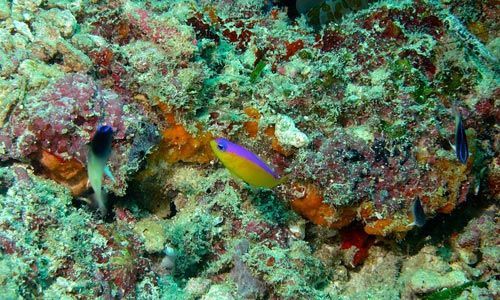
The Bicolor Dottyback (Pictichromis paccagnellae) is a beautiful saltwater fish that is half yellow and half purple. The vibrant coloration of this dottyback species makes it an excellent candidate for an aquarium. Try not to misidentify this fish with the Royal Gramma (Gramma loreto). They both have a similar shape and a fairly similar color pattern.
Sometimes called the Bicolor Pseudochromis, this fish is fairly easy to care for but can be territorial once it establishes its territory. This article will go into more depth on aquarium requirements, diet, tank mates, and breeding of the Bicolor Dottyback.
Aquarium Requirements
The Bicolor Dottyback fish will grow to around 3 inches when it reaches full size. It does best in fish tanks that are 30 gallons or larger. A larger fish tank with plenty of live rock is recommended due to its territorial personality. They aren’t outright aggressive but they are more than happy to defend their territory against larger fish.
This species of fish will also benefit from having a well-fitted lid covering the aquarium because they could potentially jump out. It’s heartbreaking losing a fish, especially one that’s expensive as a saltwater fish, so it’s best to take the precaution and cover it (if possible).
Water Parameters
The following are water parameters needed to help keep the Bicolor Pseudochromis happy:
Water Temperature: 72°-78° F
dKH: 8 – 12
pH: 8.1 – 8.4
Salinity: 1.020 – 1.025 sg
Although I cannot guarantee the fish’s survival strictly based on water parameters, keeping your parameters stable and within range will help provide a better chance of success when introducing your fish into the aquarium.
Is The Bicolor Dottyback Reef Safe?
Bicolor Psuedochromis are reef safe. They should not harm and coral and the only types of invertebrates they may target are ornamental shrimp. Clams, hermit crabs, snails, and many other types of invertebrates should do perfectly fine with your dottyback.
Food & Diet
This species of fish is carnivorous. They will require a healthy mixture of protein-rich food such as Mysis Shrimp, Brine Shrimp, Krill, and others that can be found at your local fish store or online. Also, the Bicolor Dottyback may hunt bristleworms that are crawling around your fish tank. They should readily take pellet food such as New Life Spectrum Marine Formula and flake food. I enjoy using the Marine Formula because it has 36% Crude Protein and some of its main ingredients include: Antarctic Krill, Giant Squid, Seaweed, and Kelp.
Tank Mates
After providing a proper environment for your Bicolor Dottyback, it should do well with an assortment of fish such as Dwarf Angelfish, Anthias, Blennies, Chromis, Clownfish, Tangs, Foxfaces, and much more. They are relatively well adapted to living with different fish species. I would take caution and avoid keeping your Pseudochromis with fish that can easily eat it. Fish such as Groupers, Lionfish, Puffers, and other predatory fish are bad tank mates.
Breeding
Due to their aggression and territorial behavior, the Bicolor Pseudochromis is not a good candidate for breeding in an aquarium.
Final Notes
If you’re looking for a flash of color in your reef tank or fish-only saltwater aquarium, really consider picking up a Bicolor Dottyback. They have very cool behaviors and interesting personalities after you look passed their aggression. If the Bicolor Dottyback isn’t catching your eye, take a look at other dottyback fish here.
Fluval is one of many companies that provide heaters, aquariums, lighting, and other products for the aquarium keeping hobby. The company has been around since 1975 and continues to release products for all to enjoy. This article will specifically discuss the many different-sized M Series Heaters made by Fluval. We will begin with the small Fluval M50 Heater, and make our way to the largest of the series, which is the Fluval M300 Heater.
General Fluval M Series Heater Information
Before we move onto the details of each heater, let’s discuss some of the features that the heaters share between them. The following are features that this heater series contains.
Mirrored Finish & Fully Submersible Design
A very interesting feature that can be seen with each of these filters is that they all have a mirrored finish. The goal of this mirrored finish is to allow the heater itself to blend into the surroundings. It does this by reflecting the aquarium’s colors to camouflage itself.
Fluval M Series Heaters are designed to allow full submersion. This is a fantastic feature because it allows you to hide them behind decor a bit easier. An added bonus to this is that you can also position this heater series horizontally. The only flaw to fully submerging your heater is that you’ll have to dip your hand into your aquarium to change the temperature.
Computer Calibrated Thermostat & Temperature Control Dial
This heater series comes equipped with a computer-calibrated thermostat. This makes fish-keeping a little easier because the thermostat should sense when the water hits the desired temperature and shut off. Once the water temperature drops, the heater should fire back up and bring the temp. up again.
The Fluval M Series heaters come with a fairly straightforward control dial that allows you to adjust your temperature to your needs. You can adjust and turn your dial to a wide range of temperatures. On the low end, you can set your temperature to 66° F, and 86°F on the high end. This provides you with a large range of fish of different species.
Fluval M50 A781
The Fluval M50 Submersible Heater is the smallest in this series of heaters. It is a 50 watt heater that is made to be used for aquariums up to 15 gallons (57 Liters). This heater has a fairly small footprint. It has a footprint of 11″ x 1″ x 1″. This may be a little large for Nano-fish tanks but should work very well for 10-gallon aquariums. Be sure to check out the Fluval M50 on Amazon!
Fluval M100 A782
Next, regarding size is the Fluval M100 Submersible Heater. This 100 W aquarium heater is an excellent choice for fish tanks up to 30 gallons (100 Liters). Although it uses twice as much wattage and can heat more aquarium water, Fluval M100 Heaters still has the same footprint as the M50. The M100 footprint is 11″ x 1″ x 1″. If you can afford a larger heater, I would recommend picking this one up over the Fluval M50 Heater. Before we move ahead, consider checking out the Fluval M100 on Amazon!
Fluval M150 A783
The Fluval M150 Submersible Heater is rated for aquariums up to 45 gallons (150 Liters). This model in particular uses 150 watts which is a bit more than the M50 and M100. The M150 Heater is also the first that is a little larger. It has a footprint of 13″ x 1″ x 1″. Not much larger, but it can make a difference. Overall, it is a good heater but you will likely need to get the larger M200 for something like a 55-gallon fish tank. You can pick up the Fluval M150 on Amazon!
Fluval M200 A784
The next heater on this list is the Fluval M200 Submersible Heater. This heater is rated for fish tanks up to 65 gallons (245 Liters). This is a 200 W heater that shares the same dimensions as the Fluval M150. Those dimensions are 13″ x 1″ x 1″. This heater is an excellent candidate for 55 gallons aquariums but falls short as a recommendation for 75-gallon aquariums or larger. For larger aquariums, I recommend the Fluval M300. Be sure to check out the Fluval M200 Heater on Amazon!
Fluval M300 A787
The final and largest heater in this series is the Fluval M300. This submersible heater is rated for aquariums up to 80 gallons (302 Liters). This heater uses 300 W to warm your fish tank so it packs a punch. As stated above, this is the largest of the M Series heaters in both wattage and length. The Fluval M300 Submersible Heater measures 15″ x 1″ x 1″. Large aquariums should easily hide this heater regardless of size. At the time of writing this, the Fluval M300 is not available on Amazon, but be sure to check it out on the FluvalAquatics website!
Final Notes
The Fluval M Series Submersible Heaters are just one of many types of heaters available to purchase. I have personally used these heaters for both freshwater and saltwater aquarium and am consistently happy with the results. If you have any experiences or comments about this heater series please share them with me! If you’re looking for heaters from different brands, take a look at the 6 Best Aquarium Heaters for Freshwater & Saltwater Fish Tanks!
Neon Dottybacks (Pseudochromis aldabraensis) are gorgeous saltwater fish with orange, yellow, blue, and black colorations on its body. Their vibrant colors make them an excellent addition to a saltwater fish tank.
The Neon Dottyback will spend much of its time hanging around live rock it calls its home. They are known to be semi-aggressive fish and will likely defend their territory from most fish. I will go into more depth on this later. This guide will go over aquarium requirements, dietary needs, tank mates, and more for the Neon Dottyback.
Aquarium Requirements
A Neon Dottyback will grow to about 4 inches when it is fully grown. They should do well in fish tanks that are 30 gallons or larger. It is recommended to keep varying-sized live rock in your fish tank to provide different-sized nooks for this species of fish. Also, more hiding spaces will provide more spaces to establish territory and refuge for other fish, because the Neon Dottyback can be semi-aggressive.
I recommend providing a well-fitted lid on your fish tank because Neon Dottybacks may jump out of the aquarium when spooked. Fish somehow manage to squeeze through the smallest hole when they decide to jump.
Water Parameters
Keeping water parameters in check is incredibly important for fish, crustaceans, corals, and all things in the water. It’s no different for the Neon Dottyback. The following are water parameters to keep your fish happy:
Water Temperature: 72°-78° F
dKH: 8 – 12
pH: 8.1 – 8.4
Salinity: 1.020 – 1.025 sg
Besides these water parameters, you will need to do your best to keep other water parameters such as nitrates and phosphates down. High levels of nitrates and phosphates will cause algae growth, stress your fish, and potentially shorten their life span. One of the best and easiest ways to bring down nitrates and phosphates is through water changes. I spoil my fish with Red Sea Coral Pro Salt but many different brands will suffice for your fish.
Is the Neon Dottyback Reef Safe?
Yes, Neon Dottybacks are considered reef safe. They are safe with coral, but they will likely eat very small shrimp such as Sexy Shrimp. Cleaner Shimp and Fire Shrimp should do well with this fish.
Food & Diet
These fish are carnivorous. They will require a diet that provides a lot of protein. They will enjoy foods such as Mysis Shrimp, Brine Shrimp, Krill, and more. I would also recommend providing them with pellet food that contains higher levels of protein such as New Life Spectrum Thera A pellet food. Bonus points because this pellet food has included garlic in it which should help boost the fish’s immune system.
Neon Dottyback Tank Mates
If you’re looking to add a Neon Dottyback to your fish tank, consider adding it last. They are known to be territorial and may defend their space relentlessly. Neon Dottybacks will especially chase after fish similarly shaped to themselves. Other Dottybacks and Wrasses may have a hard time with this fish, especially in smaller aquariums. Larger aquariums and extra live rock will help spread out territories.
They should do well in fish tanks with Clownfish, Dwarf Angelfish, Tangs, Foxface/Rabbitfish, and Gobies. Again, I would recommend adding them later due to their temperament.
Breeding
Due to their vibrant personalities, it is not recommended to keep this fish with other Dottybacks. That makes breeding nearly impossible in most home aquarium settings.
Final Notes
Neon Dottybacks are great fish to keep if you understand how aggressive they may be. Their coloration makes them a very interesting addition to a reef tank or saltwater aquarium. Consider picking them up, they are commonly found in fish stores and can be purchased online.
The Purple Dottyback (Pseudochromis porphyreus) often called the Magenta Dottyback, or Purple Pseudochromis is a beautiful purple/magenta fish that can be kept in a saltwater aquarium. This vibrant fish will often be seen floating very close to its home. It will spend a lot of time making sure its territory is secure. Although it stays relatively small, the Purple Pseudochromis will fight tooth and nail for its territory. This article will discuss aggression levels, aquarium requirements, diet, and tank mates of the Purple Dottyback.
Is the Purple Dottyback aggressive?
Purple Dottybacks are considered semi-aggressive. They usually keep to themselves until they have to protect their territory. I would consider introducing this fish species a little later so your more peaceful fish can establish their territories first. Although it’s not guaranteed, doing this should help alleviate some aggression.
Aquarium Requirements
The Purple Dottyback will grow to be about 3 inches in length. They will do best in saltwater fish tanks that are 30 gallons or larger. The aquarium should also be full of live rock with different-sized caves and crevices to provide cover for this fish.
Like many saltwater fish, the Magenta Dottyback could jump out of the fish tank. It is important to provide a well-fitted lid to help alleviate the potential of your fish jumping out.
Water Parameters
Keeping water parameters in check is important for fish, crustaceans, coral, etc. The following are the water parameters needed to keep your Purple Dottyback comfortable in the aquarium.
Water Temperature: 72°-78° F
dKH: 8 – 12
pH: 8.1 – 8.4
Salinity: 1.020 – 1.025 sg
One of the easiest ways to achieve proper dKH and pH levels is through water changes. Conducting water changes with a good salt mix will help provide proper and stable water parameters for your aquarium’s inhabitants.
The salt mix that works best for you will depend on what you keep in your aquarium. I usually use the Red Sea Coral Pro Salt. You can follow the link to pick it up from Amazon but it’s usually cheaper at Bulk Reef Supply.
Is The Purple Dottyback Reef Safe?
The Purple Dottyback is reef safe. It is not a danger to any coral. However, small shrimp such as Sexy Shrimp may be not safe with this fish. Other small shrimp may become a snack for the Purple Dottyback.
Food & Diet
This species of fish require a very meaty diet because they are carnivorous. You should provide them with a protein-heavy diet of Mysis Shrimp, Brine Shrimp, and krill when they are fully grown. The Purple Dottyback will also benefit from given protein-rich pellet food, and flake food. You may also see this fish consume copepods that live in and around live rock.
Tank Mates
The Purple Pseudochromis should do well with most other fish that won’t readily try to eat it. This species of fish should do well with Clownfish, Damsels, Wrasses, Dwarf Angels, Chromis, and even larger fish such as tangs, foxfaces, and rabbitfish.
If possible I would avoid keeping them with large and predatory fish such as Groupers, Lionfish, Eels, and pretty much anything that may mistake the Purple Dottyback for food. Lastly, aggression levels will likely increase if more than one dottyback is kept in a fish tank. I would avoid keeping this fish with other dottybacks such as the Purple Striped Dottyback, Splendid Dottyback, and many others.
Breeding
Because of their territorial and semi-aggressive temperament, breeding Purple Dottybacks in an aquarium setting will be impossible.
Final Notes
The Purple Dottyback is a great fish to keep in a saltwater fish tank or reef tank. As stated above, they are perfectly safe with coral, and many fish will understand to avoid their territory once they are settled in. In an appropriately sized aquarium with plenty of hiding spots and rockwork, the Purple Pseudochromis should thrive! If you’re curious about other dottyback species, check out the Dottyback information page by following the link.
The Purple Striped Dottyback (Pseudochromis diadema), also known as the Diadem Pseudochromis, or Diadem Dottyback, is a beautiful saltwater fish primarily yellow in color with a horizontal purple stripe running across its body. It is a fairly hardy fish that is quite easy to care for. Beware because the Purple Striped Dottyback can be a territorial fish and can be aggressive toward other tank mates. It is a gorgeous and vibrant fish that would be a good addition to many saltwater aquariums.
You can find the Purple Striped Dottyback for sale at many brick-and-mortar stores and online on Liveaquaria. This guide will cover aquarium requirements, food & diet, tank mates, and breeding habits of the Purple Striped Dottyback.
Aquarium Requirements
Purple Striped Dottybacks will grow to a max size of about 3″. Due to their adult size, I would recommend keeping them in fish tanks that are 30 gallons or larger. Keep in mind that they can dominate smaller fish tanks because of their temperament. Your fish tank should be decorated with live rock with varying-sized caves for your dottyback to explore and create its territory. If you cannot find live rock at your local fish store, consider picking some up from Amazon.
I would also consider adding a well-fitted lid to your aquarium because dottybacks and other fish may decide to jump out.
Water Temperature: 72°-78° F
dKH: 8 – 12
pH: 8.1 – 8.4
Salinity: 1.020 – 1.025 sg
Consider getting a High Range pH and KH test kit to test for pH & dKH. Keeping your temperature between 72° and 78° can be accomplished with a heater. Take a look at my guide which showcases some great aquarium heaters. Lastly, I would pick up a Refractometer from Amazon to keep an eye on your salinity levels. If calibrated correctly, refractometers are much more accurate compared to a hydrometer which loses accuracy due to salt buildup on the dial. Check out Different Salinity Reading Tools For Saltwater Fish Tanks to get an idea of other salinity testing devices available.
Is The Purple Striped Dottyback Reef Safe?
The Purple Striped is reef safe and can be kept with coral and invertebrates. The only invertebrates that will be in danger are copepods and small ornamental shrimp (sexy shrimp), and other very small crustaceans. They may live amongst coral but they should not eat any.
Food & Diet
This species of fish is carnivorous. They should not be picky eaters and will consume Pellets, Flakes, Mysis Shrimp, Brine Shrimp, and other meaty foods. They may be given Krill as well once they are fully grown.
Tank Mates
Because of their potentially aggressive nature, I would recommend adding Purple Striped Dottybacks later. It is good to allow other fish to establish a territory before adding this fish. They should do well with fish such as Clownfish, Dwarf Angelfish, Wrasses, Damsels, Hawkfish, Gobies, and other fish that get a little larger than the Purple Striped Dottyback. I do not recommend adding other Pseudochromis with this fish because you will likely see constant fighting between the two.
Breeding
Because of their aggressive and territorial nature, breeding this fish species is practically impossible.
Final Notes
The Purple Striped Dottyback is a vibrant fish. Although it doesn’t have the best personality, it is a great starter fish and provides unique behavior for hours of enjoyment. Overall, they are great fish, especially if you understand their temperament. If you have any comments or information on this fish, please let me know! Also, if you’re interested in other dottyback species, check out the dottyback information page by following the link.
Dogface Puffers also known as the Blackspotted Puffer get their name from having a physical resemblance to canines. Dogface Puffer fish also have gray, brown, and yellow colorations as well as black spots on their bodies. These semi-aggressive fish have a great personality and are a thrill to keep in a large saltwater fish tank. This guide will cover Dogface Puffer fish aquarium requirements, feeding habits, compatible tank mates, and more. Check out the Saltwater Pufferfish page for more information on different species of puffer.
Aquarium Requirements
Dogface Puffers get large. They will grow to be over a foot in length. It will be important to provide them with an aquarium that is 150 gallons or larger to keep them happy. Because of their size and their carnivorous diet, they will also create a lot of poop, which will lead to increased levels of nitrates and phosphates. A very good filtration system and water changing schedule will be crucial in keeping your water parameters in check. A sump system with a great protein skimmer such as the Reef Octopus 150INT Protein Skimmer will help keep your aquarium water parameters in check.
I would also recommend providing your Dogface Puffer with plenty of live rock with different sized caves to give it cover. If you can’t find live rock at your local fish store, check out the Carib Sea South Sea Base Rock on Amazon.
Water Parameters
The water parameters needed to keep a Dogface Puffer are similar to what most saltwater fish require which are:
Water Temperature: 72°-78° F
dKH: 8 – 12
pH: 8.1 – 8.4
Salinity: 1.020 – 1.025 sg
Regular water changes with a high-quality salt mix with help keep your pH, dKH, and salinity in check. You will need a properly calibrated refractometer to verify proper salinity levels. Refractometers can be purchased on Amazon by following this link. Also, you will need an aquarium water heater to keep your water temperature at the proper level. Take a look at the 6 Best Water Heaters For Fresh & Saltwater Fish Tanks to get an idea of the different water heaters available for purchase.
Are Dogface Puffers Reef Safe?
Dogface Puffer fish are not reef safe. In the wild, their primary food source is invertebrates. This includes snails, shrimp, crabs, hermit crabs, and more. Although they do not readily eat coral, they may nip and break off pieces of coral trying to grind down their ever-growing beak. I would not risk keeping this species of fish in a reef tank. They do best in Fish-Only with live rock (FOWLR) aquariums.
Food & Diet
Dogface Puffers are carnivores. As stated earlier, they eat shrimp, snails, crabs, and more meaty food in the wild. They will likely need to consume frozen food such as krill, clams, and hard-shelled shrimp in a fish tank. These foods will help them grind their beak down to size. Also, if you have any live shrimp, snails, crabs, or other invertebrate, they will likely become a meal for your Puffer.
Tank Mates
There are a lot of different species of fish that can be kept with a Dogface Puffer. They will do well with fish such as Triggers, Large Angelfish, Eels, Large Wrasses, and other large carnivorous fish. It will do best with fish that grow larger but that is not very aggressive. Dogface Pufferfish may also nip on the fins of fish.
They are known to get picked on by other Pufferfish species such as the Porcupine Puffer. I would be weary of keeping the Dogface Puffer with other Pufferfish. Sometimes they successfully inhabit a fish tank together. It all depends on the temperament of the individual fish.
Are Dogface Puffer Fish Aggressive?
As stated earlier, the Dogface Puffer can potentially nip on the fins of other fish. They are labeled as semi-aggressive but they are usually more docile compared to other large Puffer Fish species.
Breeding
I would not recommend keeping more than one Dogface Puffer in a fish tank. This makes breeding this fish impossible.
Final Notes
Dogface Puffers are unique-looking fish that make a great addition to many large FOWLR aquariums. If you’re looking for a fish that will sort of act like an aquatic puppy, consider picking up a Dogface. Maintaining balanced water parameters may become a challenge but it is well worth it for this fish!
The Blue Spotted Puffer sometimes called the Blue Dot Puffer, or Blue Dot Toby is a species of pufferfish that is often kept in saltwater aquariums. It has gorgeous brown, tan, and yellow colorations as well as blue spots speckled across its body. Like other puffers, the Blue Dot Toby has a beaklike structure that is used to break through tough invertebrate exoskeletons.
Blue Spotted Pufferfish have fantastic personalities which may make them the centerpiece of any aquarium they are in. You can often find Blue Spotted Puffers for sale at LiveAquaria, Saltwaterfish.com, or check out your local fish stores! This guide will cover the aquarium requirements, food and diet, tank mates, and breeding of the Blue Spotted Puffer.
Aquarium Requirements
The Blue Spot Puffer will grow between 4 and 5 inches. An aquarium that is 55 gallons or larger will suit this fish incredibly well. It is beneficial to provide live rock with varying-sized caves and nooks for the fish to hide in. Monitoring the water for elevated levels of nitrates and phosphates because puffers can sometimes be sensitive to unbalanced waters. They will also require the following water parameters:
Water Temperature: 72°-78° F
dKH: 8 – 12
pH: 8.1 – 8.4
Salinity: 1.020 – 1.025 sg
Providing the following water parameters will help keep your fish healthy! A simple thermometer such as the Penn Plax floating thermometer can be used to check your water temperature. DKH levels can be tested using an API KH test kit or you can get fancy with a Hanna Instrument Alkalinity Check (HI772). pH levels can be tested using an API High-Range pH test kit. Lastly, I recommend checking your salinity using a refractometer over a hydrometer. Over time, hydrometers become less accurate because salt particles build up on the tool.
Is the Blue Spotted Puffer Reef Safe?
Like many other saltwater puffers, I would not consider the Blue Spot Puffer reef safe. They consume invertebrates and can potentially eat your coral. After doing some research, some reef keepers have claimed that their Blue Spot Puffers are model citizens around coral but others didn’t have such luck. Being safe with coral is likely dependent on the individual fish but I would not risk it.
Food & Diet
Blue Spotted Puffer fish eat primarily meaty foods. You will want to feed them an assortment of foods to help wear down their teeth. Great frozen foods for Blue Dot Tobys are krill, clams, squid, hard-shelled shrimp, and Mysis shrimp. I would feed your puffer a mix of these foods to provide them with a variety to help grind down their beak. I would also recommend occasionally feeding your puffer live hermit crabs or snails.
Tank Mates
Blue Spot Puffers are fairly peaceful. They can become territorial and may nip on other fish’s fins, but overall they keep to themselves. They should do well with clownfish, damsels, chromis, dwarf angels, wrasses, and other friendly and small saltwater fish. They should also do well with larger fish such as tangs, foxfaces, rabbitfish, and other peaceful large fish.
Breeding
I would not recommend keeping more than one Blue Spot Puffer in a fish tank. Because of this, breeding is impossible.
Final Notes
Blue Spot Tobys are beautiful and vibrant fish that can be kept in a saltwater fish tank. They are a great centerpiece for aquariums that are 55 gallons or larger. If you’re looking for something unique to keep in your saltwater fish tank, consider picking up a Blue Spot Puffer fish. Check out the Saltwater Pufferfish page for information are different puffer species.
The Valentini Puffer sometimes called the Saddle Valentini, or Blacksaddled Toby is a small species of pufferfish often kept in saltwater aquariums. It has beautiful black, white, and yellow colorations on its body. They also have spots running horizontally throughout their body. Valentini Puffers are known to have great personalities and become a highlight in a fish tank. They normally keep to themselves but are known to nip on fins from time to time.
Valentini Puffer fish puff up when they are threatened or in danger. It is important to avoid having them puff because it is stressful on their body. Also, part of the Saddle Valentini holds a toxin. It should generally not be dangerous to humans unless you decide to consume the puffer. This guide will cover Saddle Valentini aquarium requirements, food & diet, tank mates, breeding, and more!
Aquarium Requirements
The Blacksaddled Toby should be introduced into well-established saltwater fish tanks. It is recommended to add them into an aquarium using a container instead of a net if possible. They become more stressed when netted and will be more prone to puffing up.
The Black Saddle Puffer’s max length is about 4 inches. It will do well in an aquarium that is 30 gallons or larger. I would personally recommend keeping them in 40-gallon fish tanks or larger due to their diet and sensitivity to fluctuations in water parameters. More water volume will help prevent large swings in water parameters. Also, I recommend adding a lot of live rock with different sized caves to provide refuge for your pufferfish during times of stress.
Water Parameters
Water parameters for saltwater fish is generally the same. However, there are some outliers that have unique parameter requirements. Luckily the Valentini Pufferfish has fairly standard water parameter needs.
Water Temperature: 72°-78° F
dKH: 8 – 12
pH: 8.1 – 8.4
Salinity: 1.020 – 1.025 sg
Is The Valentini Puffer Reef Safe?
Valentini Pufferfish do best in fish-only with live rock (FOWLR) aquariums. They may seek out invertebrates in your fish tank and make them a quick meal. I have heard mixed opinions about keeping Blacksaddled Tobys with coral. Some reef keepers claim theirs are model citizens while others observed Valentini Pufferfish nipping their coral. The personality of the individual fish will determine whether they are safe with coral or not. I would personally only keep this species in fish-only aquariums, to avoid losing coral and invertebrates to a hungry Black Saddle Puffer.
Food & Diet
Valentini Pufferfish have a beak that grows throughout their lifespan. They require foods that are hard-shelled to help grind down their beak. They will happily munch on live snails, hermit crabs, and shrimp. Providing them with live saltwater invertebrates can become incredibly expensive over time. Luckily, some foods are good replacements for live inverts. Frozen foods such as clams, krill, and squid are great to help grind down this puffer’s beak. Although they may not help grind their beak down, I would also recommend feeding Valentini Puffers Mysis Shrimp and Brine Shrimp.
Tank Mates
Black saddled Puffers are fairly peaceful in fish tanks. If plenty of live rock and hiding spaces are provided, they should keep to themselves. They will do best with similarly sized fish such as Clownfish, Damsels, Wrasses, and Dwarf Angels. In appropriately sized fish tanks, they will likely get along with a few larger fish like Tangs and Foxfaces. There are many other fish Valentini Puffers can get along with, but I just wanted to give you a general idea.
I would not recommend keeping this puffer fish with another Valentini Puffer because they will likely become territorial and aggressive toward one another. To play it safe, I would not recommend mixing Valentini Pufferfish with other puffer species.
Breeding
Due to their potentially territorial nature, I would not keep more than one Valentini Pufferfish in an aquarium. This makes breeding impossible.
Final Notes
Valentini Pufferfish are gorgeous fish with incredible personalities. If you decide to pick one up, it’ll likely become the centerpiece of your fish tank. It is important to keep up with this fish’s need to grind its beak down, but that will come naturally with the provided food. Check out the Saltwater Pufferfish page for information on different species of puffer!
The Porcupine Puffer also known as the Porcupinefish is a very smart and interactive fish that can be kept in a saltwater fish tank. They have beautiful brown and black patterns all over their body and gorgeous deep blue eyes. Porcupine Pufferfish have a beak-like structure that resembles teeth that continuously grow. They can also puff up to about twice their body size when they are stressed. The act of puffing up is a defense mechanism so the less it puffs up, the better for the fish’s health. This article will cover the Porcupine Puffer’s aquarium requirements, food and diet needs, tank mates, and more.
Aquarium Requirements
Porcupine Puffers get incredibly large, they can be about a foot long at their max size. A full grown Porcupine Puffer should not be kept in an aquarium smaller than 180 gallons with plenty of space to swim. Because of their diets and messy habits, saltwater puffer fish should have a very good protein skimmer running to help remove waste. I have had great luck with the Reef Octopus brand, the Reef Octopus Classic 150SSS Protein Skimmer will do great on a large saltwater fish tank.
Porcupinefish Water Parameters
Porcupine Puffers have very similar water parameter requirements to other saltwater fish. The following are water parameters required to keep the Porcupinefish happy.
Temperature: 72-78° F
pH: 8.1-8.4
Salinity: 1.020-1.025
dKH 8-12
Food & Diet
The Porcupine Pufferfish’s diet consists mostly of snails, crabs, clams, and many other invertebrates. The hard skeletons and shells of these animals help the Pufferfish to grind down their teeth that continuously grow. In an aquarium, their diet should consist of a variety of meaty food such as clams, krill, squid, and hard-shelled shrimp. I would also include lives snails and hermit crabs in their diet as well.
Are Porcupine Puffers Reef Safe?
Part of being reef safe means being safe with invertebrates such as snails, crabs, and clams. Technically, the Porcupine Puffer is not reef safe. Also, I have read mixed thoughts on keeping them with corals. There is a possibility that these puffers will nip on live rock to file down their teeth. This means they can accidentally bite SPS coral. I have also read that Porcupine Pufferfish have been seen biting other coral species such as zoanthids. Heavy feeding may help deter your Pufferfish from eating coral, but that seems to completely depend on the individual fish. I’d be too paranoid about keeping a Porcupinefish in a reef tank.
Porcupine Puffer Tank Mates
This species of fish is known to be fairly aggressive that sometimes nips on other fish. They will do best in an aquarium that has other semi-aggressive fish. Check out 5 Unique Predatory Fish for Saltwater Aquariums to get an idea of other fish that can be kept with Porcupine Puffers. There are more large saltwater fish that will do fine with this puffer species such as tangs, foxfaces, groupers, angels, eels, and more. Be mindful that the puffer fish may try to eat smaller fish that fit into its mouth.
As stated above, Porcupine Pufferfish are not reef safe and should not be kept with any shrimp, snails, crab, and clam. They may be fine for a little while, but eventually the puffer will find these invertebrates and make them lunch.
Breeding
This species of puffer is incredibly territorial and two of the same species should not be kept together in a fish tank. This makes breeding pretty much impossible.
Final Notes
Porcupine Puffers are incredibly fun to keep, but it’s important to keep them in an enclosure that is compatible for them. Keep in mind they can become nippy, are not reef safe, but are very personable and exciting to observe. If you are setting up a Fish Only With Live Rock (FOWLR) consider adding this species of fish into the aquarium.
The Thai Micro Crab is an incredibly small crab species that are not commonly seen in this hobby. It is a freshwater crab species that looks like a small spider and it will not get larger than 1/2 of an inch! Thai Micro Crabs are fully aquatic so they will not require any land area in their enclosure. Although they are not very commonly seen at Pet Stores, you can often find Thai Micro Crabs for sale at AquaticArts. This Micro Crab is not recommended for beginner aquarium keepers, because of their small size. If you’re looking for crabs that are larger and/or partially terrestrial, check out 9 Unique Terrestrial, Semi-Terrestrial, Brackish & Freshwater Crabs. This article will cover aquarium requirements, food and diet, tank mates, and more for the Thai Micro Crab.
Aquarium Requirements
Thai Micro Crabs are a much smaller species of crab, this makes them excellent for nano fish tanks. These crabs will do well in aquariums that are about 2 gallons or larger. Larger aquarium’s water parameters are likely to be more stable so I always recommend at least a little larger fish tank. Their enclosure should also be full of a variety of aquatic plants, and caves/rockwork for them to hide in.
Water parameters are important for aquatic animals, and it is no exception for this crab. The following are the recommended water parameters for the Thai Micro Crab:
Temperature: 72°-82° F
pH: 6.5 – 8.0
KH: 6 – 15 dKH
This little crab should settle in its new home beautifully if the water parameters in the aquarium match what it needs. Keep in mind that many invertebrates are incredibly sensitive to fluctuations in water parameters such as the ones above, but also to nitrates, phosphates, and many others!
Food & Diet
For the most part, the Thai Micro Crab should be able to find food on its own. They will primarily filter feed using little hairs on their claws. However, like most crabs, they are opportunists and may try to make a meal out of some small invertebrates such as shrimp. They are too small to cause harm to most fish. If your aquarium is not completely mature, consider feeding this Micro Crab flake food or pellet food.
Tank Mates
The Thai Micro Crab is incredibly peaceful. It mostly keeps to itself and will not harm most inhabitants of the aquarium. It may take a chance at a small invertebrate, but most fish are safe around this crab. I would be more worried of certain fish trying to eat the Thai Micro Crab due to its incredibly small size. I would keep this crab with fish such as:
Neon Tetra
Ember Tetra
Endler’s Live Bearers
Harlequin Rasbora
Other peaceful small mouthed fish
I would not house this crab with larger fish or fish that can fit the Micro Thai Crab into its mouth. Fish such as Angelfish, Rams, Kribensis, and larger may think this crab is food!
Breeding
After researching the topic, it seems that the Thai Micro Crab is incredibly hard to breed. If it breeds successfully, the offspring do not survive very long. If you have any success or more information on this topic, please consider sharing it!
Final Notes
The Thai Micro Crab is an excellent invertebrate to add to your freshwater fish tank if you have a proper setup. If you’re looking to add a crab to your aquarium, really consider this species. They will not bother fish or plants, and they are not destructive like crayfish. They can be hard to find for sale but with a little patience, one will pop up.
Halloween is an exciting time of the year. Decorating your house with spooky skeletons and jack-o-lanterns is a fun activity. What is stopping us from decorating or even creating a Halloween themed fish tank? After all, some of us like to celebrate Halloween year-round. From skulls to plants, there are plenty of options out there to build a Halloween themed aquarium. This article will go over some of the best spooky fish tank decor that can be found online!
1. Skulls
Halloween skulls are an obvious choice for our horror themed fish tank. They come in all shapes and sizes. From human skulls to dinosaur skulls, the options are out there! Many aquatic animals are shy and like to hide away in unseen places. Fish are no exception. Many fish tank skull decorations have holes and crevices in which fish can seek refuge. Some skulls have larger openings that can house larger fish!
When looking for decorations to add to your fish tanks, consider looking at the reviews. Some decorations can be made with material that is not safe for fish. Reading through reviews will help you weed out products that may be poor quality or dangerous for your pets.
2. Tombstones & Skeletons
A graveyard themed fish tank is something unique and that would also be incredibly fun to design. There are many different decoration options for a graveyard theme but one stood out the most for me. That would be the Yookeer 8 Pieces Tombstones Figurine set. This set comes with 4 tombstone pieces, 1 coffin piece, and 3 small skulls of an ape, rhino, and goat. If you’re interested in this Halloween Decoration click on the image that will direct you to its store page on Amazon. Another great thing about this set is that it is very versatile.
While it’s perfect for a graveyard theme fish tank, you can also use it for other purposes. For example, you can use the tombstones in Spooky Terrariums, Paludariums, or even just use them as small tabletop decorations.
3. Glow in the Dark Plants
Plants that glow under blue lights give off very extraterrestrial vibes. Halloween and Aliens go hand in hand, so why not build a fish tank that takes us out of this world? Bonus points if you include Glofish into your Alien planet-themed fish tank. I understand that plastic plants do not benefit fish tanks like live plants do, but it’s always cool to see fish tanks glow under blue lights. Consider creating a mosaic of live plants and plastic plants for your aquarium.
4. Sunken Ships
Sunken Ships and pirates are some of the most iconic aspects of Halloween. I may have dressed as a Pirate for Halloween once or twice. Anyway, aquariums and sunken ships are probably the most normal thing on this list so far. Decorations of Sunken Ships are great because they are often the centerpiece of the fish tank. They also help provide refuge for your fish, if there are openings. They also look cool! Finding Sunken Ship decorations for fish tanks is incredibly easy. I made it even easier for you by providing a link to the Sunken Ship page on Amazon!
5. Rocks
There are many different rocks that can be worked with to give off a Halloween or eerie feel. The few that come to mind are Lava Rock, Slate Rock, and Ohko Dragon Stone. These rocks give off a certain feeling. I would use the rocks and combine them with other Halloween Decorations to create a very vibrant Halloween scene in my fish tank.
If you have a fish store nearby, consider checking them out before purchasing rocks online. They are often a lot more expensive when ordered through the internet. There are sellers on Amazon that sell each of these stones, you can check them out by following this link!
Final Notes
There are plenty of decorations to build us a Halloween Themed aquarium. We can also fill our aquariums with “spooky” fish to complete the theme. Take a look at 5 Halloween Themed Freshwater Fish to get an idea of some of this fish you can add. Please be mindful that the health and safety of the fish is what’s important. Research the requirements of each fish to make sure the home you create is compatible. How you decorate your fish tank is entirely up to you but creating a good home for your animal is what matters the most.
The Sixline Wrasse sometimes spelled Six Line Wrasse, or 6 Line Wrasse, is a species of fish commonly found in the aquarium keeping hobby. This species has six distinct horizontal lines running across its body. It has striking purple, pink, and green colorations on its body. It is an iconic species in fish-only aquariums or reef tanks. There is a general misconception about this fish. Some people ask, “Are Sixline Wrasse evil?” The answer is no, they’re not evil but they can become territorial so it’s common to introduce this wrasse later into your aquarium. This allows other fish to establish their territories. This article will discuss Six Line Wrasse Aquarium Requirements, Food & Diet, Common Tank Mates, and more.
Aquarium Requirements
The Sixline Wrasse grows to a max size of about 3 inches. It will do well in both fish-only and reef tanks that are 30 gallons or larger. They do best in a fish tank filled with live rock with holes of varying sizes. This will allow them to be active and explore, while also providing them with cover when stressed. Like many other wrasse species, the Six Line Wrasse can jump out of the fish tank. Consider providing a well-fitted cover to prevent jumping.
Food & Diet
The Six Line Wrasse is a carnivore. It will likely feed on flatworms, copepods, and bristleworms in the aquarium, but they should be provided with additional food such as Mysis Shrimp and Brine Shrimp. They will readily take pellet food and flake food. They are not picky eaters, but if you have one that isn’t eating, consider soaking its food in Selcon or Garlic. Check out this article that talks about some of the benefits of feeding garlic to fish.
Tank Mates
Overall, the Sixline should do perfectly fine with most peaceful fish in an aquarium. This includes Clownfish, Firefish, Dwarf Angelfish, Anthias, Blennies, and much more. They should do well with larger fish such as Foxface, Butterflyfish, and Tangs. I would avoid keeping them with fish that may make a snack out of your Sixline Wrasse such as Groupers and Pufferfish. Other Wrasses may be attacked by the Sixline Wrasse as well.
The Six Line Wrasse is reef safe. It will do well with snails, shrimp, hermit crabs, and coral. Keeping Cleaner Shrimp with Sixline Wrasse should be perfectly fine. If you see them picking on coral, they’re likely just picking out the flatworms, or bristleworms within.
Breeding
Because of their territorial nature, I would not keep more than one Sixline Wrasse in an aquarium. This makes breeding almost impossible.
Final Notes
The Sixline Wrasse is a great addition to any reef tank. As long as you are cautious about their territorial habits, you should have great success with this easy-to-care-for fish. They’re usually great about eating pests such as bristleworms and flatworms. They also provide plenty of activity in a fish tank. If your fish tank allows, really consider getting yourself a Six Line Wrasse!
The Yellow Banded Possum Wrasse also known as the Pygmy Possum Wrasse is a species of carnivorous saltwater fish found in this hobby. It is a peaceful fish with beautiful red, orange, and yellow coloration on its body. The Banded Possum Wrasse stays relatively small and is an excellent fish for fish-only and reef tanks. Pygmy Possum Wrasses are known to come with internal parasites. It is recommended to quarantine your fish and medicate them before adding them into the aquarium. This article will go into detail on the Possum Wrasse’s aquarium needs, food & diet, and compatible tank mates.
Aquarium Requirements
Because the Yellow Banded Possum Wrasse’s max size is 3″, it will do well in aquariums that are 10 gallons or larger. It is important to provide plenty of hiding spaces in the aquarium. Most hobbyists use live rock to provide a natural aquascape for their saltwater fish tanks.
A tightly fitted lid is also recommended for the aquarium because the Pygmy Possum Wrasse is known to jump out of the aquarium.
Food & Diet
The Possum Wrasse is a carnivorous animal, it is very important to provide it with high-quality foods such as Mysis Shrimp, Spirulina Brine Shrimp, and Pellet/Flake Food. They are not known to be finicky eaters and usually readily take food when introduced into a fish tank. If they are stubborn and avoid eating food, consider mixing the food with Selcon or soaking the food in garlic before feeding. Check out this article about the benefits of dipping your fish food in garlic.
Tank Mates
In appropriately sized aquariums, Yellow Banded Possum Wrasses should do well with other peaceful saltwater fish. It should be fine with clownfish, dwarf angelfish, firefish, tangs, foxfaces, and much more. I would avoid keeping them with fish that can fit the Possum Wrasse in its mouth. I would also avoid mixing wrasses because many do not get along.
In a large enough aquarium, 1 male can be housed with multiple females. The males are often more vibrantly colored compared to the females of the species. If possible, I would introduce them all at the same time, or introduce the females first and bring in the male after the females are established.
This wrasse species is reef safe. It should not bother any of your coral or invertebrates. The Yellow Banded Possum Wrasse may eat flatworms and bristleworms but if you have an outbreak of bristle/flatworms, I have more confidence in different wrasse species such as the Sixline Wrasse, Yellow Wrasse, or Melanurus Wrasse.
Breeding
I do not have any information regarding breeding. Many saltwater fish are incredibly hard or impossible to breed in an aquarium.
Final Notes
Possum Wrasses are interesting fish that can be kept in a reef tank or fish-only aquarium. Their unique body and coloration make them a fantastic addition to your aquarium. They’re also great because they can be added to nano saltwater tanks. If you have more information on Possum Wrasses please share!
The Pearly Jawfish (Opistognathus aurifrons), sometimes called the Yellowhead Jawfish, is a gorgeous fish kept in the fishkeeping hobby. This fish has a white/blue body and a yellow head. These colors are not commonly seen on fish. It is a burrowing species of fish that can be very timid, especially when first introduced. However, they are very peaceful fish and spend most of their time in and around their burrow.
Opistognathus aurifrons grow to be about 4 inches when they are fully grown. Although they do not require an incredibly large fish tank, they still require a deep substrate which we will cover later. The Pearly Jawfish is reef safe, but may “spit” sandy substrate onto coral that are around its burrow. This article will go further into detail and also discuss Pearly Jawfish care, aquarium requirements, diets and more. If you’re curious about jawfish, check out the Blue Spot Jawfish Care Guide as well!
Aquarium Requirements
If you are looking to keep a single Pearly Jawfish, it does best in aquariums that are 30 gallons or larger. Be mindful because there may be aggression between Jawfish and gobies for real estate in your fish tank. Yellowhead Jawfish also do best with sand beds that are at least 4 inches deep but more is always better! CaribSea Fiji Pink Sand is a great Pearly Jawfish substrate. I would also recommend providing rock rubble around the fish tank because I have seen Pearly Jawfish use small pieces of rock to help stabilize their burrow.
To my knowledge, all Jawfish are known to be excellent jumpers. A tight-fitting lid is incredibly important if you are trying to prevent your fish from jumping to its demise.
Food and Diet
Pearly Jawfish are primarily carnivorous animals. Regardless, I have seen them happily eat pellet food as well. It is good to provide an assortment of food for your Jawfish. I would feed mine Mysis Shrimp, Brine Shrimp, Krill, and New Life Spectrum Marine Formula. When I first introduced a Pearly Jawfish into my aquarium, I would use a long turkey baster, like this one, to feed it. I sucked up the food into the syringe and tried to get as close to its burrow. I would then release the food. I did this because at first my Jawfish was incredibly skittish and would disappear into its burrow during feeding time.
Tank Mates
I would recommend keeping your Pearly Jawfish in a fairly peaceful aquarium. It does great with fish such as Clownfish, Tangs, Dwarf Angelfish, Chromis, Firefish, Hawkfish, and many other community fish. There may be some territorial disputes with gobies, but in a large enough aquarium each should find their spot. I would avoid keeping your Jawfish with larger fish like Lionfish, Pufferfish, Groupers, and other fish that may consider a Pearly Jawfish food.
In a large enough aquarium, you may be able to keep multiple Pearly Jawfish together. I would personally start considering keeping multiple in 75 gallon aquariums. Be sure you provide deep sand beds for your Jawfish.
Pearly Jawfish and Pistol Shrimp
Unfortunately, the two fish will not share a hole. The good news is, that they should be able to co-exist in a fish tank. Check out Watchman Gobies if you are looking for a fish that is compatible with a Pistol Shrimp.
Breeding
It is possible to successfully breed Pearly Jawfish. You can’t tell the difference between males and females of this species by appearance. If breeding is successful, males will hold the eggs in their mouths. I have not ever attempted to breed this fish species, but I can imagine it being incredibly difficult to separate the eggs from its parents. If you have had any luck, let me know!
Final Notes
Pearly Jawfish are beautiful saltwater fish with very interesting personalities. If you have the proper setup, I would highly recommend giving them a try! They’re very fun to observe, especially around feeding time when they dart out of their burrow to grab some food.
Harlequin Tusk fish (Choerodon fasciatus) is a species of saltwater wrasse that can be found in the Indian Ocean and Australia. They are very similar in appearance in both regions however, the Australian Harlequin Tusk has more pronounced blue streaks running vertically throughout its body. This fish species always gets heads turning because of its eye-catching coloration. On top of the beautiful colors on this fish, it also sports blue pointy teeth that will make you think twice before putting your hand in the fish tank.
Choerodon fasciatus will be 10 inches when it is fully grown. You should also be very cautious if you plan on keeping this fish in a reef tank. This guide will discuss why and also how to care for Harlequin Tusks. If you know all about the Harlequin Tusks, consider checking out 5 Unique Predatory Fish for Saltwater Aquariums!
Aquarium Requirements
Because of how large Choerodon fasciatus becomes, it is recommended for fish tanks that are 125 gallons or larger. The aquarium itself should have plenty of rockwork that creates different sized caves for the Harlequin Tusk. Juveniles of this species are often very timid so it is great to provide hiding spaces.
Most saltwater fish have similar water parameter requirements. That is not any different with Harlequins. This fish does best under the following water parameters:
Temperature: 72°-78° F
DKH: 8-12
pH: 8.1-8.4
Salinity: 1.020-1.025 sg
From my experiences and research, it does not seem like Harlequin Tusks are known to be jumpers. However, a well-fitted lid is always recommended because you never know with fish.
Is the Harlequin Tusk Reef Safe?
These fish are cautiously kept in reef tanks, primarily because although they will not eat your coral, they will devour most invertebrates that are in the aquarium. However, they are often kept in Fish Only With Live Rock (FOWLR) aquariums.
Food and Diet
The Harlequin Tusk fish is strictly a carnivorous fish. They hunt and prey on small invertebrates such as snails, crabs, shrimp, and more in the wild. Their diet should replicate something similar to what they would eat in the wild. When they are small, they can be fed an assortment of Mysis Shrimp, Brine Shrimp, and Krill. Once they are older, Mysis Shrimp and Brine Shrimp may not sustain a hungry Harlequin Tusk. I would recommend feeding it larger meaty foods such as Krill, Clam on a Half shell, and squid. They may also eat large pellets and flake food. Most invertebrates are not safe with this fish in the aquarium. Harlequin Tusks and Cleaner Shrimp are not even a safe combination.
Do Harlequin Tusk Eat Aptasia
There is very little information on whether Harlequin Tusks eat aptasia. I can safely assume that they will not eat aptasia because they will not mess with coral or anemones in a reef tank. If anyone has any concrete information on this, please share! If you need to remove aptasia, consider purchasing peppermint shrimp but beware because they may destroy other coral.
Do Harlequin Tusk Eat Bristleworms?
Being invertebrates and Harlequin Tusks being wrasses, I can assume that this fish species will eat bristleworms. Perhaps not as well as a Sixline Wrasse or Arrow Crab, but Harlequin Tusks should eat some bristleworms when the opportunity arises. However, I do not have concrete evidence to prove this.
Do Harlequin Tusk Eat Clams?
Most of the searching I have done assumes that Harlequin Tusks do not eat clams. Being the rowdy carnivores that they are, I would still be a little cautious owning clams and Harlequins.
Tank Mates
The Harlequin Tusk has a reputation for starting life as a small timid fish, but it becomes more aggressive once it settles into a fish tank and grows. Choerodon fasciatus should be kept with fish that grow larger and can hold their own. I would recommend fish such as Triggerfish, Surgeonfish/tangs, Lionfish, large Angelfish, and Groupers. Smaller fish such as Chromis, Clownfish, Firefish, and many others are commonly eaten by Harlequin Tusks. Also, there may be increased aggression and fighting towards other wrasses.
Can you Keep More Than One Harlequin Tusk?
The simple answer is no. Harlequin Tusks become incredibly territorial and aggressive when they are grown and will fight others of their species. They wreak havoc on other fish and wrasses of different species, so it’s a bad idea to consider adding two Choerodon fasciatus together. Our aquariums are not large enough to comfortably keep more than one in a system.
Breeding
Breeding is not really possible with this species in an aquarium setting. They are incredibly territorial and will fight their own species. Also, it’s incredibly hard and/or impossible to determine whether saltwater fish are males or females.
Final Notes
Harlequin Tusks are probably one of the most beautiful saltwater fish available. If you can look passed their temperament (and their cost) I would highly recommend them if you have the correct setup. If you’re not ready to pick up a Harlequin Tusk, check out some other fish that are great for 30 Gallon Aquariums.
African Cichlids are beautiful fish that range in size, beauty, and temperament. They compare very closely to saltwater fish in regards to color. These fish come in vibrant yellows, blues, reds, and much more! Keeping African Cichlids is a lot of fun and worthwhile If you can look passed their temperaments. This article will cover some of my favorite African Cichlids. This list is in no particular order and I understand that not everyone will agree with it. Hopefully, it interests you to potentially keep this wonderful fish.
1. Yellow Lab Cichlid
Yellow Lab Cichlids, sometimes called the Electric Yellow Cichlid is a vibrant and striking fish from Lake Malawi in Africa. This fish is part of a larger cichlid group called mbuna. Mbuna means rockfish and as the name suggests, the Electric Yellow Cichlid lives near rock formations in Lake Malawi. In a fish tank, Texas Holey Rock is often used to mimic the Yellow Lab’s natural habitat.
Mbuna cichlids are often overstocked in aquariums to help alleviate aggression. You will need both a properly sized aquarium and adequate filtration to successfully keep an overstocked tank of yellow labs and mbuna cichlids. I would personally keep them in 75 gallon fish tank or larger but you should get by with 55 gallons.
The Yellow Lab, like many other cichlids is semi-aggressive. It is also an omnivore, so it will require a balanced herbaceous and meaty diet. Yellow Lab Cichlids grow to a max size of 6 inches. Like many other African Cichlids, Electric Yellow Cichlids have unique water parameters compared to many other freshwater fish. They need the following water parameters:
Temperature: 72°-78° F
KH 10-15
pH 7.8-8.5
As you can see, Yellow Lab Cichlids require high pH levels and high water hardness. This, along with aggression is why they do not mix well with other tropical fish. Many aquarists will create mbuna only aquariums because the fish are best kept together and others will not do well with these aggressive cichlids.
2. Kribensis Cichlid
Kribensis Cichlids is an African Cichlid that does incredibly well in planted aquariums. They do better with fish such as angelfish, rainbowfish, and larger tetras. Unlike mbunas, your Kribensis aquarium will likely have plants, driftwood, and rocks that will not cause pH levels to spike. There are plenty of different rocks that will not alter your water parameters.
Kribensis are often kept in pairs, usually one male and one female. You do not want to keep two males together because they will likely fight over territory. Also, Kribensis Cichlids will often breed in a fish tank, and they may get incredibly territorial during this time. You should provide plenty of hiding spaces and structures to break up the space in your fish tank. Kribensis will grow to a max size of about 4 inches. I would not keep them in anything smaller than 20 gallons but 30 gallons or higher is preferred.
This species of cichlid does not require very unique water parameters. They have a nice broad range of parameters they will do well in, which are:
Temperature: 72°-80° F
KH 3-10
pH 6.0-8.0
Just like the Yellow Lab Cichlid, Kribensis are omnivorous and will require a good balance of herbaceous and meaty foods. I would provide them with herbaceous foods in the form of pellets and flakes, and frozen foods such as bloodworms or Mysis shrimp for the protein requirements.
There are a few variants of this fish species, but you will commonly see Pelvicachromis pulcher and on rare occasions albino versions of the fish. Albino Kribensis care should be the same as a regular variant.
3. Shell Dweller Cichlid (Shellies)
Shell Dweller Cichlids are a species of Cichlid that come from Lake Tanganyika in Africa. As their name suggests, they spend most of their time in, out, and around Neothauma Snail Shells. They use shells for breeding and shelter so it’s important to provide a variety of clean shells for these fish to utilize. Shell Dwellers grow to be about 2.5 inches in length, so be sure to provide shells that match the size of the fish!
There are a few different species of shell dwellers. They all fall under the genus Neolamprologus. A Shell Dweller fish tank should be a minimum of 10 gallons but I would recommend starting at 20 gallons to provide more horizontal space for the fish. Shellies have a unique water parameter requirement, which is:
Temperature: 75°-80° F
KH 8-25
pH 7.5-9.0
Shellies should be kept in small colonies of at least 6 fish of the same species. If your aquarium is appropriately sized, you can add a few more species of fish from Lake Tanganyika that do not get incredibly large. Shell Dweller Cichlids love to eat meaty food, so I would recommend providing high quality pellet food such as New Life Spectrum Thera A, and feeding a variety of Mysis Shrimp, Brine Shrimp, and Bloodworms.
4. Peacock Cichlid
I am broad when speaking about Peacock Cichlids. There are many variations in colors and species, some commonly seen species are Strawberry Peacock Cichlids, Yellow Peacocks, and Blue Peacock. These fish are originally from Lake Malawi in Africa and they are the definition of vibrant colors! In an aquarium, the dominant Peacock will be the most colorful and eye-catching in the group. The lower the fish are in the hierarchy, the duller in color they often become.
Deciding on tank mates for Peacocks is fairly simple. These fish can often be kept with other Peacocks and also Haplochromis (Haps), but I would not keep them with Mbunas because of their temperaments. Keep in mind that Peacock Cichlids can grow between 5 and 8 inches. Your fish tank should be large enough to house these large and aggressive fish. I would not keep these fish in anything smaller than 75 gallon fish tanks and that is on the small end.
These cichlids have your typical water parameter requirements which are:
Temperature: 76°-82° F
KH 10-15
pH 7.8-8.6
Peacock Cichlids are omnivorous and require a good balance of meaty and herbaceous food. I would recommend pellet food and/or algae sheets for them to graze on. I would also provide them with meaty food as a treat. Common meaty foods for cichlids are bloodworms, Mysis Shrimp and Brine Shrimp. Once they get larger, you can consider feeding them krill which may help their colors pop even more!
5. Frontosa Cichlid
The Frontosa Cichlid is an eye-catching Cichlid found in Lake Tanganyika. First, the colors on this fish are beautiful! It is a subtle blue, white and black color. On top of the color, once either the male or female reaches adulthood, they grow a large hump on their head that makes them stand out from the crowd. Frontosa Cichlids can grow to be over a foot long. They are not known to be as aggressive like many other African Cichlids, but their size can make them problematic. I would not consider keeping this fish in anything smaller than 125 gallons.
Being Haplochromis, Frontosas are very tolerant of high pH waters. They do best in the following water parameters:
Temperature: 72°-82° F
KH 10-20
pH 7.8-9.0
After doing some research, many aquarists have noticed that Frontosa Cichlids seem to be active at night. This can make them a little trickier to keep with other fish because they can harass other fish while they try to rest. Looking passed that, Frontosa Cichlids should do well with other large haps and are also often kept with Peacock Cichlids. Take their nocturnal habits as a caution! Also, Frontosa Cichlids are carnivorous, so it may limit you keep others with a Frontosa due to dietary restrictions.
6. Jewel Cichlid
Jewel Cichlids, also known as the African Jewelfish, are another species of Cichlid that is better suited for planted aquariums compared to what we normally expect with Mbunas, Peacocks, and Haps. Like most of the other fish on this list, the Jewel Cichlid’s coloration is simply remarkable. They are most commonly seen with a vibrant red body and speckled with white/blue dots. This is one of my favorite species of cichlids based on its color patterns.
Choosing tank mates can be challenging because this species can be aggressive. I would not keep tetras or rasboras with Jewel Cichlids because they will likely become food for this fish. An African Jewelfish usually grows to be about 6 inches in an aquarium, so most smaller fish will be out of the question. Good tank mates for this fish should be larger and able to hold their own against this aggressive fish. Based on their aggression and size, I would not keep Jewel Cichlids in anything smaller than 40 gallons. Also, you should consider keeping fish with matching water parameters to the Jewel Cichlid’s, which are:
Temperature: 75°-80° F
KH 5-12
pH 6.5-7.5
African Jewelfish should be kept singularly or in pairs (one male, one female). If they are kept in pairs, the two may become incredibly aggressive when they are breeding because they are very protective parents. Also, they are omnivores and their diet should reflect that. I would recommend feeding your Jewel Cichlids a high-quality pellet food, like the New Life Spectrum Cichlid Formula, and providing it with an occasional treat of bloodworms or Mysis Shrimp.
7. Demasoni Cichlid
Demasoni Cichlids are jaw dropping! I love their black and light blue combination of colors. Although they are gorgeous, this fish species can be very aggressive. I have seen small Demasoni Cichlids chase away Mbunas twice their size. I guess the temperament is necessary coming from Lake Malawi and being surrounded by other aggressive fish. Growing to be about 4 inches as adults, these fish are smaller than most other Mbunas but they can hold their own.
The Demasoni Cichlid has very similar water parameter requirements compared to other fish in Lake Malawi which are:
Temperature: 76°-82° F
KH 10-15
pH 7.8-8.6
Demasoni Cichlids are herbivorous. You should strive to provide high quality algae pellets, algae wafers, and algae sheets to graze on. I would do my best to avoid feeding them meaty foods because that can negatively affect them. Due to their dietary restrictions, some aquarium keepers keep Demasoni Cichlids in a species-only tank, but I have seen them in a Mbuna community as well.
8. Venustus Cichlid
Venustus Cichlids are another species of African Cichlid that calls Lake Malawi its home. This fish species is gorgeous, with white and brown/green patterns all over its body. a Venustus Cichlid male will have vibrant blue faces on top of the already colorful patterns. These species of freshwater fish do best with Mbuna cichlids such as the Electric Lab, Auratus Cichlid, and many more. They will have similar aquarium requirements and I would recommend using Texas Holey Rock and Substrate, such as Carib Sea African Sahara Sand which is designed to help increase the pH and water hardness in the aquarium.
A full grown Venustus Cichlid will be about 10 inches in length. I would not recommend keeping this species of fish in anything smaller than 75 gallons of water. These fish are incredibly messy and will require great filtration to help remove food and waste from their enclosure. Consider setting up an aquarium with a sump system or use a strong canister filter, like the Fluval FX6 Canister Filter to help keep your water parameters in check! Frequent water changes will likely be a must when keeping African Cichlids. Besides keeping an eye on nitrate and phosphate levels, keep track of your temperature, KH levels and pH levels. Venustus Cichlids do best in the following:
Temperature: 72°-80° F
KH 10-15
pH 7.8-8.5
Just like other Mbunas, the Venustus Cichlid does best when the aquarium is overstocked. Surprisingly an overstocked aquarium of Mbuna Cichlids helps prevent aggression. Full grown Venustus Cichlids will likely be some of the bossiest fish in the aquarium because of their size and aggression levels.
This species of Cichlid is omnivorous and will require a good balance of meaty and herbaceous food. I recommend using high-quality pellet foods, such as New Life Spectrum AlgaeMax and/or Algae Seaweed sheets, like the Far Edge Aquatics Green Seaweed for Fish. For meaty foods, I would recommend providing this fish with a combination of brine shrimp, Mysis shrimp, and perhaps krill once it grows larger.
9. OB Red Zebra Cichlid
Another gorgeous Mbuna is the OB Red Zebra Cichlid. If you’re looking for a flash of red/orange color for your Mbuna fish tank, this is your fish. This fish will be a vibrant orange with splotches of dark coloring all over its body. This fish will do best with other Mbunas, such as the Demasoni Cichlid, Yellow Lab Cichlid, and Auratus Cichlid. I would recommend providing OB Red Cichlids with plenty of Texas Holey Rock to hide in.
Full grown OB Red Cichlids will grow to be about 5 inches in length. They will do great in Mbuna aquariums that are 55 gallons or larger. Like most other African Cichlids, OB Zebras are messy and require a good filtration system and frequent water changes to keep nitrates and phosphates down. They will also do best in the following water parameters:
Temperature: 72°-80° F
KH 10-15
pH 7.5-8.5
OB Red Cichlids predominantly eat herbaceous foods such as AlgaeMax pellets or Algae Seaweed Sheets. Meaty food can be provided as a treat but it should not be the main part of its diet.
10. Auratus Cichlid
Auratus Cichlids may be one of the more aggressive African Cichlids. I included them in this list because of their unique color patterns. This fish species has black, yellow, and white stripes running horizontally across its body. Auratus Cichlid tank mates should be Mbunas they originate from Lake Malawi.
A full grown Auratus Cichlid will grow to around 5 inches in length. Do not let their size fool you, these fish can be mean! Regardless, they can be kept in aquariums that are 55 gallons or larger, but more space is highly recommended. Like others, good filtration and frequent water changes will be a must for this fish. Auratus Cichlids have similar water parameter requirements to other Mbunas, they are:
Temperature: 72°-80° F
KH 10-15
pH 7.5-8.5
This fish has an omnivorous diet. I would recommend providing algae sheets or pellet food with large amounts of fiber. Occasionally provide frozen meaty foods such as Mysis Shrimp and Brine Shrimp to help give Auratus Cichlids a well-rounded meal.
Final Notes
There are many different African Cichlids that can be kept in a home aquarium. They all have their quirks and there hopefully one from this list interests you. If you have kept African Cichlids, do not hesitate to contact me and share your experiences with them!
Betta fish are some of the most iconic freshwater fish available to keep at home. These fish are a staple in this hobby with their long flowing fins and variable colorations. The betta, sometimes called the Siamese Fighting Fish, is an incredibly intelligent fish with interesting personalities. Once you own this fish, you will learn all of its quirks and emotions.
Many newcomers in this hobby believe that bettas will do fine in small bowls but that is not the case. Betta fish do best in at least 5-gallon aquariums but more is always better! You can keep them in fish tanks as small as 2 gallons however, the smaller the aquarium the higher the odds of water parameter fluctuations. This guide will cover practically everything you will need to set up a betta fish tank!
If you want to do it right, a Betta tank setup will likely run you anywhere between $75 and $200. You are more than welcome to go all out and buy any and all supplies for your betta or you can keep things a little more simple. The choice is yours and I hope to cover all of the necessities in this guide. I will break down the supplies that are needed to keep a Betta Fish. Regardless, once your betta tank is set up, you will more than likely begin spoiling your new friend.
1. Aquariums for Bettas
The first thing we need on our betta supplies list is an aquarium. We can go a few different routes when shopping around for a betta fish aquarium. We can get a simple aquarium kit, a more “stylish” aquarium kit, or start with an empty glass aquarium and build it from there. If you have an aquarium at home and do not know its water volume, measure the dimensions and input them into the Aquarium Volume Calculator to get an estimated gallon. Let’s start covering the different options out there.
Aquarium Kits
Aquarium kits and their stylish counterparts function almost the same but are different in appearance and design. That is the main reason I chose to separate them. An aquarium kit usually comes with everything you need equipment-wise to start your fishkeeping journey. If you’re tight on space check out the Aqueon LED MiniBow Kit. This kit comes in either 2.5 gallons or 5 gallons. It comes included with the acrylic aquarium, hood (with built-in light), power filter, and other small things to get you started. You will have to purchase a heater separately but I will discuss heaters further down in this article.
If you’re looking for something a little larger, check out the Aqueon Aquarium Starter Kit with LED Lighting. This fish tank kit is 10 gallons and will come included with the glass aquarium, LED hood, QuietFlow Power Filter, Preset Heater, and many other small things like a water conditioner and a fishnet to start you off. I would personally scrap the included thermometer and swap it with an internal one, such as the Marina Floating Thermometer. These kits are a great way to get into keeping a betta fish without the hassle of shopping for lights and filters.
Stylish Aquarium Kits
What I call a stylish aquarium kit functions the same as any other type of kit. Their design and filtration system may be different but overall they provide a home for your fish. I use the word stylish for a lack of better words but also because these aquariums usually look sleeker and packaged to make your fish tank look like a piece of art. Many aquarium keepers enjoy setting up these fish tanks in offices, desktops and countertops because of their appearance. At the end of the day, it is all personal preference. You can make any fish tank look like a work of art but what matters is that it provides a happy home for your fish.
Fluval SPEC & Aquatop Pisces
The Fluval SPEC and the Aquatop Pisces are two aquarium kits that come to mind. They both have a sleek look to them. The Fluval SPEC is an Aquarium Kit that comes included with the glass aquarium, cover, circulation pump, and LED light. The beauty of this little fish tank is that the filter system is built into the aquarium. You do not have a hanging power filter on the back. All your filter media sits inside which saves you a little space.
The Aquatop Pisces has a few different models. One specifically looks similar to the Fluval SPEC but the front of the glass is rounded. The Aquatop Pisces comes included with a glass aquarium, lid, LED light, and a filter system that slides into the aquarium. I think the internal but detachable filter is a cool idea, in case you ever want to swap it or replace it with a sponge filter or a different filtration system. Both of these fish tanks will require a heater which we will talk about in the next section.
Fluval Betta Premium Aquarium Kit
Fluval has designed an aquarium kits specifically designed to tailor to betta fish. The Fluval Betta Premium Aquarium Kit comes included with a 2.65 gallon glass aquarium, aquarium cover, an LED light, a Fluval pre-set heater, and a filter built into the glass aquarium. This kit is nicely designed and has all the equipment needed for your betta fish. If you’re looking for a professional and a kit that comes included with all the equipment, consider picking up this one.
Glass/Acrylic Aquarium
Glass aquariums can be purchased at just about any pet store. They vary in size from 5 gallons and up. If you’re curious, you can check out the list of standard aquariums available. The most common glass aquarium brands in my general area are Aqueon and Marineland. Either will work very well for bettas and I am quite familiar with both brands. There are countless other aquarium brands out there, just find the one that works best for you. If you purchase just the glass aquarium, you will have to buy the equipment separately. Buying a bare aquarium is nice because you can customize it to your heart’s desire. The next few sections will discuss all the equipment you will need if you go this route.
2. Filter for Betta Fish
This section will cover filtration systems if you purchased a glass/acrylic aquarium. If you plan on purchasing an aquarium kit, you can skip the next few sections. For small fish tanks, such as the 5 or 10 gallon, the best filters will likely be the sponge filter or the power filter. The sponge filter is great because it creates an excellent environment for beneficial bacteria to flourish. Sponge filters will provide mechanical and biological filtration. It lacks chemical filtration. You may have to make up for the lack of chemical filtration with more frequent water changes and/or with the addition of live plants. Sponge filters are fantastic filtration systems and I encourage you to check out this Sponge Filter How To article.
Power Filters are also an excellent choice for smaller aquariums. One of the big perks in my opinion for power filters is that they add a little bit more water volume. This is important because nano aquariums are susceptible to larger swings in water parameters due to the lack of water volume. Power filters also provide biological, chemical, and mechanical filtration. I still recommend performing water changes to keep water parameters down and live plants are always a bonus! I will talk a little more about plants later in this article. If you’re shopping for power filters consider taking a look at some of the Best Power Filters available for fish keeping!
3. Heater for Betta Fish
If you’re planning on purchasing an aquarium kit with a heater included, you are more than welcome to skip this section. If you keep your house, apartment, office, etc. above 75° Fahrenheit (23.89° Celsius) you can also skip this section. A betta will do best in water temperatures between 75° Fahrenheit and 80° Fahrenheit (26.67° Celsius). For smaller fish tanks like a 5 gallon aquarium, you can consider adding a pre-set heater with your betta. There is no shame in buying a larger heater either. A larger heater is beneficial because when (not if) you decide to upgrade your fish tank, you can use the old heater for the new aquarium. For information and different heater options, take a look at some of the Best Heaters for Freshwater and Saltwater Aquariums.
If you have one of those external thermometers that stick to the outside of your aquarium, I suggest throwing that out. I do not find those as reliable as something like the Marina Deluxe Floating Thermometer. The biggest perk of this thermometer is that it is inside your fish tank, checking the temperature of the actual water. A digital thermometer may be a little overkill for this setup, but to each their own!
4. Lighting for a Betta Tank
If you’re not buying a kit for your Betta fish, you will want to add a light into the aquarium. Luckily there are nice and cheap lighting options on Amazon like the NiCrew light. If you want to build your own light fixture you can also purchase an Incandescent Light Fixture with a clamp from any hardware store. I would combine that with a 5000K – 5500K PAR 38 bulb. Any light 5000K – 5500K light bulb should work, I enjoy using the PAR38 bulbs.
5. Other Supplies Needed for a Betta Fish Tank
Substrate
The world is your oyster when it comes to choosing your substrate. You can choose a vibrant rainbow-colored substrate, sand, or something more natural looking. When purchasing substrate, be sure it is aquarium safe and give it a good rinse before using it. Only use water when rinsing substrate. Do not use any cleaning solutions like soap, bleach, or anything similar.
Decorations
Decorations are incredibly important, whether you want a natural look to your betta tank or something out of this world. Decorations provide hiding spots for your betta when it is stressed or wants to get away from the world. I have seen bettas hide in little caves or rest on top of leaves. I love creating natural-looking setups so when setting up a fish tank, I usually add rocks, driftwood, and live plants. Check out some easy to grow plants in aquariums, to give you some ideas if you’re new to this hobby.
The decorations you choose for your aquarium are completely up to you! However, make sure whatever decor or material you use is fish safe! I would also give everything a good rinsing before adding them into your fish tank, but do not use soaps or bleach to clean anything in your aquarium. Water should be enough for most things.
Water Conditioner
A water conditioner is something I use in my freshwater fish tanks, especially since I live closer to the city. Our water is filtered so chemicals are added to it to make it safe. What is safe for us, is not the same for fish. A tap water conditioner such as the API Tap Water Conditioner will neutralize chlorine, chloramines, and other chemicals to make tap water safe for your fish. Every time you add water into your aquarium, you should add some tap water conditioner.
Fish Nets
I have many different sized fishnets on hand for emergencies. You never know when you might need it so it’s good to keep a fishnet on hand. I never go out of my way to take fish out of my fish tanks. However, a fish can get sick or start getting picked on by others, which forces me to scoop it out and isolate it. You’ll likely never catch a fish by hand so that’s where a net comes into play.
Food for Betta Fish
Having an assortment of food is a fantastic way to provide a balanced diet for your Betta Fish. I like to provide different food options for my fish. I feed my Betta pellet food such as the New Life Spectrum Tropical Fish Food. I also feed different flakes foods to my betta. You can feed yours any kind of brand, but consider looking at the Omega One Betta Flake Food. Betta fish will happily eat frozen bloodworms, brine shrimp, and Mysis shrimp. I feed frozen food to my Betta as a treat. As a first time betta fish keeper, consider starting your betta off with flake and/or pellet food.
Test Kits for Freshwater Fish Tanks
Test kits for freshwater aquariums are used to monitor the water parameters in your fish tank. There are different tests that can be conducted. Knowing what is going on in your water is important because you do not want to add your fish into unsafe water conditions. For freshwater aquariums, I really enjoy using The API Freshwater Master Test Kit. This test kit allows you to test for Nitrates, Nitrites, Ammonia and pH. Ammonia, Nitrite and Nitrates will be seen during the aquarium’s Nitrogen Cycle. After the cycle, you will likely only see Nitrates in the water. It’s good to have ammonia and nitrite tests on hand just in case. It is good to keep an eye on your pH and I would also purchase a GH & KH test kit. These tests give you an idea of what the general hardness and carbonate hardness is in your fish tank.
Final Notes
There are plenty of other supplies that can be purchased for Betta Fishkeeping. I wanted to provide a list of necessary things, especially if you are a beginner in this hobby. Betta Fish are incredibly intelligent fish and if you have patience, you can teach them a few tricks! If you have kept a Betta Fish, or are currently keeping one, don’t hesitate to share your experiences!
The Aquaclear Power Filter series is a fantastic filtration system with all shapes and sizes for most standard aquariums. It is one that I have used in the past and plan on using for future aquarium builds. It provides biological, chemical, and mechanical filtration for your fish tank and has an entirely customizable media basket. This article will go into detail about each Aquaclear HOB Filter. If you have used Aquaclear Filters and are interested in other brands, check out the 7 Best Hang-On Back Power Filters for Freshwater Aquariums, otherwise continue reading!
The Aquaclear 20 Power Filter is rated for fish tanks between 5 and 20 gallons. You can check it out on sale at Amazon by following this link. Out of the box, this power filter comes with foam sponges, activated carbon, and BioMax. The AquaClear 20 filter flow rate is roughly 100 gallons per hour (378 liters per hour) at its maximum. You can adjust the flow of this filtration system to fit your needs. The minimum flow rate is 33 gallons per hour (125 liters per hour). This HOB filter has a media basket that allows you to easily swap out filter media. AquaClear branded media is available to make switching out filter media incredibly simple. This model’s filter media will have a large 20 labeled on the box.
I would recommend purchasing bulk media such as activated carbon and foam sponges. Those are things that will more than likely need to be switched out over time. You may not require ammonia remover if you have an established fish tank. An established fish tank should not have increased levels of ammonia. If you own loose filter media, you can purchase AquaClear 20 Nylon Bags to add your filter media.
AquaClear 20 Dimensions
This filter is small and compact but still provides plenty of power to keep your fish tank clean! The AquaClear 20 dimensions are 4 7/8″ x 4″ x 5 3/4″ (LxWxH). If you’re using the metric system to measure the dimensions they are 11.75cm x 10.25cm x 14.75cm. Most of the filters will hang on the outside of the aquarium. The only piece inside the fish tank will be the intake tube. This allows you to have plenty of space for aquascaping!
How Much Electricity Does AquaClear 20 Use?
The AquaClear 20 does not use much electricity at all. When running this little filter will use 6W. This isn’t too much energy considering a filter is a fairly important tool we use in fishkeeping.
Fluval AquaClear 30 A-600
The AquaClear 30 Hang-on Filter is rated for aquariums up to 30 gallons. You can check out the Aquaclear 30 on Amazon. This model comes included with a Foam Sponge, Activated Carbon, and BioMax. The AquaClear 30 Power Filter has a little more power to it than its smaller counterpart. The AquaClear 30 flow rate will max out at 150 gallons (568 liters) per hour and has a minimum flow rate of 50 gallons (190 liters) per hour. Similar to other AquaClear filters this one has filter media specifically designed to fit its media basket. You will see a large 30 on filter media boxes rated for the AquaClear 30.
This HOB filter also has a media basket that allows you to mix and match different filter media. There are AquaClear branded media available to purchase to make your life easier. The filter media is appropriately sized to easily fit into your filter. This model’s filter media will have a large 30 labeled on the box.
AquaClear 30 Dimensions
This filter has a little larger footprint compared to the AquaClear 20. The only difference in size between AC20 and AC30 is the length. The AquaClear 30 dimensions are 6″ x 4″ x 5 3/4″ (LxWxH). For anyone using the metric system, that is 15.25 cm x 10.25 cm x 14.75 cm. This is a filter that is just a little larger but benefits from an increased flow rate and more space for filter media.
How Much Electricity Does AquaClear 30 Use?
It might be surprising, but like the AquaClear 20, the AquaClear 30 also only uses 6W of energy. With this filter, you get more surface area for biological, chemical, and mechanical filtration and more water flow.
Fluval AquaClear 50
The AquaClear 50 filter is designed for aquariums of up to 50 gallons. Check it out on Amazon here. This filter model will come included with AquaClear Foam Sponge, Activated Carbon, and BioMax. The AquaClear 50 flow rate will max out at 200 gallons (757 liters) per hour. On the other hand, it can be dialed down to have a minimum flow rate of 66 gallons (250 liters) per hour. So far each filter increases the max flow rate by intervals of 50 gallons per hour. The pump will intake water which will feed through the filter housing. Like the other AquaClear hang-on filters, the housing will have a media basket that will help provide mechanical, biological, and chemical filtration.
AquaClear 50 Dimensions
AquaClear 50 dimensions will remain roughly the same as the smaller models. The only thing larger with this model is the length. AquaClear 50 Power Filter is 7″ x 4″ 5 3/4″ (LxWxH). If you prefer seeing these measurements in centimeters, they are 17.75cm x 10.25cm x 14.75cm. Overall, it is not much larger than the AquaClear 30 but benefits from providing more flow and more surface area for filter media.
How Much Electricity Does AquaClear 50 Use?
Similar to the smaller hang-on-the-back models, the AquaClear only uses 6W of energy. This filter might be a little overkill for smaller fish tanks, but it may still be great for 20 or even 30-gallon aquariums.
Fluval AquaClear 70 A-615
The AquaClear 70 is rated for aquariums up to 70 gallons. Pick it up on Amazon by following this link. However, if I have an aquarium this large with a well-stocked fish tank I would consider using a canister filter and maybe supplement the fish tank with this filter. Heavily planted aquariums will probably get by with an AquaClear 70 but fish tanks with high-bioload fish will, in my opinion, require something more.
Anyway, the AquaClear 70 flow rate will max out at about 300 gallons (1135 liters) per hour. You can adjust the flow and at its minimum, this filter will pump water at about 100 gallons (380 liters) per hour. This filter increases the flow rate in the aquarium by 100 gallons per hour, compared to the AquaClear 50.
It comes included with Activated Carbon, Foam Sponges, and AquaClear BioMax. When hunting for filter media replacements look for AquaClear boxes with a large 70 labeled on them.
AquaClear 70 Dimensions
We see an increase in length, width, and height for the AquaClear 70 dimensions. The AquaClear 70 is 8 1/4″ x 6″ x 8″ (LxWxH). For our friends that use the metric system, the dimensions are 21cm x 15.25cm x 20.5cm. That is a fairly large increase in size which will help your aquarium become filtered successfully. Remember, you can’t over-filter your aquarium!
How Much Electricity Does AquaClear 70 Use?
The AquaClear 70 only uses 6W of energy. It’s a little much for smaller aquariums but great for 40, 55, or 75-gallon fish tanks. If the flow is adjusted, it may work on a 30-gallon aquarium.
Fluval AquaClear 110
We have finally gotten to the largest AquaClear Power filter. The AquaClear 110 Filter is a behemoth. You can pick up the AquaClear 110 Filter on Amazon! It is rated for aquariums up to 110 gallons. The AquaClear 110 flow rate will max out at 500 gallons (1890 liters) per hour! At its minimum, this power filter will output water at 166 gallons (630 liters) per hour. As stated above, I would personally choose a canister filter if I have a large bio-load over a power filter of this size. Luckily, in this hobby there is no single correct way of doing something right, so do what works best for you.
This power filter model will come included with Activated Cabon, BioMax, and Foam sponges. When shopping for filter media, replacements for the AquaClear 110 will have a large “110” label on the box.
AquaClear 110 Dimensions
The dimensions for the AquaClear 110, are larger than all of the other models. This hang on the back filter is 13 1/2″ x 6 3/4″ x 9″ (LxWxH). For metric system visitors that translates to 34.5cm x 17.25cm x 23cm. This provides plenty of space for filter media and plenty of surface area for beneficial bacteria.
How Much Electricity Does AquaClear 110 Use?
The AquaClear 110 power filter uses a little more electricity compared to the other models. This model uses 14W of energy. It is not incredibly more but just know that it does consume a little more electricity.
AquaClear Instructions & Installation
The AquaClear hang-on filter is incredibly easy to install. After opening the box, you can remove the filter media from inside the housing. Make sure that all plastic wrapping is removed. I have known new aquarium keepers that tried running the filter with media still wrapped in plastic packaging. You can start putting the filter together. Here is how I would recommend installing your AquaClear filter:
Prepare Filter Media inserts (rinse carbon, transfer BioMax, etc.)
Install filter media inserts in the media basket and place the media basket into filter
Attach the Intake U Tube to filter
Attach the Leveling device
Mount power filter onto aquarium & adjust leveling device
Add water into Power Filter Housing, and fill the housing with water
Plug the power cord into the electrical outlet
Here is an AquaClear manual that shows the specs, parts list, and instructions for AquaClear filters. The manual also provides a list of replacement parts and troubleshooting information at the end, including tips on what to do if your AquaClear filter is not working.
Final Notes
Hopefully, this article helps give you a rundown on the different AquaClear models and you can decide which will work best for you. Overall, I think the AquaClear brand is fantastic and very reliable. I love the media basket because it gives you a little more versatility and control over what you can add and use. If you have any experience with AquaClear filters let me know! Already have a filter and looking for a heater? Check out this guide that discusses some of the best heaters available in this hobby!
The Neon Pothos (Epipremnum aureum), sometimes called the lime green pothos is a vibrant, lime-colored plant that can be used in terrariums and paludariums. This species of plant gives you a fantastic ability to add a splash of eye popping green into your enclosure. This species of Pothos grows up trees or whatever it can cling to and climbs high to try and reach more sunlight. Overall this is an incredibly hardy plant and does well in a multitude of environments. This article will cover Neon Pothos care in a paludarium or terrarium, and I will provide personal experiences with keeping this plant.
Neon Pothos Light Requirements
In a terrarium or paludarium, the Neon Pothos plant does well in medium to bright lighting. The plant naturally stems up and will climb up surfaces it can attach to. I started to grow mine in a shadier part of my paludarium and it quickly grew up and keeps climbing up my cork bark walls. Trimming and directing this plant’s growth is fairly easy. In low light, the leaves may be smaller and paler. Keep an eye out for that and make sure your plant gets enough light. I currently have this plant growing incredibly well under a NICREW RGB Plus Aquarium Light. The light does a great job bringing out colors in the Pothos and more importantly provides plenty for photosynthesis.
Watering & Humidity
Neon Pothos only needs enough water to moisten the soil. This species is quite resilient and will tolerate wet soils, but over time it may cause harm to it. Yellowing and wilting leaves may be witnessed due to overwatering of this plant. From personal experience, I rarely have to water Pothos in my paludarium because my humidity sits between 60% and 80%. There is enough moisture in the environment to keep this plant happy. I occasionally mist the paludarium but Neon Pothos is quite tolerant if you miss a watering.
On the other hand, I have kept Neon Pothos in a pot outside of my paludarium. The plants out of the paludarium required watering at least once a week. Without watering, I began seeing the leaves droop down and shrivel up. This is partly because my home’s humidity is not nearly as high as the paludarium. Keep a close eye on your plant. Different room temperatures, lighting, environments, and other factors may force you to water this plant more often. Drooping leaves and stems are clear indicators that this plant needs more water.
Neon Pothos Temperature Requirements
Neon Pothos are quite versatile in regards to temperature. They do great in temperatures between 70° and 90° Fahrenheit. They will temporarily tolerate temperatures in the lower 60s but it’s best to keep them warm to maximize growth and health. Luckily, most houses will hit this plant’s temperature range requirements. This is a fairly hardy plant in regards to temperature and is quite forgiving.
Soil and Substrate for Pothos
The Neon Pothos is an epiphytic vine. In the wild, it is often found high up in trees. This detail can already help determine what type of substrate Neon Pothos will need. Water flows down trees due to gravity which means that Neon Pothos will rarely sit in the soggy substrate. Also, because they grow in trees, there may be a lack of soil altogether. The best soil and/or substrate for Neon Pothos will drain well, retain water, and provide aeration for the roots. I have personally had great luck with Zoo Med Eco Earth substrate but other fibrous substrates should work perfectly fine. You can even consider ReptiChip Compressed Coconut Chip Substrate.
Fibrous substrates should drain water fairly well and their size will also help keep the roots aerated. You can help retain water around your Neon Pothos by adding mosses around the base of this plant. Placing Zoo Med’s New Zealand Sphagnum Moss around your Pothos will help provide water retention for this plant. The moss will slowly grow around and spread around the pothos and give a more natural look.
Extra Information about Neon Pothos
Is Pothos Toxic?
Neon Pothos is dangerous to humans and pets if consumed. Keep this plant out of reach of children and be sure your pet does not consume this species of plant. They are safe to touch but may irritate the skin when propagating or pruning. I would suggest wearing gloves when working with this plant.
Can Pothos be submerged in water?
Pothos should not be fully submerged in water. They are a terrestrial plant species and struggle fully submerged because they need to exchange oxygen from the air. However, there are two ways pothos will do well around water. First, and in my opinion, the best way to grow pothos in water, is to only submerge part of the stem. Doing this will allow your pothos to root into the water but keep their leaves above the water’s surface. The pothos will release large, long roots into your water and provide hiding spaces for your fish.
You can submerge pothos in water but some leaves will need to be above the water’s surface to exchange gasses with the air. It will not do well fully submerged but a good portion can be underwater. If you’re looking for plants that are fully aquatic check out 5 Great Aquarium Plants for Low light Aquariums.
Final Notes
Neon Pothos and most other Pothos species are fantastic plants for paludariums and terrariums. They come in many different variations, like the Jade or Golden Pothos, each with their own colorations and appearance. Although harder to find, variegated neon pothos can also be found from time to time. Be mindful that when consumed, this plant can be dangerous but otherwise it is incredibly safe and removes toxins from the air.
The Celestial Pearl Danio (Danio margaritatus) is a gorgeous freshwater fish with vibrant colorations and a fantastic personality. It is a popular fish in the hobby and a must have for a planted fish tank. Also known as the Galaxy Rasbora, this species of fish enjoys living in groups larger than 6 because of their social nature. Celestial Pearl Danio’s max size will be around 1 in. (2.5 cm) and it has a lifespan between 3 and 5 years. Overall, this is a very peaceful and fairly hardy fish but it can also be very timid! We will dive into the requirements of keeping this beautiful freshwater fish species.
Aquarium Requirements
This fish remains small, but will require at least a 10 gallon aquarium to be happy. You should be able to keep between 6 and 8 Celestial Pearl Danios in a 10 gallon aquarium. I would add 2 gallons of water for each additional fish added. I would not recommend keeping this fish in anything smaller, such as a 5 gallon or 1 gallon fish tank. Those are too small for shoaling fish.
Recommended Water Parameters
Galaxy Rasboras do well in a wide range of water parameters. They will do well with many other fish species because of this. However, Celestial Pearl Danios temperature requirements are higher than some other species of danio. This fish species will require a heater. If you are looking for cool water fish, check out White Cloud Mountain Minnows, Leopard Danios, or Zebra Danios. Those fish tolerate cooler waters. If you need suggestions on heaters, check out Aquarium Heaters for Freshwater & Saltwater Fish Tanks. The following are the water parameter requirements for this fish species:
Water Temperature: 72° – 78° F
pH: 6.5 – 7.5
KH: 2 – 10 dKH
The water parameters that are required to keep Galaxy Rasboras make it an excellent candidate for a planted fish tank! The parameter requirements for this fish are fairly similar to a lot of different freshwater fish species, but I would still recommend doing research on every fish before purchase.
Do Celestial Pearl Danios Jump?
This, of course is a trick question. Any fish can jump out of an aquarium if they are committed and I would recommend having a lid on. However, to my knowledge Celestial Pearl Danios do not commonly jump out of fish tanks. If they do, it’s suggested that something startled them which would cause them to bolt up and jump out.
Celestial Pearl Danio Diet
The Galaxy Rasbora is an omnivore. This gives us plenty of different options for food! They can eat high quality flake food such as New Life Spectrum’s Optimum Flakes. At full size, they should be able to consume New Life Spectrum Thera A pellet food, which will help bring out more colors in Celestial Pearl Danios. This fish should also readily consume bloodworms, algae wafers, brine shrimp and other small frozen foods.
Fully sized Celestial Pearl Danios should do ok with smaller species of shrimp, such as Neocaridina. Shrimp babies may get eaten but the adults should not become a snack for this fish. If you’re paranoid of losing your shrimp, consider larger species of shrimp such as the Amano Shrimp.
Celestial Pearl Danio Tank Mates
This species of fish are for the most part incredibly peaceful. They will more than likely leave other fish alone, but may chase after one another. The Celestial Pearl Danio should do well with most other community fish. Always consider aquarium size limitations before purchasing fish. Rasboras, Tetras, Danios, Guppies and Corydoras should do incredibly well with this fish. In a large enough and heavily planted aquarium, Celestial Pearl Danio with Dwarf Gourami can be possible but I personally prefer Honey Gouramis.
As stated earlier, very small (baby) shrimp may become a meal for this fish. However, Celestial Pearl Danios and Cherry Shrimp, Red Crystal Shrimp, and other Neocaridina should be fine once the shrimp are adults. The fish’s mouth should be too small to consume adult shrimp.
How to Breed Celestial Pearl Danios
Celestial Pearl Danios will breed fairly easily in an aquarium setting. The biggest thing is finding the fish for sale and figuring out the correct ratio of Celestial Pearl Danios males and females. Usually you would want less males and more females. I often recommend 1 male for every 3-4 females. This will help deter aggression between males and increase spawning opportunities. If you’re really interested in breeding Celestial Pearl Danios, consider setting up a breeding tank that only has this species of fish. Check out this video that goes into a great level of detail on how to breed Galaxy Rasboras at home.
Overall, Galaxy Rasboras are fairly easy to breed as long as their water parameters are inline with what they need. Otherwise, you just need to fatten them up and let nature run its course. Successfully growing fry into adults is where things may get a little more challenging.
Final Notes
Galaxy Rasbora are an incredibly beautiful freshwater fish. If you are looking for a colorful animal to put into your aquarium, consider this species. You will (hopefully) not be disappointed. They’re a little tough to acquire but you may be able to find Celestial Pearl Danio for sale in certain fish stores near you but more commonly online. There are plenty of online pet stores and breeders that are selling this fish!
To provide the best experiences, we use technologies like cookies to store and/or access device information. Consenting to these technologies will allow us to process data such as browsing behavior or unique IDs on this site. Not consenting or withdrawing consent, may adversely affect certain features and functions.
Functional Always active
The technical storage or access is strictly necessary for the legitimate purpose of enabling the use of a specific service explicitly requested by the subscriber or user, or for the sole purpose of carrying out the transmission of a communication over an electronic communications network.
Preferences
The technical storage or access is necessary for the legitimate purpose of storing preferences that are not requested by the subscriber or user.
Statistics
The technical storage or access that is used exclusively for statistical purposes.The technical storage or access that is used exclusively for anonymous statistical purposes. Without a subpoena, voluntary compliance on the part of your Internet Service Provider, or additional records from a third party, information stored or retrieved for this purpose alone cannot usually be used to identify you.
Marketing
The technical storage or access is required to create user profiles to send advertising, or to track the user on a website or across several websites for similar marketing purposes.